As we crossed the plains of North Dakota this weekend, I made a surprising discovery: my college roommate Frank is now the Honorable Franklin R. Parker, assistant secretary of the Navy.
We were headed to Bismarck to register Brendan for his first-year classes at the University of Mary. Jodi was driving, and I sat hunched in the back seat of our little commuter car, giving Brendan and his mom some quality time up front. We had been talking to him about things that change as you move through life: interests and priorities shift, people you were close once slowly drift away. “It just sort of happens,” I said. “Often it’s not even intentional: my buddy Frank from Yale and I used to be in touch a couple times a year — we would at least exchange letters at Christmas — but this last winter I didn’t hear from him and our Christmas letter bounced back to us. They must’ve moved.”
I sat a moment, then said, “Of course, he is an attorney and has worked for some pretty big firms, so I could probably find him again in just a few minutes on Google.”
* * * * *
I pulled out my phone, entered “franklin r parker,” and voila: “President Obama Announces More Key Administration Posts.” To be sure this was, in fact, Frankie Parker of Durfee Hall D-21, I dug deeper and found his official bio page on the U.S. Navy’s website.
That’s him. That’s guy I roomed with freshman and sophomore year, whose parents took us to see Ray Charles perform in New Haven, who stood up as a groomsman in our wedding at tiny St. Liborius Catholic Church in Polo, South Dakota, and whose own wedding was a Chicagoland mashup of African-American and Asian influences with a little Cherokee thrown in.
I shared my discovery with Jodi and Brendan, and for the next hour or more, periodically shook my head, murmuring, “Wow…Frank Parker…working for the President…who knew?…assistant secretary of the Navy..huh…”
If I’m honest, a small part of me was, not jealous, but curious if I could have been something more. As evidenced by his resumé, Frank is a smart fellow, and he’s always been better at making connections than I am — but I did well in college and well in every job I’ve had since. What is it that separates two men with an Ivy league education and a liberal arts degree, such that one goes on to graduate school, prestige, and power, and the other works retail, starts a family, and lands at his local church as faith formation director?
Ever have that happen? It’s not envy — I don’t begrudge him his success or even want what he has. It’s more like a form of pride or vanity, wondering if I could have been more than I am.
* * * * *
Ultimately I remembered something I wrote during freshman year at Yale: I came East for an education. It was never about a career for me, and I never planned to stay there. I came to learn all I could at one of the great old universities our country has to offer. And I did.
Brendan is a smart young man. He can do almost anything he sets his mind to, and for years his goal was the Naval Academy and the Marine Corps, until he began to grow deeper in his Catholic faith and realized he wasn’t sure he could trust our country’s leadership to deploy him to only just wars. Then his focus was engineering, until he began to think specifically about what he liked (understanding how things work and making stuff, like his Dziadzi) and what he didn’t like (lots of math, computer work, and CAD, like a professional engineer). He’s always loved history and enjoyed theology and literature — so he began thinking about studying, teaching, and writing about the things that he loves.
I can’t fault him for that.
* * * * *
We spent the night in the Expressway Inn in Bismarck (nicer and quieter than it sounds) and the next morning, headed out of town and up the hill to the University of Mary for Mass and registration activities. I hadn’t visited yet, and though I knew it was small, I hadn’t imagined what small might look like in this case. My last higher-education employer, the University of Minnesota, has about 51,000 students; my previous higher-ed employer, Ferris State University, boasts 14,500, and Yale has around 12,000, with a bit more than 5,000 undergraduates.
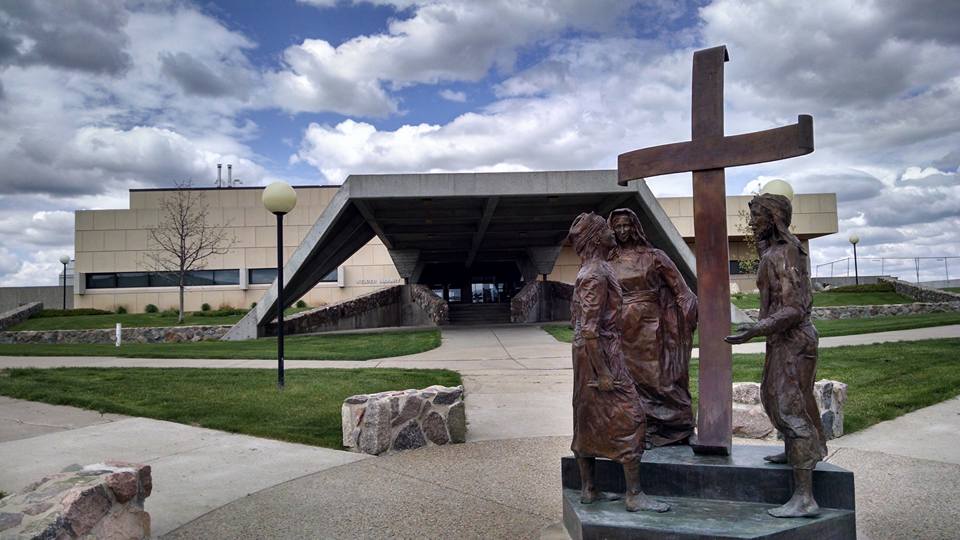
UMary, by contrast, has a total enrollment of just 3,000 — a tiny cluster of stone and concrete buildings hunkered on the edge of a high bluff overlooking the Missouri River. The buildings aren’t beautiful in any conventional sense; built in the middle of the last century for the wear and tear of young people and the wind and weather of the plains, they are low, solid structures with the quiet strength of stones unmoved by the world and its ceaseless spinning.
* * * * *
We started our day in a tiny chapel, well lit and peaceful, with a handful of prospective students and their families, current students, and administrators. We were first to arrive just behind the priest, a gray-haired Benedictine, and prayed in silence until Mass began. It being the feast of St. Mathias, the readings were focused on the selection of Mathias to replace Judas among the Apostles and Jesus’ command to love one another.
In his homily, Fr. Anthony contrasted our current presidential election process with the prayerful selection of St. Mathias, and contrasted the fame and power of our political leaders with the relative anonymity of St. Mathias both before and after his selection: basically the only things we know for sure are that he was with the other apostles in following Jesus from the beginning through the Resurrection and that he died while sharing the faith with an unbelieving world. He does not appear to have been self-seeking, but to have had one desire: to “to go and bear fruit that will remain” and to lay down his life.
I have reflected on his homily numerous times since, and while I don’t fault Frank for working hard to be where he is in his life, I am no longer curious where else I could be.
* * * * *
After Mass I told Brendan and Jodi I had a tremendous sense of peace about UMary. “This is a good place,” I said.
The original school was founded by Benedictine nuns at what was, at the time, the end of the railroad tracks headed West. During the opening session of the day, the current religious sisters who live in the monastery at the edge of the campus came to pray over the incoming students and their families. They ended their prayers with a beautifully harmonized sung blessing, and we were separated into smaller groups from the rest of the day.

Brendan was assigned an upperclassman to his liking: a triple-major in history, Catholic studies, and secondary education; the drummer in a rock band who was studying Polish in hopes of doing graduate work in Poland. Jodi and I talked with various campus representatives, including an administrator in Admissions who said our parish’s reputation precedes us and asked what we thought it was that makes St. Michael a special place. We also wandered the campus, talking and taking a few photos, and I ended the day with a sense of great joy: I believe Brendan is where he belongs.
It is true, practically speaking, that students should enter college with some sort of plan for what they want to do with a degree — otherwise the time and money are potentially wasted. But I believe it is also true that, for good students, a structured approach to the liberal arts can help create flexible, resilient young men and women who are prepared to lead, to sacrifice, and to preserve our culture in the days to come. I believe, in choosing UMary, Brendan has chosen a higher education (higher even than Yale in the ways that count most), and I’m proud and excited to see where this path leads.

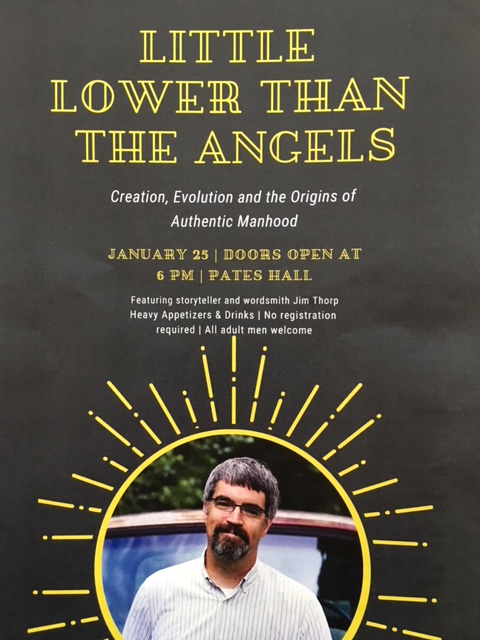 Late last month I was invited to speak to the Men’s Club at


 Archangel Stomp