Book Break: Three Little Books

I’m playing catch-up on a few recently completed books, lest you think (aside from The Brothers Karamazov) I haven’t been reading in the past year. All of them are “little” books in one sense or another, but none are insubstantial; in fact, all three have Catholic or spiritual underpinnings and overtones. I shall write about them in the order that I completed them, though the last one I began reading even before Dostoevsky.

Parish Priest: Father Michael McGivney and American Catholicism by Douglas Brinkley & Julie Fenster is a short biography of the founder of the Knights of Columbus and an intriguing glimpse into the struggles of American Catholics in the nineteenth century. Fr. McGivney, like many priests of his day, died young, but nevertheless transformed the communities of which he was a part, and ultimately re-envisioned the role of Catholic men in America. The authors admit he left few personal papers or other items behind, and at times, it felt as though the material on Fr. McGivney was a bit thinner than the book. I was particularly struck by several points, however:

  • Fr. McGivney’s gifts as a parish priest, and his ideas behind the Knights of Columbus, first manifested themselves at St. Mary’s Catholic Church on Hillhouse Avenue in New Haven, Conn. Interestingly (to me, at least), when I was at Yale, this was a church I walked by on a daily basis, and when I met my bride and began (occasionally) to attend mass, it was at St. Mary’s. As a result, the book was full of names and places I knew and could envision from my college days.
  • Catholics in America were subject to discrimination; however, New Haven’s sophisticated liberal leanings made the community quite tolerant of its Catholic immigrants. On the other hand, when I was at Yale, the community’s sophisticated liberal leanings caused the students to look sideways at the priests and parishioners at St. Mary’s.
  • Fr. McGivney’s desire to start the KCs stemmed from the problems he saw in his Irish Catholic community, including poor widows, fatherless children, and men who wanted something more than their workaday lives, but were seeking it in the bottle and secret societies that separated them from their faith and their families. As they say, the more things change…
The book was a quick read, and especially for Yale Catholics and my KC brothers, I recommend it.

Antoine de Saint-Exupery’s The Little Prince is a grown-up fable masquerading as a children’s book. It’s a book I’ve seen often and have often wanted to read based on the whimsical illustrations alone, but until I recently heard an interview about the book on the local Catholic radio station, I’m embarrassed to say I knew almost nothing about the book or the author. I found a like-new, soft-cover, second-hand copy at The Sixth Chamber in St. Paul, brought it home, and did something I certainly haven’t done since Trevvy learned to read for himself: I began to read to the kids after dinner.

It’s neither overtly Catholic nor overtly religious. It is beautiful. I won’t tell you a thing about the story; I knew very little, and I found my voice choking with emotion throughout as I discovered my kids, and especially myself, in the characters in the story.* I will say only that it is worth reading and worth sharing. Everyone, from six-year-old Trevor to Jodi and I, loved the book. Gabe says it may be his new favorite. Our teenager said, “Will you pick another book, Dad? I really like this!”

If you want just a taste, my good friend Fr. Tyler wrote about The Little Prince, as well, on his Prairie Father blog. The excerpt he used is one of my favorites, too. Read this book!

Finally, the other night at Adoration I finished Introduction to a Devout Life, a Catholic spiritual classic written in the early 17th century by St. Francis de Sales. The copy I have is a pocket-sized hardcover; an undated old printing of an old translation, I suspect. The book is available for free in its entirety on several web sites; CatholiCity.com describes it this way:

Introduction to the Devout Life is the most popular Catholic “self-help” book of all time. First published in the early 17th century, it has proven its value as a daily spiritual guide and helpful reference for living an authentic Christian life. Written specifically for laymen, it began as letters from Saint Francis to a married woman who was seeking holiness amidst the distractions of her life of wealth and status. It contains treasures of wisdom for every reader, from eager beginner to lifelong Christian.

I came late to the Church and was confirmed as a young husband and father and an aspiring writer.** I picked St. Francis de Sales as my confirmation saint, primarily because he is the patron saint of writers. I read a bit about him and learned that he had a privileged education and upbringing, and he was looking for signs all the time…so it took him awhile to come to the decision to serve God. (That seemed appropriate.) Once he became a priest, he went into fairly hostile areas to convert people, and often used his writings to do so. These details, plus the fact that Francis is a family name on my father’s side, seemed like good reasons at the time. (I never even considered any of the numerous St. Jameses.)

It wasn’t until years later that I realized St. Francis de Sales was a doctor of the church and decided I should probably read my patron’s writings. I searched for a copy of the book and wound up with two (one in English, and one in French, which I don’t read or speak. I’ve been reading it a bit to a time each Monday night in the Adoration Chapel ever since. The sentences are often intricate, but the saint’s voice and genuine joy in serving God shines through. The book provides step-by-step guidance for increasing devotion and holiness in your life, and the saint’s suggestions, while intimidating taken in their entirety, are individually small, practical, and still relevant today. And every so often something strikes you as so profound that you incorporate it immediately into your prayer life. It is a challenge to anyone living in this world, but I suspect it rewards repeat readings.
—-
* Of course, I am an emotional guy…
** I’m still all of these things except young.
The Second Third, Week 18: Sleep

Yale has a tradition called Feb Club — as I recall, every night of the shortest month of the year (and the long denouement of winter) someone hosted a party somewhere in the general vicinity of Yale, and everyone was invited. 28 parties in 28 days. Intensity in ten cities (or at least three: New Haven, New York, and Boston). Or so I was told.

See, I never did the whole Feb Club thing. Why? Wasn’t much of a partier, not enough disposable income, and to be honest, I need my sleep. I also only ever pulled one all-nighter in my entire academic career.* I lived by the creed that it was always better to be half-studied and well-rested than the opposite.

People always say eight hours is ideal, but I don’t know anyone who gets more than six or seven hours a night on a regular basis. I also don’t know any adult who sleeps soundly through the night. (I’d pay for a couple hours of the drooling unconsciousness of my children!)

I also know certain people who thrive on less than eight hours. But not me. Eight hours is perfect. Four to five hours can work for a night or so if I’ve got something to pull me through the next day: an exciting road trip, hunting, that sort of thing. But after six or seven hours — my typical amount — waking is like swimming through molasses. I’m dead tired all day. And that’s most days.

I could attempt to train my body to do more with less, but I don’t want to. As I recall, the Feb Club slogan used to be, “You can sleep when you’re dead.” I was never less interested in accelerating the process. In my Second Third, I want to get to bed earlier. And sleep just a little past sun-up. Because those stolen minutes are the best.

*It was the last anthropology paper I ever wrote, as a senior, for a professor I’d had for two or three other classes. I didn’t have a topic until the night before. He gave me a B-, not because it wasn’t well written or accurate, but because I apparently regurgitated a lecture from one of his classes two years earlier.

The Second Third, Week 10: The Big Payback

Blogger’s Note: The whole idea behind these “Second Third” posts can be found here.

When I left home for Yale, my folks left a cushion of money in my checking account. I’m thinking there was $150 of their money, hidden beneath the zero balance, in case I ever was in trouble and needed to come home. I never counted it as mine, so there was always $150 difference between my balance and the bank’s. My folks trusted me not to piddle it away, and I didn’t let them down.

Instead, I collected my suitemates’ empties and turned them in for the deposit, cleaned our bathroom (shared by seven of us) in exchange for pizza at Yorkside, and worked 20 hours a week to pay my bills. When one of my suitemates ran out of spending money and called his mother to yell at her, I was shocked. And when my roommate bought a new stereo, I set my little Sony dual cassette player aside and listened to his music. Even synthpop and show tunes.

I think it was my sophomore year that I “graduated” to a Visa with a strict credit limit — $500, I think, just for emergencies, my folks said. Again, I walked the line: at Thanksgiving, I got a hand-me-down Apple IIsi computer from my sister, and when I needed to crank up the Soundgarden, I could always go next door to our common room. The rest of the time, the little Sony would suffice.

Junior year, however, I roomed with two new guys, both fairly private, with no common room and no common stereo. They were out a lot, and I wasn’t…so the stereo bug bit. I’d been listening to the same little Sony since the Christmas after Ghostbusters II came out — I remember because I got the boombox (I use the term loosely) and Bobby Brown’s Dance!…Ya Know It on cassette, together, as it were. (And as everybody knows, that cassette had remixes of, among other things, the GBII soundtrack single “All On Our Own”…) I had worn out two Soundgarden Badmotorfinger cassettes, and couldn’t get enough volume to startle the squirrels outside my window.

It was an audio emergency. I needed a stereo. I deserved a stereo. And I’d totally pay it off in a matter of a couple of months. J&R Audio catalog and a Visa. Done deal.

I loved that stereo. I still have it, actually — it serves as a makeshift “theater” system in our basement family room. Did I pay it off in a couple months? Probably. Did I demote the Visa back to emergency-only duties? Nope.

The love bug bit next. I met Jodi at Wall Drug one summer, and decided to get engaged the next. Did I have money the ring? Nope. Did I have money for a down payment? A little…

I drove the length of the state to Sioux Falls to buy the ring I knew she liked — and they looked sideways at the fact that I had no permanent address (a student P.O. Box in Connecticut or Wall Drug?) and only seasonal employment. Finally they relented and said they would finance, but I’d need to put more money down.

This was my one shot. I called Citibank. They bumped my credit limit. I left with the ring.

We may still be paying for that ring. We’ve been in debt of some form or another ever since, and although we’re slowly digging out, it’s hard. Our furnace is dying, and it makes sense to replace the A/C at the same time — but that’s a few thousand dollars we don’t have in hand, plus my car’s acting up. What to do, what to do…

When I bought my first car from my dad, I got a loan. It wasn’t a big loan, but it was big enough for me at the time. I remember Dad saying, “They’ll make it easy for you. They want to loan you the money — it’s how they make money. And they want to loan as much as you can possibly pay back, even if it takes awhile.”

Especially if it takes awhile.

We’re trying to be smarter, and we keep chip-chip-chipping away at our debt. I’m looking forward to the big payback here in my Second Third: eliminating bills, saving our money, paying cash whenever possible as we move forward, and letting the kids know in no uncertain terms that there is no such thing as an audio emergency…even if your roommate is rocking to Erasure.

The Second Third, Week 3: Faith and Family

Blogger’s Note: The whole idea behind these “Second Third” posts can be found here. I’ve had multiple half-baked ideas for posts these past few weeks, but this one jumped to the forefront after reading Prairie Father’s latest post. Kudos, Father Tyler, for sparking this. The choice between two goods is the very definition of a dilemma, don’t you think?

Here at the beginning of my Second Third, I’ve gotten more comfortable with a me I never thought I’d be: a church guy. You know, a weekly worshipper, and more than that: a known quantity in the gathering space after Mass, a meet-n-greeter, a volunteer. One of those guys…

This is somewhat surprising. I was raised a good Catholic in every way except the church-on-Sunday way (so-called “old-fashioned” morals and values, but aside from a brief stint my late elementary years, no Mass or catechesis), then went on to study evolutionary anthropology, which was generally an atheist discipline. Thankfully I had just enough churching and manners to not drive Jodi away entirely when we first met. She brought me around.

The funny thing is, I got along with all sorts of people in school, but didn’t necessarily fit in anywhere. I was a poor athlete, and Coach asked me to help the first-stringers study for their exams. My bearded and be-hatted dad drove the mule to town now and again; that and my square tendencies caused even some of my closest friends to contemplate my Amish-ness. In college, too, I was square and old-fashioned, never an outcast, but never A-list. Friends were surprised when I went to South Dakota to sell western boots, and floored when I came back talking marriage and kids. These were not Ivy League aspirations — at least, not in the near-term.

Jodi brought this baptized Catholic back to the church. A number of good priests — good friends — inspired me and advised me to follow my doubts and questions. Even my dad, who does not share my faith, has never discouraged me from seeking and finding.

So I’ve searched and searched for people like me. Michigan to Connecticut to South Dakota to Michigan again, and finally to St. Michael Catholic Church in St. Michael, Minnesota. I have family in Michigan, family I miss terribly. But I have brothers and sisters here, too, and each week, each Sunday, it gets harder to imagine living anyplace else.

In early October, I had the opportunity to meet my dad on the Tahquamenon River in Michigan’s Upper Peninsula to fish on our old houseboat. I could get just Friday and Monday off from work: drive all day Friday, sleep Friday night, and head up the river at first light on Saturday to the fishing hole. The boat landing was a couple hours downstream from our fishing hole, and the closest Catholic church was 40 minutes from the landing, and offered just two Masses: 5 p.m. Saturday or 9 a.m. Sunday.

Either we’d have to pull up our anchor after lunch on Saturday, go to church, and sleep ashore again, then resume fishing mid-morning Sunday, or we’d have to pull anchor a couple hours before sundown on Saturday, sleep ashore at the landing, then drive into church Sunday morning. We’d get back to the fishing hole in early afternoon and get a couple hours of fishing in before we needed to head back to landing, since I’d need to leave first thing Monday to make it home.

I prayed on it, talked to a friends, and decided it was important to spend this time with Dad, even if it meant missing Mass. I further resolved to spend time Sunday praying the rosary and reading scripture — and to receive the sacrament of Confession before Mass the following Sunday.

I had a great weekend with Dad, a great Sunday, and honestly never felt far from God. But all weekend, when I thought about missing Mass, a little pang would shoot through my chest. For the first time, it wasn’t so much guilt for missing Mass…it was missing Mass. Longing for it.

How weird is that? I thought.

I did go to Confession the following Saturday, and another good priest told me he thought it was important that I spend time with my dad, but reminded me that if I truly believe, then I must also understand that attending and actually praying the Mass is the most powerful thing I can do for anyone I love. More food for thought.

In Matthew Chapter 12 is a passage that used to trouble me. Jesus is with his disciples, and he is told that his mother and brothers wish to speak with him: But he said in reply to the one who told him, “Who is my mother? Who are my brothers?” And stretching out his hand toward his disciples, he said, “Here are my mother and my brothers. For whoever does the will of my heavenly Father is my brother, and sister, and mother.” — Mt 12:48-50

I think I’m beginning to understand. So in my Second Third, I’m embracing my inner Church guy, and working to balance our family by blood and our family in the Body. I can love both — and I should if I am to love either one well.

The Second Third, Week 1: Pulling My Own Weight

Somewhere around ninth or tenth grade, I took my required high-school health class. Early that first semester, we were asked to set a fitness goal for ourselves. I was one of the small guys on the football team, and a mediocre wrestler, at best, with a large head, skinny build, and little natural athletic talent — so there was plenty of room for physical improvement.

I thought about speed and strength-related goals, like many of my male classmates, but ultimately settled on this: “I want to be able to bike or walk anyplace I want to go, even when I’m in my 70s.”

Or something like that; you get the gist. To be completely honest, I had visions of a family bike trip across the country. Our teacher was also a coach on his way to assistant principal, but even he took notice. This goal was not like a lot of the others. It was extremely long-term, and seemed modest, but as a man of a certain age, he knew this was no small thing.

As a senior, I played varsity football as second-string noseguard. I was about 6-2 and 175 pounds at the end of season, so when wrestling started, I told my coach I was going 189. (Dad told me in 7th grade, when I said I wanted to wrestle, that I always had to wrestle up a weight class — I was forbidden to cut weight, or he would pull me from the team.)

By the mid-point of the season, I weighed 152 pounds, and wrestled 160, 171, and 189, as needed. I was skinny, sure, but had never been in better shape, and had my best (albeit still mediocre) season.

Freshman year at Yale, after several months away from organized sports, I entered an intramural wrestling tournament. I wrestled three shortened periods, won my first match, and went outside to puke in the snow.

The second match was the next day. This time, my opponent had put at least modest effort into his cardio since high school, and it showed. For me, it’s been downhill since.

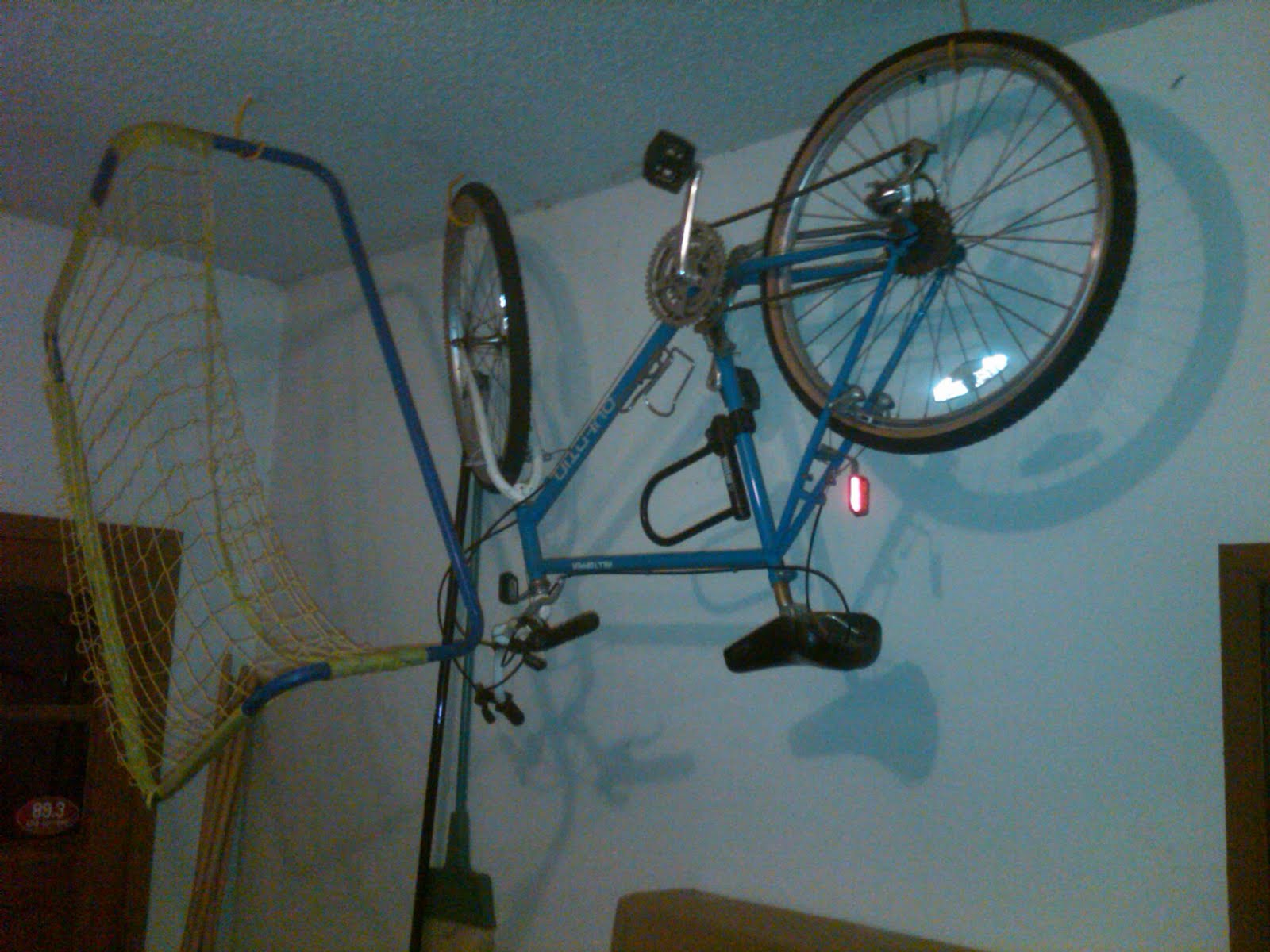
Today? 6-3 and 235 (on a good day). My bike hung in the garage all spring and summer this year. I road the stationary bike indoors after dark fairly regularly for a few months — but as far as biking anywhere I want to go…well, I can still ride, but we aren’t gonna make time. Especially on the hills.

What’s more: it has begun to bother me that I cannot move my own weight with just my arms. I can do solid pushups, but no pull-ups. From a survival standpoint, this seems like a bad thing. Not that I expect to be in a fight-or-flight situation this week, but then, that’s the point: you never know…

In some ways I was wise as a kid; in some ways, just way less busy and as invincible as only a teenage boy can be. But here in my Second Third, I should be self-sufficient — and that means physically, too. I’ve got work to do.