One of the great pleasures of these latter years as a father is receiving books and book recommendations from my grown children. The University of Mary in Bismarck, Saint John Vianney Seminary in Saint Paul, and the Franciscan Friars of the Renewal have led each of them on tremendous intellectual and spiritual journeys. Occasionally, I tag along.
This past Christmas, Brendan and Becky presented me two books I may have never encountered had Brendan not taken a surveying (as in, land measurement) course as an undergrad…a surveying course taught by a history professor with a love for useful arts and practical skills.
Both books are by Matthew B. Crawford, who holds a PhD in political philosophy and a prestigious research fellowship at the Institute for Advanced Studies at the University of Virginia. He also runs a motorcycle repair shop. In these two books, he makes a convincing case that we are ceding more and more of our will, abilities, and control to technologies and systems that make life easier by making it less lively, less human, less worth living.
Shop Class as Soul Craft: An Inquiry Into the Value of Work
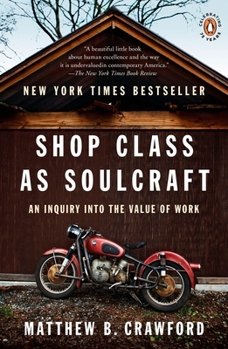
The first of these books, Shop Class as Soul Craft (2009), opens with the push, when many of us were kids, to discontinue classes like shop and encourage everyone to pursue college and the seemingly limitless opportunity of the “knowledge economy.” Through a great combination of humorous first-person stories, straightforward but precise philosophical argument, and facts and figures, he articulates why college is not for everyone, why “trades” never go away, and what has changed in our culture and technology that make so many of us feel like we have no control—like life is happening to us. He guides the reader through the changes to labor that happened during the Industrial revolution and afterward: the development of scientific management, the transition from being paid for a product or service to being compensated for time, the rise of “consumption engineering” (marketing) to keep workers motivated, and the shift from debt as a negative to credit as a requirement of good economic citizenship. Crawford advocates for individual agency and human excellence: skills that are measurable, jobs that are doable, and lives that are satisfying—and offers concrete and practical ideas of how to go about it. Getting our hands dirty, it turns out, is good for our souls.
Why We Drive: Toward a Philosophy of the Open Road
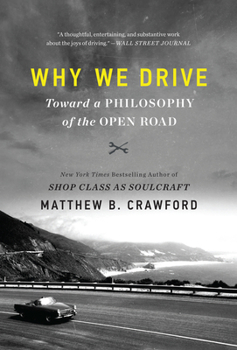
The second of Crawford’s books I read, Why We Drive (2020), caught my attention in a sort-of-review on the Imaginative Conservative website. I inherited from my father a love of classic cars and driving (though I’m more of a road-trip/country-cruiser than a dragstrip/hot-rodder), so the initial premise of the book—that relinquishing control of our cars to safety settings, Google Maps, and self-driving functionality is costing us valuable physical and mental abilities as well as social skills—was an easy sell for me. But the book is a much deeper cultural and political critique. Like Technopoly and The Shallows before it, it provides more current and harrowing perspective on how little attention we pay to the technologies that drive us. We are safer and more comfortable, but also increasingly compliant and obedient—to whom? Again, Crawford mixes colorful stories with deep thinking and solid reporting; I read the book in a flash, enjoyed it, and haven’t stopped thinking or talking about it since.
The two books combined have me working on Rosa, my 1966 Ford pickup, trying to get her back to daily driver status. Check out both books, and I’ll take you for a drive to discuss when she’s back on the road!
 Archangel Stomp