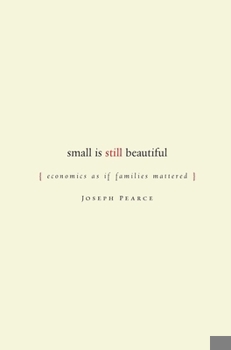
Providentially, my reading lately has all been cut from similar cloth: our relentless pursuit of better, newer everything and the dangers it poses to our humanity and health (physical, mental, and spiritual). This latest volume, Small Is Still Beautiful: Economics as if Families Mattered by Catholic scholar, biographer, and author Joseph Pearce was a gift from our Bismarck family, and is a reiteration and expansion on E.F. Schumacher’s 1973 classic Small Is Beautiful: Economics as if People Mattered, with a particular focuses on the environment, food supply, and land use.
In my 2017 review of Schumacher’s book, I described a couple non-academic objections and numerous things I loved about the book. I also said it seemed like the sort of book that had been read, admired, and forgotten in the powerful current of worldly progress.
Published in 2006, Pearce’s book faces similar risks:
- After decades of continuous global consumption, many of his and Schumacher’s dire predictions have not come to pass.
- Many conservatives who admire his focus on subsidiarity, families, and freedom, may also be dismissive of his concerns about concentrated wealth and power, environmental degradation, and the dangers of unfettered capitalism.
This is a challenging book, because it requires us to examine and attempt to reconcile our conflicting beliefs. It is a Catholic book, weaving together Catholic social teaching, Gospel values, papal instruction, and humanity’s God-given stewardship of Creation. It includes philosophy and theory, but not enough to bog down non-academic readers. Plus, it includes practical examples of how “human-scale economics” can still work in a world of multinational corporations, economies of scale, and giantism, including the craft-beer revolution, organic farming and grocery chains, and cooperatively-owned businesses.
It is easy to feel swept along in the economic tides. We may choose to drift so we don’t drown. But Pearce, like Schumacher before him, proposes another choice: resistance, lived at the most basic (and important) levels of society…the family and local community.
If you haven’t, Pearce reiterates Schumacher enough for you to read his book with no further background, but I found the original very compelling. Read one, or both!
 Archangel Stomp