Author: J. Thorp
And the Heavens Respond
Dante, or Three Things to Love About the Divine Comedy
Blogger’s Note: Several years ago, I agreed to my friend Jacqui’s challenge to read 15 Classics in 15 Weeks. I continue to press forward, this being number 13 of 15, and at this point 15 Classics in 15 Years seems quite doable…
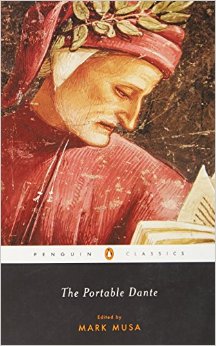
Late last week I finished reading Dante Alighieri’s Divine Comedy in its entirety for the first time. I had read excerpts for different classes over the years, and have read a little about the great work. The book itself was something of a pilgrimage through hell, purgatory, and heaven. This is my least favorite of the thirteen classics I’ve read so far as part of this challenge, and was tough sledding at times. Nevertheless, I do agree that this is a great literary work and worth the effort to complete at least once.
Without further ado, Three Things to Love about Dante’s Divine Comedy:
- The Ambition. Dante the poet takes us on a journey through the Inferno (Hell), Purgatorio (Purgatory), and Paradisio (Heaven) with Dante the Pilgrim in order that the fictional Dante may change his ways and be saved. Each of these three journeys are told in verse, thirty-three cantos each, with each canto approximately 140 to 150 lines long. Along the way he meets ancient and more recent historical figures, who comment and prophesy on the political and religious turmoil of Dante’s time and place, along with sharing their own experience in the world and in the afterlife. The running commentary on the political machinations and rivalries in Dante’s home was the least interesting aspect of the book for me, but it is nonetheless impressive how much he weaves into this ambitious work.
- The Creativity. The denizens of Hell and Purgatory, in particular, suffer in hundreds of ways peculiar to their specific sins and attachments. Dante’s Hell is hellish, disgusting and terrifying at times, culminating in an immense figure of Satan, not surrounded by flame, but eternally frozen in ice, suffering for his own sins. The journey through Purgatory is hopeful, but not easy, as imperfect souls labor to let go of those earthly things that weigh them down. Heaven, to me, was actually the least interesting of the three, in part due to the poet’s continued insistence that the beauty of the place was beyond his words and ability — but persevering to the end, to full union with God in the beatific vision, has its rewards. The last few cantos are lovely.
- The Deep Belief. This, to me, is the greatest aspect of Dante’s masterpiece: the depth of theology, of faith, of true belief. Dante believes in the reality of Hell, and he puts people he loved in this world in that place of torment because of their sins. He peoples his poems with friends, contemporaries, nobles, and popes, explaining how and why each fell or rose, and when Dante the Pilgrim is asked to testify to his own faith, the lines resonate as the poet’s own sincere profession. Who knows how accurate a portrayal of the afterlife these poems are, but Dante gives us much to contemplate as we navigate this world.
I have begun number fourteen of fifteen classics, Tolstoy’s Anna Karenina, with that great opening line: “All happy families are alike; each unhappy family is unhappy in its own way.” It is a long book, but engaging— I hope to be done within the month!
Long Goodbye Addenda
In the emotion of last weekend, I neglected a few details from dropping Brendan off at UMary:
- No sooner had Bren and his roommate introduced themselves to each other than one of the Benedictine Sisters of Annunciation Monastery and one of the RAs appeared to sprinkle holy water in the room, pray with them, and give them a cross-shaped icon to hang. So the first real interaction Brendan and his roommate had with each other and with the university community was shared prayer. Very nice.
- I posted a photo of Bismarck’s Big Boy drive-in, but not the details, and this may be of interest to anyone who, like me, brew up with Big restaurants. The plump fellow in checked overalls and the Big Boy name is there, but the experience is something different entirely. First, it is strictly a drive-thru. Second, it does not serve breakfast, and for lunch and dinner, has a unique menu including tasty fried chicken, a pizza burger “flying style” (i.e. pressed flat and sealed tight around the edges so it doesn’t leak in your car), fries with country gravy, and the Purple Cow, a grape-flavored milkshake. It’s not fancy, but tasty and relatively cheap, if you are ever in need of a quick bite in Bismarck.
- In an effort to get daytime, and especially nighttime, driving hours, Gabe pushed himself hard to do most of the driving for the trip. He drove from Albertville to NDSU in Fargo to drop Bren off with friendson Friday afternoon, negotiating a surprising amount of traffic and a stiff crosswind with the big blue Suburban. I drove from NDSU to the hotel for the night, and to Sandy’s Donuts (great!), NDSU, and 30 minutes toward Bismarck in the morning, then Gabe took over again to get us to a gas station in Bismarck. Jodi drove from the station to Big Boy and U Mary–then Gabe drove a full six hours straight from Bismarck back home again.
- The “highlight” of the drive home? A stretch of about 10 miles in which the bugs hitting the Suburban sounded like rain, and the wipers and fluid couldn’t keep up. Visibility was probably 60 percent when we finally found a gas station to clean the windshield. A half dozen other vehicles were doing the same, and the place was completely sold out of wiper fluid. We got the windshield cleaned, and had no further problems–but Sunday morning, the bugs were still so thick on the grill and headlight they were attracting other bugs to feed. Disgusting.
Long Goodbye
It’s a strange sensation, like a high-tensile wire stretched six hours west to a bluff above Bismarck and the Missouri River, a steady thrum, more felt than heard, reminding me that a part of me is there. Not gone, but definitely not here, and I can’t know from one moment to the next what he’s about. We are six hours distant, so I know less about his day-to-day — but I am more keenly aware of him than I have been in years. His absence is a presence, palpable, in our home.
I am wearing an old hardware-store t-shirt he left behind.
I haven’t felt this sort of connection to my eldest son since he first came home with us — the heaviest ten pounds I ever lifted — and I realized he was ours to shape and raise to manhood. Then the connection was direct, bare skin on bare skin, almost frighteningly close: his little chest expanding and contracting, the soft spot where his skull had yet to form pulsing, his every need and discomfort so close to the surface we could almost feel it. Now it’s this invisible strand from one eggish Thorpian occiput to another. He’s always at the back of my mind.
At different points this past summer, it felt like such a blessing that the University of Mary started late. We planned an August send-off, since Brendan didn’t want a grad party and had lots of time to plan and few conflicting parties to contend with. As we watched more and more friends drop their teens off at college, we thought it was helping to prepare ourselves for this weekend. Perhaps it did. But the past three weeks or so began to feel like a very long goodbye. Brendan left his job at the hardware store at the end of July, and his electrician’s job a few weeks back. His band, Pabulum, played their Final Jam. (They insist they are done as a group, which would be a pity.) All of his friends expect Olivia (who is a senior this year) left for college, and he started packing his things, some for Bismarck, some for storage.
The week before last he took a solo road trip to Michigan to spend some down time with my folks. As God’s providence would have it, a high-school friend of mine has a son who was transferring to St. John Vianney Seminary in St. Paul this fall; he and Bren were best friends in preschool, and Will and his stuff needed a ride to Minnesota. They came back together, two peas in a pod, and Will dropped right into our family. When we took him to the seminary a day or so later, it was actually a little emotional — call it practice or anticipation, we were beginning to feel the ties to Brendan being stretched.
Last Monday, Jodi and I took Brendan out to supper and to get sheets, supplies, and decor for his dorm. We had such a good time eating his favorite food (Mexican, this time at El Bamba), listening to his current favorite band (Icelandic blues-rock outfit Kaleo — Bren, his friends and I are going to see them in October); making him pick out dishes, sheets, and towels when he couldn’t care less. It was a great evening.
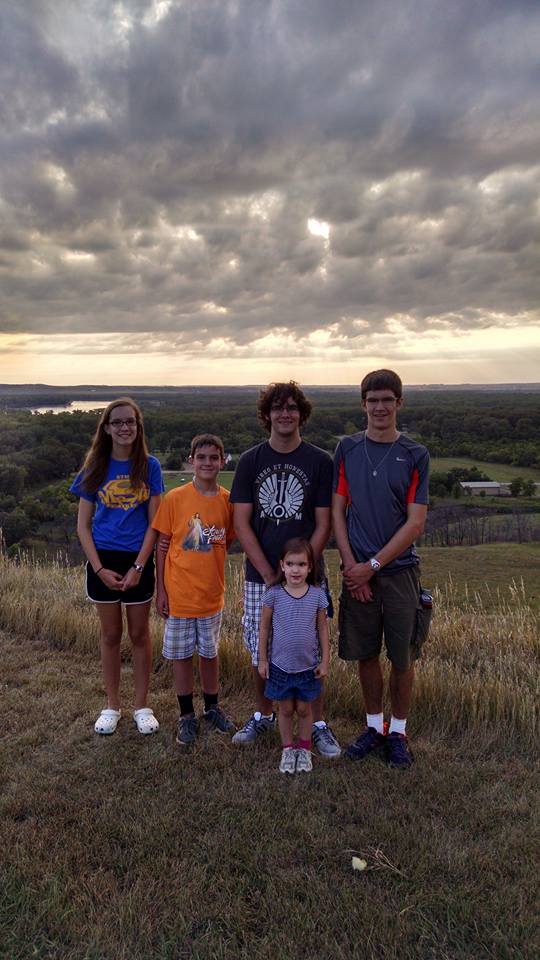
And then this weekend. Originally only Trevor wanted to make the trek to UMary, until Gabe realized he could potentially get 12 hours of driving toward his license. Once he decided to go, Emma jumped aboard, realizing that otherwise she would be left to babysit Lily alone. So all seven of us went — the largest single-family contingent I saw on campus. Jodi and I took Friday off, and we left early in the afternoon so Bren could connected with his NDSU friends in Fargo and catch our local high school’s football game against Moorhead. He spent the night on campus; the rest of us in a hotel. Seeing his friends joyful and comfortable on campus, was reassuring; arriving at UMary itself was doubly so: simple, joyful, peacful.
![]() |
| Bismarck’s Big Boy Drive-In — unique in my experience, with menu items you don’t see anyplace else. Google it! |
We met his roommate, Ethan, a nursing student and Vikings fan from western Minnesota, and Ethan’s parents — they seem like a wonderful family — and heard from UMary president Monsignor James Shea, who told the students with clear affection and blunt honesty that their lives were not their own, but a gift for others, and unless they find a way to spend themselves in love, they will have wasted their time here. He told us parents, as well, to step away and allow our children to stumble and fall that they may learn to stand on their own.
He strikes me as a good man, and I couldn’t be happier to entrust Brendan’s young mind and character to him these next few years.
One other speaker shared an Erma Bombeck quote, comparing raising children to flying a kite: letting out more and more string until ultimately the tether breaks and the kite soars away on its own. It’s not a bad metaphor, but I see things differently. This connection between us is stretched thin, but not to breaking; it is keen, sensitive, and strong, and though it can be tangled, wound about the world, stretched to invisibility and nigh untraceable, it cannot be broken.
I told him as much, in a letter I left in one of his boxes. No matter how far away he goes, I am here waiting for his return. Because he is mine, and I love him.
When we finally decided, after dinner on campus, that it was time to head home, Bren walked with us to the Suburban. He hugged each of us (Mom and Lily more than once) and told us he loved us. He told the older kids to keep doing their thing: Emma, to keep baking; Trevor, to keep drumming; Gabe, to keep being himself and making people laugh. Lily’s last words to him from inside the Suburban: “Love you, Brendan! Don’t do anything bad out here!”
We’ve done the best we could. I think he’ll be alright.