Camp Lebanon Scripture Reflection

Blogger’s Note: This past Sunday I was blessed to offer a brief morning scripture reflection at Camp Lebanon 2015, the summer outing parish families have undertaken for the past several years. This is a write-up of roughly what I think I said.

Since yesterday was the Solemnity of the Assumption, I want to focus on a small portion of that gospel reading. The passage is called the Canticle of Mary, her song of joy to God. I want to share this because this is something I often struggle with: being a joy-filled Christian. I get caught up in all the problems of this world — the persecution of Christians around the world, the whole abortion scandal in the news right now, the decline of our culture, the upcoming election — and I become a very somber Christian. I get wrapped around the axle about all these things that I can’t do anything about (except pray), and I lose the joy of our Blessed Mother. Continue reading

LIFT Links for Late Summer

We’re headed into August, and summer is, for better or worse, winding down. If you’re like us, in the flurry of summer and back-to-school activities, it can be hard to find quality time to spend with God, or even with the entire family. To that end, here are a few ideas for a late summer day or weekend:

  • Lakeside Fellowship. Camp Lebanon is coming quickly, but if your summer isn’t plum full already, consider joining other St. Michael and St. Albert families the weekend of Aug. 14-16 for great food, fellowship, and lakeside fun. Details can be found here, and the registration form is here — we still need families in order to hold the entire camp for our two parishes!
  • Family Movie Night. A few years back I watched and recommend the beautiful animated movie, The Secret of Kells. Both Kells and a newer movie in the same style (which I haven’t seen), Song of the Sea, are available for unlimited streaming on Amazon Prime. Ignatius Press recently published this review of Song of the Sea — should be well worth watching. We will definitely be checking it out! (The Secret of Kells is also available on Netflix.)
  • Silent Retreat. Christ the King Retreat Center in Buffalo is hosting a men’s and women’s silent retreat in late August entitled “Sowing Seeds of Mercy.” The retreat is Aug. 21-23 at King’s House, with a suggested donation of $160. More details and registration information can be found here.
  • Spaghetti Dinner. Sometimes just having a family meal together that you don’t have to cook is the ticket to reconnecting with family. If so, you can eat for a great cause at the upcoming Kunzman Spaghetti Dinner fundraiser hosted by Knights of Columbus Council 4174 at the St. Albert Parish Center. The dinner is Sunday, Aug. 23, from 4:30 to 8 p.m., with free-will offerings to support Brother Knight Erich Kunzman and family. Erich has suffered some complications due to a significant surgery and could use our prayers and support!
Have a great rest of your summer!

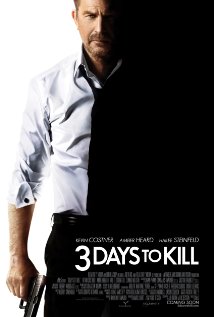
Movie Break: Three Days to Kill

Last night, I watched the recent Kevin Costner flick, Three Days to Kill. It’s the story of a CIA lifer with a broken family who may be dying of cancer, but can earn a chance to try an experimental cure for the proverbial one last job.

I’ve never been a Costner hater, and in fact, I’ve enjoyed him in a number of roles over the years, though he does bring a solidly predictable Costner vibe to most every character he plays. I guess that’s what motivated me to write a post on this movie. It’s not great by any means, and I flat didn’t like a few of aspects of it — but I really enjoyed Costner’s world-weary, worn-out spy. Early in the movie, his diagnosis is delivered matter-of-factly, punctuated flatly with, “You should get your affairs in order. The CIA thanks you for your service.” Now that he’s out of time, he realizes how much he’s lost being away from his wife and daughter doing awful work for an organization that is ready to move on, and his gruff Pittsburgh persona is endearing as he tries to relate to his family again.

Objections? The movie is an oddall mix of violence, humor, and emotion, and it certainly stretches credulity that the perpetually coughing assassin could shift gears from sickbed to superman and back and still be virtually unstoppable. The agent in  charge of this final job (three days to find and eliminate a terrorist and his henchmen in Paris, hence the title) is a young woman who inexplicably goes from a somewhat bookish professional in the opening scene to a bleach-blonde (and later raven-haired), chain-smoking (that’s just mean, given Costner’s condition) femme fatale, raising questions about her allegiances, motivations, and the contents of the mystery drug she’s giving him as a possible cure. The drug accelerates his heart rate (bad in his line of work) and causes mild hallucinations (worse) — but thankfully, alcohol will take the edge off (keeps getting better). To make things weirder, the gal insists upon dressing provocatively and meeting him in strangely lit rooms where dancers gyrate and smoke swirls…the better to provoke hallucinations and suspicions, I guess. His daughter’s boyfriend, too, is called into question, but in several cases, these were just red herrings. (The actual plot twist did take me by surprise, however — not so the reviewer on Roger Ebert’s site, but I tend to shut down my analytics until after the popcorn-muncher is over.) 

It’s the family scenes, plus a great opening gunfight, an intense melee in a deli, and an ingenious car-jacking, that make this movie worth seeing. In retrospect, it reminds me a bit of Clint Eastwood’s Unforgiven — a formerly icy killer who just wants to be left alone with his family and live up to his wife’s expectations in an environment that brings out the worst of what he’s best at. (It’s interesting that so many action movies these days involve secret agents who want to be left alone: the Bourne movies, the Taken movies, even the most recent Bond movies have this sense of world-weariness…wonder what this says about our mentality these days?)
I would say this movie is a hard PG-13 due to language, violence, seminudity and general weirdness. It could probably have been R.

Our Hope Demands Change

I don’t know about you, but I avoid the news like the plague. No matter the source, the media today is a place of constant conflict, and it’s easy to get caught in the ceaseless spin cycle and feel as though everything is falling apart around us. It’s easy to lose the perspective that we are in this world, but not of it. And once we lose that perspective, it’s easy to lose hope.

But as Catholics, our hope is in God and transcends this world. Specifically, our hope is in a personal God, who loves each of us enough to become like the least of us: wriggling and helpless in a Bethlehem stable; hungry and homeless on the road to Egypt; hard-working and cash-strapped in the wood shop in Nazareth; hounded and criticized by His own people; persecuted and abandoned by those who should have known and loved Him best. Jesus’s perfect and total Yes to the Father finally silenced the steady drumbeat of Nos that had echoed through the ages since the fall of Adam and Eve. He lived, He died, He rose again—we know this through the words of the prophets, the witness of the apostles, and the blood of martyrs. Never before have so many sacrificed everything—their very lives!—for so outlandish a claim as a God-Man who let himself be humiliated and slaughtered only to rise again from the dead. Who would die for such a thing? If you had any doubt in your mind, would you give your life?

Thousands of people have, from Jesus’s day to the present. We believe far more these days on less credible evidence, and yet we’re skeptical of this?

When the apostle Thomas encountered the resurrected Jesus in the flesh, his famous skepticism was transformed—he declared, “My Lord and my God!” Jesus replied, “Blessed are they who have not seen and have believed.”

That’s us: believers in an unseen Christ. Blessed are we who persist in the faith.

Of course, as Catholics we still encounter the living God, just not by sight. We encounter Christ in His Body, the Church, and in the sacraments—particularly the Holy Eucharist. We know that the Eucharist is the Body and Blood of Jesus by His own words: “This is my Body…This is the cup of my Blood.” Jesus is God, and just as in the Creation story, what God says, is.

This is Good News—the Best News, in fact, and we are obliged to share it. It’s not enough to just accept Christ’s mercy and grace, or receive His Body and Blood. We are called to be disciples: not dependants, and not simply students, but followers, who learn, live, and spread the Gospel. No one encounters God without changing, and indeed Jesus says whoever wishes to be His disciple must pick up His cross and follow. If we are unwilling to change our behaviors and priorities; to work, suffer, and die for the sake of the Kingdom, we are not yet full-fledged disciples.

Why should we care? Because it takes disciples to make disciples. We can’t lead others to Christ if we aren’t following in his footsteps ourselves. Fr. Mike Schmitz reminds us that Jesus gave us one job to do while He is gone: go and make disciples of all nations. When He comes back, it won’t matter that the car is waxed; the laundry, folded; or the recycling, sorted. He’s going to look around to see if we did that one thing. Our hope demands change.

Blogger’s Note: This article appear in the Sunday, July 19, parish bulletin.
Book Break: Impact of God

This spring, Fr. Richards tasked the parish staff with reading Fr. Iain Matthew’s book, The Impact of God: Soundings From St. John of the Cross. This request was a blessing in disguise. It’s a blessing, because the book, ultimately, is a beautiful and thought-provoking exploration of the Spanish mystic’s theology of nada and todo (nothing and all), his approach to prayer, his call to love and union with God. It was in disguise, because by most accounts, St. John of the Cross is not an easy read:

  • first, because he begins with poetry — in particular, achingly breathless love poetry — to God;
  • second, because his unpacking of these poems exposes layer upon layer of latent meaning — like God Himself, hidden within;
  • and third, because his message of detachment and relinquishing control to a God whom we cannot hope to see clearly is a hard teaching.
It’s a difficult book to review, given the challenge of the topic, so instead I will share three key concepts that stuck out to me and to which my thoughts have returned many times in the weeks since I started it. If these entice you, pick up the book and savor it, a bit at a time.
  • St. John writes of a hidden, but active God. Too often we think of God as “out there” — we set out to seek Him, and feel as though the effort is ours. According to St. John of the Cross, this is not the case: God is actively seeking us and inviting us to Himself. The first move is His, and when we respond, the reason He is difficult to perceive is not because He is far away, but because He is infinitely vast and incredibly close. God is not eclipsed by things closer at hand; He is all-eclipsing.
  • God desires union, but needs space to achieve this — and complete union with the infinite God requires lots of space! This is why detachment is important: we must empty ourselves of the things of this world in order to receive the things of the next. When St. John speaks of nada (“nothing” in Spanish), he is talking about creating this space for God, who then makes of Himself a gift in Christ, which by its nature is todo (“all”). Put simply, the only space big enough for todo is nada. While we can work toward this goal of nada ourselves, remember that God is active: He seeks to make room. St. John says that those times of bewildering suffering in life, when God seems so hard to find, quite often are the times in which God is making room for Himself, in you — not forcibly, but by invitation, inviting you to let go and take His hand.
  • Finally, St. John insists that spiritual advisors, teachers, and other guides exercise great care that they not become hindrances to the work of our seeking God. He writes, “God carries each person along a different road, so that you will scarcely find two people following the same route in even half of their journey to God.” This sensitivity to the individual reflects our nature and dignity as unique images of God.

The flexibility is fundamental because it alone does justice to the dignity of each person, a ‘most beautiful and finely wrought image of God’. It does justice too to the laws of growth. … John says that humanity, and each person, was wedded to Christ when he died on the cross, a wedding made ours at our baptism. But all that happens ‘at God’s pace, and so all at once’. It has to become ours at our pace, ‘ and so, little by little’ (Matthews, p. 15).

I will admit that I also found Fr. Matthew’s writing challenging, at first. He weaves quotes from the saint’s poetry, prose, and letters in freely with his interpretations and explanations, creating a poetic account that does not read like literary or theological analysis. Ultimately, this too is a blessing, because a book that could have been an academic exercise turns into a personal invitation to explore the mystic’s works further and to strive for a deeper prayer life. Once you trust that the author knows St. John of the Cross well enough to write with authority, the book reads like a mini-retreat — and I’m sure I will read it again.