No Greater Gift

Amen, amen, I say to you, when you were younger, you used to dress yourself and go where you wanted; but when you grow old, you will stretch out your hands, and someone else will dress you and lead you where you do not want to go.John 21:18

Some years ago I brought our son Brendan, then in grade school, to work with me for the day. Among other activities that day, he drew a picture for a dear friend of my own dear friend Patty — a young man who had recently enrolled at United States Military Academy My son had already been thinking for some time about a career in the military, and it excited him to know that there were colleges specifically geared toward such things. He sent the drawing and his best wishes to West Point, and began to shape his own dreams around the U.S. Naval Academy and the Marine Corps.

Over Memorial Day weekend, Patty was herself at West Point for her young friend’s graduation and commissioning. She shared photos with us from throughout the weekend, and the boy who left home four years ago has become very much a fine young man, fit and confident, dashing in his India whites. Brendan was impressed.

I remember once sharing with a different colleague that Brendan hoped to be a Marine one day. His response? “Well, at least you have a few years to talk him out of that…”

As Brendan prepares to enter high school in the fall, I think more frequently about the possibility that he could be called to combat one day, and it frightens me. But someone has to do this job, and if he is called, who am I to refuse to let him answer, when I have benefited so much from the lives of those who have gone before?

* * * * *

Around the same time that Brendan was drawing that picture, Gabe began seriously contemplating the priesthood. Admittedly, at age seven or so, seriously contemplating may be defined rather loosely — but  today he is approaching his twelfth birthday and has not wavered. This spring, recognizing that I hadn’t spent much one-on-one time with Gabe in recent months, I offered a day in which we could do whatever he wanted. As a result, we found ourselves at Sunday morning Mass at St. John Vianney Seminary in St. Paul, at the end of which Fr. Michael, the rector and our former pastor, introduced him as “a future priest, Father Gabriel.” We were greeted by a dozen or so seminarians afterward, including a couple from our neck of the woods, then we went to brunch with Father.

During brunch Father and I both made an effort to include Gabe in the conversation, but several times the discussion turned to more “grown-up” topics: men’s evangelization, stewardship, work and home life. I apologized to Gabe on the way home for not doing a better job of steering the conversation to include him.

“It’s not a problem,” he said. “I learn a lot listening to you guys talk.”

I see him, hear him, in these situations, and think he’s serious about this vocation. Father thinks he is, too. I’ve written about this before … and a friend characterized the religious life, in her view, as a sort of “performance art,” which I took to mean richly symbolic and interesting, but ultimately strange, impractical, and somewhat meaningless. Needless to say, I disagree.

* * * * *

A year or more ago, an an older man I know learned that these two sons of mine aspired to the military and the priesthood. “How old are they?” he asked, and when I answered, said, “That says something, that they are thinking seriously about service at such an early age. You must be proud.”

I am. And frightened. For both of them.

Then yesterday a mutual friend of Patty’s and mine stopped me in a stairwell at the university to ask how the long weekend was. “And what’d you think of Patty’s photos?” she asked.

I told her they hit me hard, in a way I hadn’t expected. Those photos, coupled with Memorial Day and the knowledge that two priest-friends of mine are being reassigned to new parishes (our associate pastor is one; Prairie Father is the other), made me think not only about service and sacrifice, which are hard but noble things, but also about obedience, which for Americans, it seems, and men in particular, can be tougher to stomach.

Both of my older sons currently feel called to a life I don’t believe I could lead — a life of obedience in which the very clothing they wear will publicly signify that they are subject to a higher authority and held to a higher standard. Should they continue on their respective paths, they will be scrutinized and criticized; assigned relentless, sometimes monotonous, work; bear impossible burdens; and pour out their life-blood, figuratively and possibly literally, for people who may or may not appreciate or acknowledge their sacrifice.

This alone would be too much to wrap my air-conditioned, pillow-padded mind around…and then I think of the confidence our leaders inspire in me. Am I confident that my oldest son won’t be sent marching into Hell for political gain? I am not. Am I confident my middle son will be able to shepherd his flock without getting crosswise of a government and a society who has little use for Truth and even less for faith? Not at all.

And they will be expected to serve, to sacrifice, to obey, regardless. I don’t know if I would be strong enough to do that. I pray to God that my sons are better men than their father.

* * * * *

In addition to observing Memorial Day, we’ve also celebrated the Feasts of the Ascension and Pentecost — Christ’s Great Commission before returning to His heavenly Father and the descent of the Holy Spirit so the disciples could carry out that commission. On Ascension Sunday, our deacon spoke in terms of graduation to describe the bittersweetness of Jesus’s departure, and it makes sense: Christ Himself was “graduating” from his earthly ministry to assume his true heavenly kingship, but so, too, were the Apostles about to leave behind what they knew (or thought they knew) before to answer a deeper call and become something greater still — a new Body of Christ on Earth.

Then on Pentecost, our associate pastor related the story of his ordination as a transitional deacon (on the way to priestly ordination) — how, in our archdiocese, those seminarians being ordained begin in the pews seated next to their families, then at a certain point, are called forward before the altar and “never return again.” They are no longer the men they once were, but are public persons and servants of Christ.

Reflecting on his words brought to mind a Scripture passage that has often troubled me:

And another said, “I will follow you, Lord, but first let me say farewell to my family at home.” [To him] Jesus said, “No one who sets a hand to the plow and looks to what was left behind is fit for the kingdom of God.” Luke 9:61-62

In the past this passage has felt almost heartless, but in the context of Father’s story, it began to make sense to me.

Once we are called to something — a vocation, an act of love, and opportunity in life to do real good and to do it well, we should act immediately and rejoice in doing so. As believers, in particular, we should have confidence that God is working for the good of all, and that not one of His sheep will be lost or wasted. In this light, my sons should rush headlong into the unknown, provided they are heeding the Master’s call.

The road that stretches before the feet of a man is a challenge to his heart long before it tests the strength of his legs. Our destiny is to run to the edge of the world and beyond, off into the darkness: sure for all our blindness, secure for all our helplessness, strong for all our weakness, gaily in love for all the pressure on our hearts. — My Way of Life: The Summa Simplified

Go get ’em, boys.

How Many Kids Does It Take to Kill a Spider?

The other day, Trevor was talking to Emma, matter-of-factly, about the spider that lives behind the door in the downstairs bathroom.

“Kids,” I said, “if you can say, ‘Y’know the spider that lives behind the door…’ it’s been there too long.”

“It’s a daddy long-legs,” offered Emma, helpfully.

“A daddy long-legs is a hunter and doesn’t stay in one place,” I countered, unsure as to why it mattered. “It’s probably one of those long-legged cobweb spiders we find in the basement. It should be gotten rid of.”

Skeletal critters. Creepy.

“It helped me get over my fear of spiders,” said Trevor. “Gabe, too. He talked to it, and wasn’t afraid anymore. So did I.”

Too cute, but I persisted: “It’s gotta go. Gabe, will you take care of it?”

Gabe swallowed hard. “Uh. Sure.” He looked sick.

“They don’t live that long, so it’s probably not the same spider.”

“It’s not that,” he said. “I don’t mind killing it, except that I don’t like killing — squishing — anything!”

“I don’t care if you catch it in a cup and let it outside, but it’s gotta go,” I said. “See what you can do.”

He goes downstairs, and I hear him fumbling around. Sigh.

“Brendan!” I call. “Help Gabe if he needs it, okay?”

“‘Kay.”

More fumbling behind the door, and muffled voices, then I hear Brendan: “C’mon Gabe! It’s the only way he’ll get to spider heaven! You’re helping him!”

Not exactly what I had in mind.

Good Help Ain’t Hard to Find

Last summer, for my bride’s birthday, we bought paint. Emma’s room needed some work prior to the arrival of Lily, and Jodi has wanted the bathrooms redone for quite awhile now. Since the upstairs bathroom gets the most traffic (and since most of the changes there were to be cosmetic) we bought paint for Emma’s room and the upstairs bathroom and looked for time to undertake these projects.

Emma and I finally tackled her room this past fall. She helped a lot – but although I knew she liked to paint, I also figured most of her enthusiasm had to do with it being her room and us using paint she picked out.

Lily arrived, then Christmas and New Year’s, and the bathroom remained untouched. We got new towels to coordinate with new Bird’s Egg Blue shade Emma had helped pick for the bathroom, but the walls remained a splotchy, pale sea green. Finally Valentine’s Day rolled around, and Jodi didn’t want anything. I offered to make sure the bathroom was repainted by St. Patrick’s Day. She accepted.

Luckily, last Friday was a day off for me. I asked Emma to help me by taking down the decorations and the shower curtain. She did, then served as my “gofer,” bringing me tools, etc., as I needed them. As we got closer to actually painting, she asked if she could help with that, too.

“Of course you can,” I said. “Thanks for the offer!”

She helped prep the walls for the first coat, helped roll it on, watched me do the brush work around the edges, then went with me to Goodwill and Menards to look for a medicine cabinet. When we returned late in the afternoon, a friend asked her if she wanted to come over and play. She declined.

“I’m helping my dad,” she said.

“Wow, Rosie,” I said, “I didn’t know you liked to paint so much.”

“I do,” she said, “but I also like spending time with you.”

I melted. I know it won’t be like this forever, but still.

The next day, St. Patrick’s Day, we were the first two up. We put on our green t-shirts and listened to Flogging Molly over breakfast, then went back to work. Later Emma and I and Trevor continued our quest for a medicine cabinet – found an over-the-toilet model we had missed at Menard’s, plus an antique mirror at a shop in Elk River. We returned home just in time for Emma to enlist her mom’s guidance in another project all her own: Jodi and I were going out for the evening, and Emma had planned to make the boys a St. Patrick’s Day cake with green frosting and pistachios. She wanted to do it all herself, but want to get it in the oven before we left, just in case.

Here is the result:

Emma did everything herself, including the decorating. (She learned that it pays to let the cake cool a bit more first.) Her three brothers each ate two small pieces that night while Jodi and I were gone; Emma didn’t taste it until Sunday, since she had given up sweets for Lent. She earned two 10s, and a 9 from Trevor, who said the cake was still a little too warm when she served it. Jodi and I thought it was excellent.

Especially since Lily’s arrival, Emma has been a tremendous help, and she is becoming quite the young lady. For her birthday this month, she wants money to save for a Nook or a Kindle so she can read more without lugging books. I’ve had many opportunities to talk with her these past several days, and I also learned:

  • She is not feeling crowded in her room, despite all the baby stuff – and in fact, she thinks that, despite the nine-year age gap, she will always love Lily so much she won’t ever want her own room.
  • She is thinking about the University of Minnesota (because I work there) or the College of St. Benedict (where she is slated to visit for a Young Authors Young Artists program). When she mentioned a Catholic college, I mentioned Wyoming Catholic College, which sounds like my kind of place – now that’s on her list…
  • She, too, knows she won’t want to hang around me forever, which is why she’s doing it now.

Gosh, I love that girl. And good help is right next door!

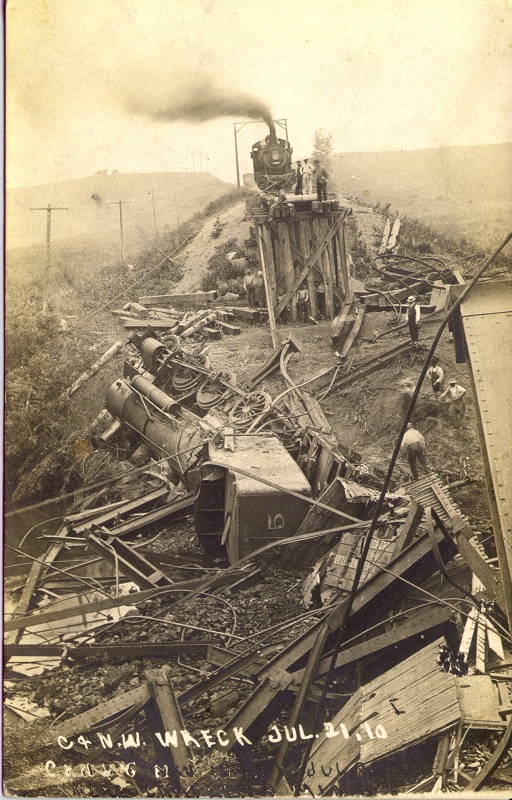
Lenten Trainwreck, and What May Be Learned From It

Courtesy of the History of Lamberton, Minnesota, web site
Teach us, good Lord
To serve thee as thou deservest,
To give and not count the cost,
To toil and not seek rest,
To labor and not ask for any reward
Save that of knowing that we try to do your will.
– St. Ignatius of Loyola

We’re nearly three weeks into Lent and thus far it’s been a train wreck of sorts. On one hand, a couple of daily spiritual investments I’m promised to make I have successfully carried through with thus far. On the other hand, every sacrifice I committed to for this Lenten journey I have failed to observe at least once. I suppose it could be construed as a point in my favor that I chose to “give up” aspects of my day and diet that have apparently become compulsive – however, it’s pretty sad that it took Lent to make me realize how habitual my eating and technology usage is, and even sadder that my newfound awareness has yet to translate into consistent action.

On top of these things, in the back of my mind I hear a soft but constant chant: almsgiving, almsgiving, almsgiving… Have I neglected this aspect of Lent? Just posing the question suggests that I have.

Last night I went to the church for brief Knights of Columbus project meeting. While waiting for my collaborator, I listened in as Fr. Meyers answered questions from the Monday night adult catechesis small groups. The first had to do with the icons of the Apostles in our sanctuary, and specifically, the meaning of the positioning and gestures of their hands. Father offered a brief overview of icons and assured everyone that the gestures do have meaning – then, spying me, he said, “In fact, Jim Thorp, who is standing just over there, is being trained to give tours of the church…”

I began to retreat down the stairs, only half in jest.

Jodi and I are a welcome couple, greeting families who are new to our parish at a regular lunch. We are supposed to offer them a tour of the church, but since we’ve never been on one ourselves, I decided to schedule one with a local deacon who knows the art and symbolism in our church very well. Word got out, and now, it appears, I have become a tour guide.

I am overextended, as always – but during Adoration last night, I identified something else in me that needs deeper reflection this Lent: I have become an Unjoyful Giver.

Consider:

  • Each day I have a meeting or evening activities related to the Church or the Knights of Columbus, I have a knot in my stomach all day.
  • I was impatient to learn whether Confirmation classes were cancelled because of the snow last week.
  • I dread running into people who need volunteers, because I dread being asked.
  • I have begged out of a few new commitments lately (after initially saying yes) because I couldn’t give them enough attention.

You may look at that list and say, “Well, maybe you’ve got enough on your plate – you help out plenty, plus you’ve got four involved kids and a new baby. Cut yourself some slack!” And I would be grateful for the vote of confidence, except for the following facts:

  • I am the founding member of our new Catholic brew club, the Bottomless Pint Brewers, and have joined another men’s group.
  • I am considering other new commitments, in part because they involve the possibility of modest compensation.
  • And upon further reflection, I did not mind the idea of conducting periodic church tours.

The truth is, I want to do what I want to do. I’ll make time for the stuff I enjoy, and the rest I find myself trying to avoid. Also, I pay only lip service to discernment. Aside from the rare weak moment when someone catches me totally off-guard, when I’m asked to volunteer, I generally tell people I’ll prayerfully consider it. In my case, “I’ll pray on it” usually means “I’ll pray around it.” Last night I came to realize that saying a prayer and then considering is not the same as prayerfully considering. I have not been asking what God wants me to do – how He wants me deployed. As a result, I’ve said Yes to things I shouldn’t have, and have become bitter about things I want to do but don’t have time to do well. And I’ve probably declined opportunities I should have leapt at, as well.

Indeed, this is part of the problem with my Lent thus far – I did not delve deeply into what God wanted from me, or think through what it would require. I ran headlong into Lent without looking, without prayerfully considering, without sufficiently preparing. I was looking back over my shoulder to see who was in pursuit, and smacked headlong into Ash Wednesday. I’m still recovering, I think.

Right now, I can think of no worse feeling than doing a half-assed job for God – and the latest edition of “Columbia” magazine gave me some insight into why. See, God doesn’t just love us – He isn’t merely a love-ing God. He is love – all love – it’s his very nature and being. Now, think of how you felt as a child (or even now) when you disappoint someone. If you’re like me, your agony over letting them down is often in direct proportion to how much you know that they love you. For example, if a stranger says he is disappointed in you, that will have less of an effect than if a teacher says it, and the teacher will have less of an effect than a dear parent, grandparent, aunt or uncle.

Now multiply that times a billion.

When you contemplate God as limitless, life-giving love, you realize there can be only one response in return: joyful reciprocation. And then, if you’re me, you realize how far short of that ideal you fall every day, not only in the community and at church, but especially at home, with those you try to love, and who do their level best to love you back.

It is my hope that I can make myself slow down and ask, in the solitude of my own heart, where I am supposed to be, and that I can be still and silent enough to hear the reply. Genuinely prayerful consideration of my strengths and weaknesses, as well as where God wants me to be, should lead me in a new direction, in which I become a Joyful Giver, glad to serve, even when it’s difficult, because I know I’m doing the will of the One who sent me. To that end, I hope to make the prayer at the top of this post a daily reminder. Amen?

Homebrew III: The Experiment

It’s almost time to bottle my fourth batch of homebrewed beer, a clone of Pete’s Wicked Ale brewed from a Midwest kit, which means I ought to finally report on batch three…The Experiment.

The Experiment came about like this: not long after my successful Irish Stout, some friends were gathering to brew again. I didn’t have the money to purchase another kit — but I did have a “can kit” left over from a misguided venture (retold here) into brewing a decade or so earlier when we still lived in Michigan. The can was a Munton’s Export Stout kit, containing hopped dark malt syrup and abridged instructions. I had a leftover packet of dry brewer’s yeast from my Irish Stout kit (I used a Wyeast packet instead) and, stealing an idea from a molasses stout recipe I’d seen online, I spent a few dollars on raw cane sugar to add to the mix in place of several cups of corn sugar. If all went well, I would have two cases of good dark beer for about five bucks.

I did not follow the instructions to the letter, but combined them with my past two brewing experiences – which means, primarily, that I boiled the ingredients longer. Fermentation was robust the first few days, as expected — the smell from the airlock was sweeter that the Irish stout had been, but with a whiff of hops. Unfortunately I forgot to take a hydrometer reading before sealing the primary fermenter, then dropped and broke my hydrometer during the transfer process. Since I had already drawn a sample during the transfer, I took the opportunity to taste the flat, room-temperature brew. It was sweet—not quite cloying, but sweeter than I had hoped—reminding me at first swallow more of a doppelbock than a stout (or even Samuel Adams Triple Bock, which Dad and I tried once and (like many others) did not enjoy).

I tasted it again at bottling and was again struck by the sweetness. I had read that the raw sugar could lend a “rum” taste to the brew; I hoped the carbonated bottles would not be too sweet to be drinkable.

I opened the first bottle a few weeks ago. It was poorly carbonated, winey, and sweet. I drank about half the bottle and wasn’t crazy about it, but swirled the remained bottles and moved them to a warm place in hopes of further carbonating them. I tried another earlier this month, and while the carbonation was better, the head was still thin, fizzy, and brown, and the beer itself was simply too sweet for my taste. I probably should’ve used corn sugar as recommended, but at least I’ve seen something of the effect of raw sugar in that rummy/winey taste.

In the end, I dumped all but 12 bottles, which I kept for cooking. This weekend I cooked a pot roast in one – seared it first in a cast iron pan with olive oil, then put it in the crock pot with one bottle of The Experiment, two yellow onions (chunked), garlic salt, pepper, and Worchester sauce, and let it cook most of the day. The resulting meat was delicious – so the remaining 11 bottles will be good for something!