Book Break: Three Quick Reads

I’m playing catch-up on “reviewing” a few faith-building books I’ve read in recent months. I recommend all three, depending on where you and your family are on your faith journey.

Blessed Are the Bored in Spirit by Mark Hart

cee7e-boredinspiritMark Hart is a former Catholic youth minister, self-proclaimed Bible geek, and vice president of LIFE TEEN…and a recovering cultural Catholic who was just going through the motions in his younger years. Blessed Are the Bored in Spirit: A Young Catholic’s Search For Meaning is a short (less than 150 pages), light, and humorous look at the temptations, attitudes, and obstacles that keep teens and adults lukewarm in their faith. If you’ve heard Hart speak (as in this video we shared at LIFT this past year), you’ve got some idea of the tone and level of this book. I recommend it for teens, young adults, and family discussions.

Jesus Shock by Peter Kreeft
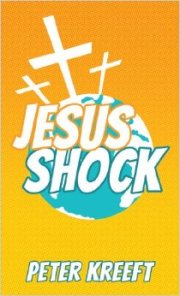
19ac5-jesusshockThe title and cover of Peter Kreeft’s 176-page Jesus Shock make you wonder if it’s by that Peter Kreeft. It is. Kreeft  is a professor of philosophy, lecturer, and author of countless books on theology, philosophy, history, and apologetics — but Jesus Shock is the result of asking God, “What do You want me to write?” The answer, he says, was “Me.” Kreeft asks questions of his readers to help them probe their knowledge of and attitude toward Jesus, and uses Scripture to show how the Incarnation, the God-Man, the Word of God and Savior of the World, is everything we long for and anything but boring. This a somewhat deeper and more academic read that Mark Hart’s book, and more clever than humorous, but still very accessible for adults and motivated teens. It’s a good book for self-reflection or discussion.

The Weight of Glory by C.S. Lewis
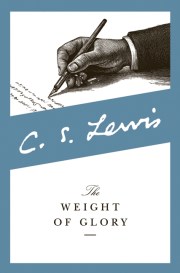
5a453-weightofgloryAnd now for something completely different: The Weight of Glory by C.S. Lewis is a collection of beloved homilies, lectures, and essays by the great writer and apologist, on topics as diverse as the problems with pacifism, why study of the liberal arts matters, the challenge of forgiveness, the incoherence of a strictly scientific worldview, what membership means (and what it should mean), and more. These individual pieces are not directly related to each other, except by authorship, but they present a picture of Lewis’s Christian outlook and concerns about the direction of modern culture that have stood the test of time and are perhaps more relevant today than ever. If you enjoy Lewis’s writings beyond the Narnia series, or if you want to dig more deeply into Christianity in the modern world, brew some coffee, get comfortable, and enjoy. This book is great for personal reflection and deeper discussion, especially if you like stretching your intellectual muscles a bit!
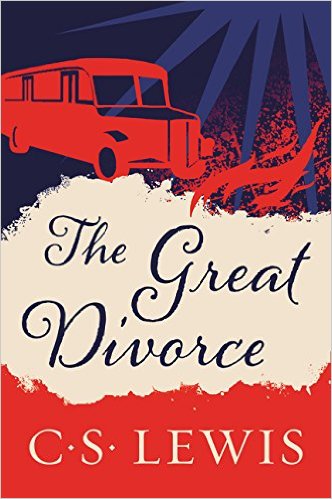
Book Break: The Great Divorce

I mentioned in an earlier post that I had a profound Good Friday, but that was only half the story. The other half of the story is that, early that Friday morning, I sought out some spiritual reading for the day, and wound up with a new top-five favorite book: C.S. Lewis’s The Great Divorce.

Of course, when reading spiritually, the Bible is always a good place to start, and I’m also making slow but steady progress through Dante’s Divine Comedy a canto or two a day. But I wanted something fresh, something I could possibly read in a day, and something related to the penitential character of Good Friday and the great saving act of our Lord.

On a hunch, I took C.S, Lewis’s The Great Divorce from the bookshelf. I have great regard for Lewis as a writer and had heard good things about the book, particularly from my good friend Angie at Take Time for Him.

Lewis had me hooked from the preface, which begins by explaining the title of his fantasy:

BLAKE WROTE the Marriage of Heaven and Hell. If I have written of their Divorce, this is not because I think myself a fit antagonist for so great a genius, nor even because I feel at all sure that I know what he meant. But in some sense or other the attempt to make that marriage is perennial. The attempt is based on the belief that reality never presents us with an absolutely unavoidable “either-or”; that, granted skill and patience and (above all) time enough, some way of embracing both alternatives can always be found; that mere development or adjustment or refinement will somehow turn evil into good without our being called on for a final and total rejection of anything we should like to retain.

The book begins with our narrator in line at a bus stop in a grey and gloomy town, surrounded by people he doesn’t know and wouldn’t want to — unsure of where he is or where he’s going. It unfolds like Dante’s Divine Comedy in modern miniature: a pilgrim’s journey from hell to the edge of heaven in just 128 pages. I’m reading Dante now, too, canto by canto, and it is powerful in its way, but this held my attention from the preface to the end, with every word relevant to this sinner and this sinful time. Lewis articulates with poetic beauty and unflinching honesty the glory of God and his angels and saints, the pain of detaching from this world, and the stubbornness, the grasping, the pride and distrust that keep even “good” people from choosing God and reaching Heaven.

The book challenges the reader particularly on the Greatest Commandment: “You must love the Lord your God with all your heart, with all your soul, and with all your mind” (Matthew 22:37). On this point, Dante provides an unintended summary (being some seven centuries older) which, as providence would have it, I read over lunch on Easter Monday. In Purgatorio, Canto IX, Lines 127-132, he writes the words of the angel guarding the gates of Purgatory proper:

“I hold these keys from Peter, who advised
‘Admit to many, rather than too few,
if they but cast themselves before your feet.'” 
Then pushing back the portal’s holy door,
“Enter,” he said to us, “but first be warned;
to look back means to go back out again.”

We sin when we put anything — even the blessings of life on this good Earth — ahead of loving and seeking God. Pilgrim after pilgrim turns his or her back on Heaven because the cost of entry is too high: the cost of admitting that they are mere creatures and of letting go of their earthly pleasures, passions, and prejudices. They want Heaven on their own terms and choose Hell to feel like they have some say in the matter. They cannot stand the humiliation of grace as an unmerited gift.

It is a powerful book: perhaps tied at this moment with Steinbeck’s East of Eden as my favorite of all time (although Tolkein’s The Lord of the Rings (which I still need to review as an adult) and Sigrid Unset’s Kristin Lavransdatter trilogy are right up there, too!) It paints a stark and revealing picture of how far so many of us have to go to be purged of all sin. So I will end this post with Lewis’s words from the Preface, on a hopeful note:

I do not think that all who choose wrong roads perish; but their rescue consists in being put back on the right road. A wrong sum can be put right: but only by going back till you find the error and working it afresh from that point, never by simply going on. Evil can be undone, but it cannot “develop” into good. Time does not heal it. The spell must be unwound, bit by bit, “with backward mutters of dissevering power”– or else not. It is still “either-or.” If we insist on keeping Hell (or even earth) we shall not see Heaven: if we accept Heaven we shall not be able to retain even the smallest and most intimate souvenirs of Hell. I believe, to be sure, that any man who reaches Heaven will find that what he abandoned (even in plucking out his right eye) was precisely nothing: that the kernel of what he was really seeking even in his most depraved wishes will be there, beyond expectation, waiting for him in “the High Countries.”

The Great Divorce. Find it. Read it.

Reliving My Childhood

Yeah, that’s the look!

I have a confession to make: I have spent the last few weeks with a goofy grin on my face, reliving my childhood. It began back in November when, for the first time in many year, I finished J.R.R. Tolkien’s The Hobbit and decided against my original intentions to begin The Lord of the Rings trilogy immediately. These were my favorite books as a child and teen, and indeed, I still have the Special Silver Jubilee Edition paperbacks I grew up with — tattered, torn, and taped back together again. I have meant to turn back to them for some time now, considering that the the last time I read and loved them I was less than half the age I am now and neither Catholic nor even Christian in any meaningful way.

Consider this as well: for the past 14 years, the only substantive interaction I’ve had with the peoples and history of Middle Earth has been through the hit movies (and an occasional comment from my older two sons, who have read them in the interim). Truly I underestimated the impact of regular exposure to the films without reading the books. I had forgotten just how wonderful these stories really are!

Somewhat disturbing, but it was all I had!

You see, I had grown up with the Ralph Bakshi animated movies and had not loved them. I daydreamed about what the characters and places would look like in real life. In high school, I ran across a hardcover edition of The Complete Guide to Middle Earth with this image on the cover (the rest of the fellowship shows up on the back), and it fueled those daydreams for many more years.

Loved it, except for Aragorn as a musketeer? And Pippin’s hat…

So when the first of The Lord of the Rings movies was released, my love was deep, fueled by the imagery and fanned by a long absence from the text. As I re-read the stories in recent weeks, I was drawn back in: to the breadth and scope of Middle Earth; to the perils at every stage of the journey to Bree, Rivendell, and Mordor; to the practical concerns of traveling unseen across an unfriendly landscape; to the brutality of war and love of honor, fellowship, and song–and of course a pipe and a pint. I shook my head in disbelief, I grinned, I laughed out loud — I even choked up a time or two!

I also realized how utterly short the movies fall. Not simply because of what was left out or added — but in terms of the overall tone and message of the story.

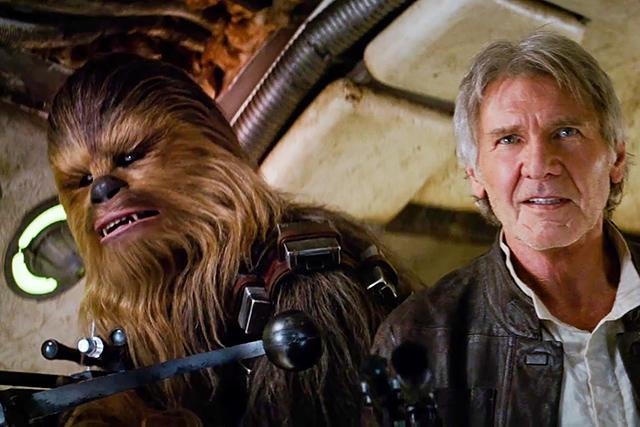
Then on Tuesday I took the older four kids to see Star Wars: The Force Awakens. Star Wars has even deeper roots in my childhood psyche: these are the first movies I remember loving, and those stiff plastic action figures are the first toys I ever craved and collected. Even as a grade-schooler I think I recognized that Star Wars had all the elements of the stories I liked best: aliens and spaceships, swords and sorcery, a “lone ranger” and his native sidekick in a rough-and-tumble desert wasteland. Of course, The Empire Strikes Back was the best of three original movies, and of course, Han Solo was the best character — both for the same reason: I was beginning to realize that life wasn’t all sunshine and daisies, and people aren’t always perfect. From that standpoint, Empire seemed very real to me, and Han Solo gave me hope that even a scoundrel could find a way to rise above.

So imagine my delight the first time this image started circulating the Web:

“Who’s scruffy-looking?”

Much has been made about how the new Star Wars movie is a throwback to originals, with so many iconic images like this one that call to mind the movies I grew up with. But on top of that, I found a sense of wonder and chemistry that the three prequels abandoned in favor of spectacle and special effects. Again, I shook my head in disbelief, I grinned, I laughed out loud — I even choked up a time or two. I was a kid again.

Blogger’s Note: I will likely write a more thorough post on each of these experiences in the near future. In the meantime, let me say that, without a doubt, Han shot first. He always more Clint Eastwood than John Wayne, anyway — more of a Lone anti-Ranger than the Lone Ranger himself. Also, if I can’t be Sam Elliott in my elder years, I’ll be Harrison Ford.

Book Break: In the Beginning: A Catholic Understanding of the Story of Creation and the Fall

One of the many things I meant to do in the past year was to explore and review several books on the Catholic view of creation and evolution, in order to help parish parents and grandparents answer their questions on the topic and those of their children. My hope was to find a book or two that might be helpful to inquiring minds of all ages.

As usual, I bit off more than I could possibly chew and have completed only one such book. On a positive note, it was excellent.

‘In the Beginning…’ A Catholic Understanding of the Story of Creation and the Fall is an edited compilation of four Lenten homilies given by Pope Benedict XVI in 1981, when he was still Joseph Ratzinger, archbishop of Munich and Freising. His goal was to develop a catechesis of Creation for adults. The four homilies build, one upon the other, to present a clear case for what the Genesis accounts of Creation and the Fall mean and why they continue to matter:

  • The first homily, “God the Creator,” lays out the so-called conflict between the Creation account(s) and science, and discusses how and why we interpret scripture the way we do: in the context of Jesus, to whom the entirety of scripture, written over the course of centuries, points.
  • The second homily, “The Meaning of the Biblical Creation Accounts,” addresses the Creation story specifically, the reasonableness of belief in Creation, the ways in which science points to Creation, the sabbath structure and rhythm of Creation — and the emergence of the view that humanity is at conflict with nature.
  • In the third homily, “The Creation of the Human Being,” Pope Benedict focuses on the heart of the matter for many modern Catholics: where humans come from. He explains that Genesis has more to do with who we are (imago Dei, or image of God) than how we got here, then tackles evolutionary theory directly — what it can explain about our existence, and what it can’t.
  • In the fourth homily, “Sin and Salvation,” Pope Benedict discusses the Fall of Adam and Eve, and the plan for salvation, with Christ as the new Adam. In perhaps the most profound explanation for me personally, he clearly lays out why, because we are creatures created by God, obedience to God’s law is not a restriction of freedom (like we often perceive it) — we are made for this, and thrive under God’s law because it’s in our nature!
The entire book is exactly 100 pages, including the Appendix, entitled “The Consequences of Faith in Creation, which reads like a fifth homily on how we got to the point that, since the Renaissance, understanding of and belief in Creation theology has diminished to the point that it is rarely spoken of in modern Catholicism, and why our fundamental “creatureliness” is essential to our future. Pope Benedict’s style is straightforward and clear; he is obviously well-read and -researched on this topic, but makes it accessible to (though not always easy for) the patient reader. The book is less specifically about evolution that I imagined, but rewarding and worth the time. It’s fun to imagine these as homilies, sitting in the pews, wishing someone was writing all this down.

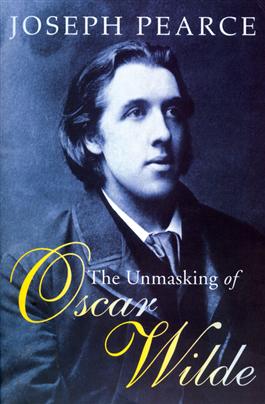
Book Break: The Unmasking of Oscar Wilde

A little more than a year ago, I wrote a brief review of Oscar Wilde’s play, The Importance of Being Earnest. I was quite disappointed in it, given how much I loved his novel The Picture of Dorian Gray when I read it in 2009, and I said so.

My bride’s soon-to-be sister-in-law — who is as smart and well-read as they come, and who loves Wilde — suggested that there might be more to the play than I thought. A short while later, I ran across Joseph Pearce’s book The Unmasking of Oscar Wilde. I knew only a hint about Wilde’s life and thought perhaps the finding of the this biography was providential. When I saw that it was published by the Catholic publishing house Ignatius Press, I was still more intrigued and vowed to read it. I started it this summer, and finished it last week. It is a thought-provoking, page-turning biography of a fascinating and tragic man.

For someone who knew only a little of Wilde’s purported life, the book was eye-opening on many levels. Pearce cites primary sources such as personal correspondence, several other Wilde biographies, writings from and about Wilde’s contemporaries, and even excerpts from the literature and criticism Wilde wrote and admired. He makes strong attempts to debunk a few longstanding “facts” about Wilde — e.g., that Wilde ever had syphilus — and delves deeply into the thesis that Wilde’s decadent, and ultimately destructive public persona was a mask covering a deeply moral, and tragically conflicted, core. Wilde’s personal descent from artistic genius and admired husband and father into a world of drinking, drugs, homosexuality, and prostitution is reflected in The Picture of Dorian Gray and other works — but almost without exception, those works ultimately conveyed a traditional moral. The legendary decadent was quite often a very Christian writer

Pearce makes his case for the mask analogy well, beginning with Wilde’s mother’s own tendency to cultivate little fictions about herself and to morph with the times, and Wilde’s early and frequent attraction to the romance and arresting beauty of Catholicism, which was viewed unfavorably by his father — and continuing through his apparent long-delayed conversion as he lay dying, broke and lonely.Through each period of Wilde’s life, Pearce draws upon biographical events, historical circumstances, and the often obvious conflict between Wilde’s running criticism of art and society and the deeply moral and religious poetry, fiction, and plays he created alongside it.

Pearce almost makes his case too well for my taste, in fact, building the biography upon Wilde’s love of Dante, as a long descent into Hell, followed by a climb through Purgatory toward an eleventh-hour conversion and (God willing) Paradise. Each chapter fits the construct neatly, and Pearce moves so freely between Wilde’s words and those of his contemporaries, that an inattentive reader can easily lose track of what is actually Wilde in his own words, and what is Pearce positing a reasonable theory about Wilde using the words of others, but that could be mistaken.

Upon reflection, however, I found myself convinced by Pearce’s premise and understanding of Wilde, but wishing that in each chapter he had quit hammering once the nail was driven. I suspect the flourishes that bothered me will delight many other readers.

Learning about Wilde’s life did not make me love The Importance of Being Earnest as a story or play — though it makes the origins and intentions behind the play more interesting to contemplate. Wilde’s own words in the edition I own describe the play as follows: “The play is exquisitely trivial, a delicate bubble of fancy, and it has its philosophy…That we should treat all the trivial things of life seriously, and all the serious things of life with a sincere and studied triviality.” This is the voice of Wilde’s public persona: the irreverent, boundary-breaking, drawing-room wit that made him as legendary and popular as his carnal weaknesses made him infamous. The back cover  of my copy claims that Earnest embodies more than any other play, Wilde’s “decency and warmth” by which I think it means it was lighter fare and not in danger of being attacked as indecent, as some of his more explicitly decadent and overtly moral books, like Gray, were.

So why this shift to something lighter — simultaneously less decadent and controversial, and less moral and moving? Pearce isn’t explicit about his views. But it is interesting that Wilde wrote this play during a break in the self-destructive relationship with another man, Alfred Douglas, that brought about his downfall. He hadn’t worked in some time, was deeply in debt, and had few friends upon whom he could rely for help — and he wrote a satire that, unlike his other works, appears purposely to be an exercise in style over substance, mocking conventional morality instead of leveraging immorality to drive home a moral.

It was a triumph at the box office. Perhaps necessity is the mother of invention?