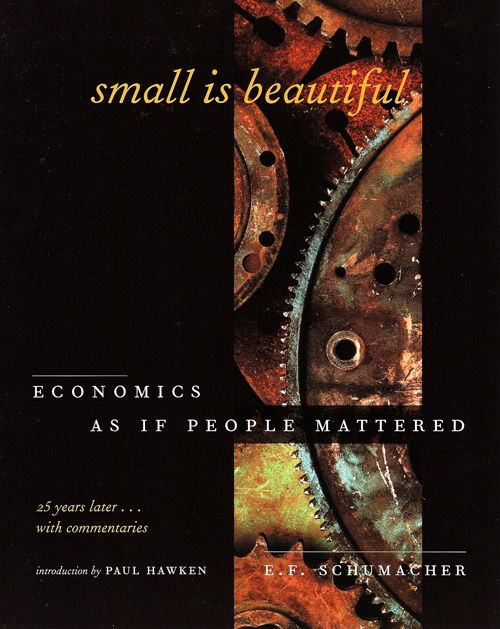
Book Break: Small Is Beautiful: Economic As If People Mattered

One of my regrets from my college days is not taking any courses in economics. I received a relatively unstructured liberal arts education: aside from a few specific prerequisite courses for my undergraduate degree, all class were divided into four groups, and we had to take a certain number from each group. Math and physical sciences were grouped together, so the classes and labs I took in chemistry meant I didn’t have to take math. I heard only complaints from my friends in economics classes, and since I had so many other interesting classes in the social sciences to choose from, I skipped it.

This teenage shortsightedness bothers me still today, since our news and politics revolve around the economy. E. F. Schumacher’s Small Is Beautiful: Economics As If People Mattered recognized this utter domination of economics over all, warned against it, and proposed specific antidotes. Written in 1973—a year before I was born—and recommended to me by a former boss, it strikes me as a book that was likely read, loved, and then neglected by many in the last 40 years as they were swept along by currents too strong to swim against.

With no economic background of my own with which to offer a proper review or critique, I will instead offer a couple of objections and a few ideas I loved from the book.

The most obvious grounds for dismissal of Schumacher’s book for many will be that the alarms he sounded in 1973 were, in retrospect, too shrill—the gloom and doom he predicted, especially in terms of natural resource shortfalls and environmental crises, have not yet come to pass. For some readers, this alone will “prove” that the author obviously didn’t know what he was talking about. Schumacher himself, a Rhodes Scholar and economic advisor with the British Control Commission and the British National Coal Board, warned against trying to predict the future. Common sense told him that finite resources can’t last forever, and exploratory calculations suggested that, at the rates of consumption and growth he was seeing in the 1970s, we were living on borrowed time. He acknowledged it was possible that we would find new sources of fossil fuels and other rapidly consumed resources—his point was, to what end? Unless we change our habits, eventually we will suffer.

The second objection was, for me, the more difficult: at this point in his career, Schumacher had strong opinions about what was wrong in the world and what needed to be done about it, and his blunt negative assessments of markets, economists, and motivations in his day leave little room for compromise or evangelization. I found myself nodding in agreement with three-quarters of his writing, only to run against passages about which I thought, surely not everyone in capitalist society is solely motivated by relentless profit-taking?

On the other hand, Schumacher does an excellent job of drawing our attention to the underlying problems with an economic approach to everything. Early in the book  he quotes his fellow British economist (and an early benefactor of sorts) John Maynard Keynes from 1930: “For at least another hundred years we must pretend to ourselves and to every one that fair is foul and foul is fair; for foul is useful and fair is not. Avarice and usury and precaution must be our gods for a little longer still. For only they can lead us out of the tunnel of economic necessity into daylight.”

Is this not contrary to the Christian ideal and common sense? Can fallen man use sin to achieve virtue? Of course not—but he can use his fellow man to achieve personal prosperity.

Schumacher goes on to write, “This was written forty years ago and since then, of course, things have speeded up considerably. Maybe we do not even have to wait for another sixty years until universal plenty will be attained. In any case, the Keynesian message is clear enough: Beware! Ethical considerations are not merely irrelevant, they are an actual hindrance, ‘for foul is useful and fair is not.’ The time for fairness is not yet. The road to heaven is paved with bad intentions.”

Lest you think of Schumacher as a naïve idealist imagining utopia, consider that two simple, practical ideas he advocated in his writings were the continuation of coal development and reducing energy consumption. He recognized that mankind is notorious for developing new problem-solving technologies that create new problems; that turning one’s back on an entire energy source on the belief that we could replace it entirely with oil or nuclear energy and meet rapidly growing worldwide demand, was foolish, even if it turned out to be true; and that wasting resources we cannot, ourselves, replace never makes sense.

This, to me, is (at least in part) what conservatism ought to be: maintaining the tried and true even as we explore new possibilities and conserving, even when a crisis is not looming, because it’s the sensible and moral thing to do.

Am I good at it? Not very—but getting better.

His biggest idea, however, was the concept of intermediate technologies for developing countries. Schumacher traveled the world and saw that most economic development supported by wealthy nations not only replicated the patterns of economic dysfunction he was in the developed world, but deepened the economic problems in the developing country for all but a fortunate few.

One example he uses (which I will paraphrase and expand on) is that of a large earthwork project that needs to be done in a developing country. You have a range of options you may employ for accomplishing this work, from people using their hands to scrabble and scrape away at the earth to the most modern and powerful earth-moving machinery. The former approach would cost almost nothing and “employ” a lot of people for a long time at menial and nearly impossible work; the latter would employ relatively few people for a relatively short time, unless the expensive equipment broke down and needed repairs—in which case there would be no parts or expertise locally to fix it. In the middle, however, are a range of intermediate technologies, however, that could put people to work, providing income for their families, value for their time, and dignity for themselves. For example, equipping a hundred men with well-built shovels and wheelbarrows would put those men to work—plus many more making and repairing shovels and wheelbarrows using local materials. The money earned by all those people (instead of just a few heavy-equipment operators) could be used to support other local industries—because what good is producing food or consumer goods if no one has any money to buy them?

There is much to love in this book, including Schumacher’s very Catholic views on the dignity of work and the human person. He speaks against an all-pervasive economic approach to efficiency, which quantifies and assigns value to the incalculable and invaluable. When everything is assigned a value, the sacred (such as human life) is diminished and no longer sacred. He speaks against an approach to labor and productivity that reduces work to individually pointless tasks without freedom or creativity and fails to employ large segments of society that, because they see no value in their time and effort, quickly devalue themselves. And he speaks against the underlying assumption that one who works less and consumes more is better off than one who works more and consumes less.
It is a thought-provoking read, and I highly recommend it. 


Long Goodbye

It’s a strange sensation, like a high-tensile wire stretched six hours west to a bluff above Bismarck and the Missouri River, a steady thrum, more felt than heard, reminding me that a part of me is there. Not gone, but definitely not here, and I can’t know from one moment to the next what he’s about. We are six hours distant, so I know less about his day-to-day — but I am more keenly aware of him than I have been in years. His absence is a presence, palpable, in our home.

I am wearing an old hardware-store t-shirt he left behind.

I haven’t felt this sort of connection to my eldest son since he first came home with us — the heaviest ten pounds I ever lifted — and I realized he was ours to shape and raise to manhood. Then the connection was direct, bare skin on bare skin, almost frighteningly close: his little chest expanding and contracting, the soft spot where his skull had yet to form pulsing, his every need and discomfort so close to the surface we could almost feel it. Now it’s this invisible strand from one eggish Thorpian occiput to another. He’s always at the back of my mind.

I wonder if he feels it, too?

* * * * *

At different points this past summer, it felt like such a blessing that the University of Mary started late. We planned an August send-off, since Brendan didn’t want a grad party and had lots of time to plan and few conflicting parties to contend with. As we watched more and more friends drop their teens off at college, we thought it was helping to prepare ourselves for this weekend. Perhaps it did. But the past three weeks or so began to feel like a very long goodbye. Brendan left his job at the hardware store at the end of July, and his electrician’s job a few weeks back. His band, Pabulum, played their Final Jam. (They insist they are done as a group, which would be a pity.) All of his friends expect Olivia (who is a senior this year) left for college, and he started packing his things, some for Bismarck, some for storage.

The week before last he took a solo road trip to Michigan to spend some down time with my folks. As God’s providence would have it, a high-school friend of mine has a son who was transferring to St. John Vianney Seminary in St. Paul this fall; he and Bren were best friends in preschool, and Will and his stuff needed a ride to Minnesota. They came back together, two peas in a pod, and Will dropped right into our family. When we took him to the seminary a day or so later, it was actually a little emotional — call it practice or anticipation, we were beginning to feel the ties to Brendan being stretched.

Last Monday, Jodi and I took Brendan out to supper and to get sheets, supplies, and decor for his dorm. We had such a good time eating his favorite food (Mexican, this time at El Bamba), listening to his current favorite band (Icelandic blues-rock outfit Kaleo — Bren, his friends and I are going to see them in October); making him pick out dishes, sheets, and towels when he couldn’t care less. It was a great evening.

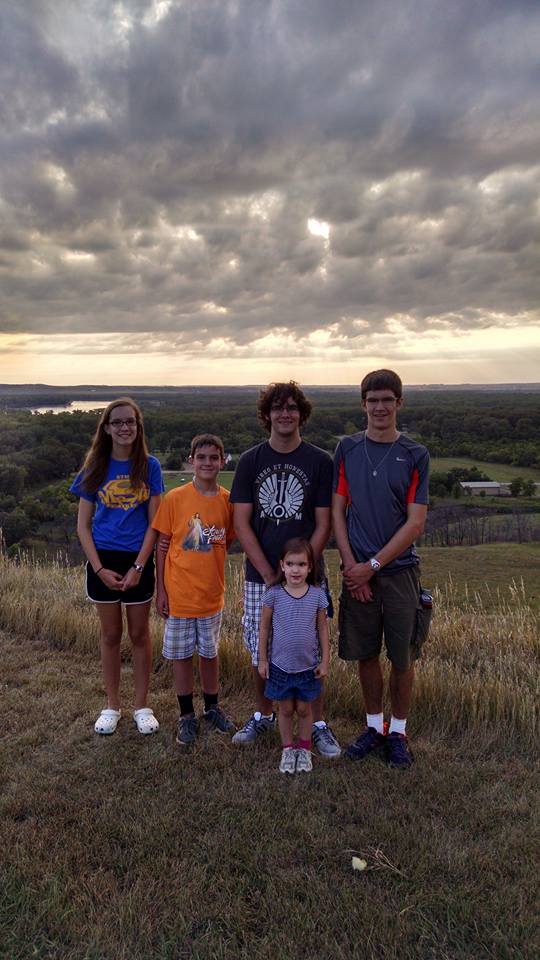
And then this weekend. Originally only Trevor wanted to make the trek to UMary, until Gabe realized he could potentially get 12 hours of driving toward his license. Once he decided to go, Emma jumped aboard, realizing that otherwise she would be left to babysit Lily alone. So all seven of us went — the largest single-family contingent I saw on campus.  Jodi and I took Friday off, and we left early in the afternoon so Bren could connected with his NDSU friends in Fargo and catch our local high school’s football game against Moorhead. He spent the night on campus; the rest of us in a hotel. Seeing his friends joyful and comfortable on campus, was reassuring; arriving at UMary itself was doubly so: simple, joyful, peacful.

Bismarck’s Big Boy Drive-In — unique in my experience,
with menu items you don’t see anyplace else. Google it!

We met his roommate, Ethan, a nursing student and Vikings fan from western Minnesota, and Ethan’s parents — they seem like a wonderful family — and heard from UMary president Monsignor James Shea, who told the students with clear affection and blunt honesty that their lives were not their own, but a gift for others, and unless they find a way to spend themselves in love, they will have wasted their time here. He told us parents, as well, to step away and allow our children to stumble and fall that they may learn to stand on their own.

He strikes me as a good man, and I couldn’t be happier to entrust Brendan’s young mind and character to him these next few years.

One other speaker shared an Erma Bombeck quote, comparing raising children to flying a kite: letting out more and more string until ultimately the tether breaks and the kite soars away on its own. It’s not a bad metaphor, but I see things differently. This connection between us is stretched thin, but not to breaking; it is keen, sensitive, and strong, and though it can be tangled, wound about the world, stretched to invisibility and nigh untraceable, it cannot be broken.

I told him as much, in a letter I left in one of his boxes. No matter how far away he goes, I am here waiting for his return. Because he is mine, and I love him.

When we finally decided, after dinner on campus, that it was time to head home, Bren walked with us to the Suburban. He hugged each of us (Mom and Lily more than once) and told us he loved us. He told the older kids to keep doing their thing: Emma, to keep baking; Trevor, to keep drumming; Gabe, to keep being himself and making people laugh. Lily’s last words to him from inside the Suburban: “Love you, Brendan! Don’t do anything bad out here!”

We’ve done the best we could. I think he’ll be alright.

A Higher Education

As we crossed the plains of North Dakota this weekend, I made a surprising discovery: my college roommate Frank is now the Honorable Franklin R. Parker, assistant secretary of the Navy.

We were headed to Bismarck to register Brendan for his first-year classes at the University of Mary. Jodi was driving, and I sat hunched in the back seat of our little commuter car, giving Brendan and his mom some quality time up front. We had been talking to him about things that change as you move through life: interests and priorities shift, people you were close once slowly drift away. “It just sort of happens,” I said. “Often it’s not even intentional: my buddy Frank from Yale and I used to be in touch a couple times a year — we would at least exchange letters at Christmas — but this last winter I didn’t hear from him and our Christmas letter bounced back to us. They must’ve moved.”

I sat a moment, then said, “Of course, he is an attorney and has worked for some pretty big firms, so I could probably find him again in just a few minutes on Google.”

* * * * *

I pulled out my phone, entered “franklin r parker,” and voila: “President Obama Announces More Key Administration Posts.” To be sure this was, in fact, Frankie Parker of Durfee Hall D-21, I dug deeper and found his official bio page on the U.S. Navy’s website

That’s him. That’s guy I roomed with freshman and sophomore year, whose parents took us to see Ray Charles perform in New Haven, who stood up as a groomsman in our wedding at tiny St. Liborius Catholic Church in Polo, South Dakota, and whose own wedding  was a Chicagoland mashup of African-American and Asian influences with a little Cherokee thrown in.

I shared my discovery with Jodi and Brendan, and for the next hour or more, periodically shook my head, murmuring, “Wow…Frank Parker…working for the President…who knew?…assistant secretary of the Navy..huh…”

If I’m honest, a small part of me was, not jealous, but curious if I could have been something more. As evidenced by his resumé, Frank is a smart fellow, and he’s always been better at making connections than I am — but I did well in college and well in every job I’ve had since. What is it that separates two men with an Ivy league education and a liberal arts degree, such that one goes on to graduate school, prestige, and power, and the other works retail, starts a family, and lands at his local church as faith formation director?

Ever have that happen? It’s not envy — I don’t begrudge him his success or even want what he has. It’s  more like a form of pride or vanity, wondering if I could have been more than I am.

* * * * *

Ultimately I remembered something I wrote during freshman year at Yale: I came East for an education. It was never about a career for me, and I never planned to stay there. I came to learn all I could at one of the great old universities our country has to offer. And I did.

Brendan is a smart young man. He can do almost anything he sets his mind to, and for years his goal was the Naval Academy and the Marine Corps, until he began to grow deeper in his Catholic faith and realized he wasn’t sure he could trust our country’s leadership to deploy him to only just wars. Then his focus was engineering, until he began to think specifically about what he liked (understanding how things work and making stuff, like his Dziadzi) and what he didn’t like (lots of math, computer work, and CAD, like a professional engineer). He’s always loved history and enjoyed theology and literature — so he began thinking about studying, teaching, and writing about the things that he loves.

I can’t fault him for that.

* * * * *

We spent the night in the Expressway Inn in Bismarck (nicer and quieter than it sounds) and the next morning, headed out of town and up the hill to the University of Mary for Mass and registration activities. I hadn’t visited yet, and though I knew it was small, I hadn’t imagined what small might look like in this case. My last higher-education employer, the University of Minnesota, has about 51,000 students; my previous higher-ed employer, Ferris State University, boasts 14,500, and Yale has around 12,000, with a bit more than 5,000 undergraduates.

UMary, by contrast, has a total enrollment of just 3,000 — a tiny cluster of stone and concrete buildings hunkered on the edge of a high bluff overlooking the Missouri River. The buildings aren’t beautiful in any conventional sense; built in the middle of the last century for the wear and tear of young people and the wind and weather of the plains, they are low, solid structures with the quiet strength of stones unmoved by the world and its ceaseless spinning.

* * * * *

We started our day in a tiny chapel, well lit and peaceful, with a handful of prospective students and their families, current students, and administrators. We were first to arrive just behind the priest, a gray-haired Benedictine, and prayed in silence until Mass began. It being the feast of St. Mathias, the readings were focused on the selection of Mathias to replace Judas among the Apostles and Jesus’ command to love one another.

In his homily, Fr. Anthony contrasted our current presidential election process with the prayerful selection of St. Mathias, and contrasted the fame and power of our political leaders with the relative anonymity of St. Mathias both before and after his selection: basically the only things we know for sure are that he was with the other apostles in following Jesus from the beginning through the Resurrection and that he died while sharing the faith with an unbelieving world. He does not appear to have been self-seeking, but to have had one desire: to “to go and bear fruit that will remain” and to lay down his life.

I have reflected on his homily numerous times since, and while I don’t fault Frank for working hard to be where he is in his life, I am no longer curious where else I could be.

* * * * *
After Mass I told Brendan and Jodi I had a tremendous sense of peace about UMary. “This is a good place,” I said.
The original school was founded by Benedictine nuns at what was, at the time, the end of the railroad tracks headed West. During the opening session of the day, the current religious sisters who live in the monastery at the edge of the campus came to pray over the incoming students and their families. They ended their prayers with a beautifully harmonized sung blessing, and we were separated into smaller groups from the rest of the day. 
Brendan was assigned an upperclassman to his liking: a triple-major in history, Catholic studies, and secondary education; the drummer in a rock band who was studying Polish in hopes of doing graduate work in Poland. Jodi and I talked with various campus representatives, including an administrator in Admissions who said our parish’s reputation precedes us and asked what we thought it was that makes St. Michael a special place. We also wandered the campus, talking and taking a few photos, and I ended the day with a sense of great joy: I believe Brendan is where he belongs.
It is true, practically speaking, that students should enter college with some sort of plan for what they want to do with a degree — otherwise the time and money are potentially wasted. But I believe it is also true that, for good students, a structured approach to the liberal arts can help create flexible, resilient young men and women who are prepared to lead, to sacrifice, and to preserve our culture in the days to come. I believe, in choosing UMary, Brendan has chosen a higher education (higher even than Yale in the ways that count most), and I’m proud and excited to see where this path leads.