The Seed Is…Me?

I’ve had a handful of conversations lately about our faith formation programs at St. Michael: what we’ve done differently this year, what’s working and what’s not, and what more I wish we’d done. I am tempted to sudden actions and grand gestures at times, and midway through the faith formation year is no exception: I am tempted to blow up what we’re doing in our parish and start over. So many people need to know that God is real, that Christ is present in the church…and I’m stewing over videos, Powerpoints, and the Catechism.
Then a good friend shares this with me, from something he is reading these days. He knows where my head has been lately, and thinks this might be helpful. He’s right.

“Commenting on the Church’s evangelizing efforts, Pope Benedict XVI warned that Catholics today must resist what he calls ‘the temptation of impatience,’ that is, the temptation to insist on ‘immediately finding great success’ and ‘large numbers.’  He says that immediate, massive growth is not God’s way.  ‘For the Kingdom of  God as well as for evangelization, the instrument and vehicle of the Kingdom of God, the parable of the grain of mustard seed, is always valid.’  He goes on to say the new phase of the Church’s evangelizing mission to the secular world will not be ‘immediately attracting the large masses that have distanced themselves from the Church by using new and more refined methods.’  Rather, it will mean ‘to dare, once again and with the humility of the small grain, to leave up to God the when and how it will grow.’”

The quotes from Pope Benedict are from “The New Evangelization:  Building a Civilization of Love,” his address to catechists and religion teachers, Jubilee of Catechists, December 12, 2000.
We talk often of planting seeds in others, not knowing where, when, or whether they will germinate. But Pope Benedict calls me to the humility of the small grain. 
What does that mean?

A seed perseveres through inclement conditions. It bides its time, then when the time and place are right, it germinates: puts roots down and sends visible growth up.
So far so good, I think.
As conditions are favorable, it continues to grow, and God willing, to put forth fruit. The plant itself has little impact on how much fruit results year to year or what becomes of the fruit once it ripens and drops. But it continues to produce, year after year, as long as it is able. 
The seed is me? That’s a thought I hadn’t thought before…

Detachment

Lord, you call us to new life, to rebirth in the Spirit. How can I be holy for You unless I am wholly for You?

“If anyone remembers my name

If I’m ever known for anything
Let it be I ran into the night
Running with a firelight, firelight
Cause I don’t wanna stroll the streets of gold
While there’s still a soul to love
Let me run into the night
Running with a firelight, firelight
Burning with a firelight, firelight”

Don’t Lose Your Sense of Wonder

I sometimes think of life as a high sledding hill with God at the top, giving us a push. It’s left to us to steer, but like any good father, He knows our tendencies to close our eyes or overcorrect better than we do, and so He can see every curve we’ll negotiate, every bump that will bounce us airborne, every tree we’ll hit. He sees the trajectories of other sledders and knows their tendencies, as well—He knows whose paths we’ll cross, for good or for ill, and when we’ll be blindsided. He alone has the long view, the Big Picture. We must persist with less—a glimpse of heaven through the treetops as we slip away, faster, faster…


I remember, as a boy, waiting breathlessly for Christmas. Christmas Eve was sweet agony—tossing and turning, knowing I had to fall asleep so Santa would come and yet straining my ears for the jingle of bells and the chance at a glimpse of that jolly, saintly man. I couldn’t wait for presents, of course, but I knew they would be great because I knew HE was great! And although we were not, for the most part, a church-going family, still we had a beautiful Nativity, and I knew the story of birth of Jesus. I knew, at least, that He too was a great man and a great gift to us. In these two stories, magic, hope, anticipation, and gratitude combined into one overwhelming sensation for my young heart: wonder!

Wonder seems harder to come by these days. Our science and technology have helped us explain the Heaven out of the world around us. And we have so much on our plates. In Mary’s day, she and Joseph were very much concerned with their daily bread, with doing God’s will, and with deliverance from evil. Now we have countless other worries, from careers to car repairs, birthday parties to ballgames. Beneath it all we hear the steady drumbeat to, as one retailer put it this year, “Win the Holidays.”  We seem so short of time, and the pressure on our heart squeezes it empty. Too many of us feel a hollow ache between our lungs as Christmas approaches, instead of joy and wonder.

The good news is that it’s not too late. Christmas is not a day so much as a season, which begins with the Feast of the Nativity on December 25th and continues for a dozen days: a celebration that “God so loved the world that he gave his only Son, so that everyone who believes in him might not perish but might have eternal life (John 3:16).” The good news is that Santa is ephemeral, while Christ is eternal. The good news is the Good News: that Jesus is God made flesh, that He came to live with us and suffer and die for us, that He rose again from dead, and that He saves us from our sins.

It is no wonder we sometimes feel blue at Christmas. We celebrate a joy we will not experience this side of heaven. No matter how blessed we are in this life, the gulf between what we have and what our heart yearns for in Heaven is so deep and so wide we cannot clearly see the other side or hope to cross it on our own. But Jesus came to show us the way; He gives us His Body and Blood to strengthen us, and His own Spirit to lead us.

The road that stretches before the feet of a man is a challenge to his heart long before it tests the strength of his legs. Our destiny is to run to the edge of the world and beyond, off into the darkness: sure for all our blindness, secure for all our helplessness, strong for all our weakness, gaily in love for all the pressure on our hearts.

– My Way of Life, a simplified Summa Theologica

May God bless you and yours with peace and love throughout this season and beyond. Merry Christmas!

Blogger’s Note: This article appears in the Sunday, Dec. 27, parish bulletin.

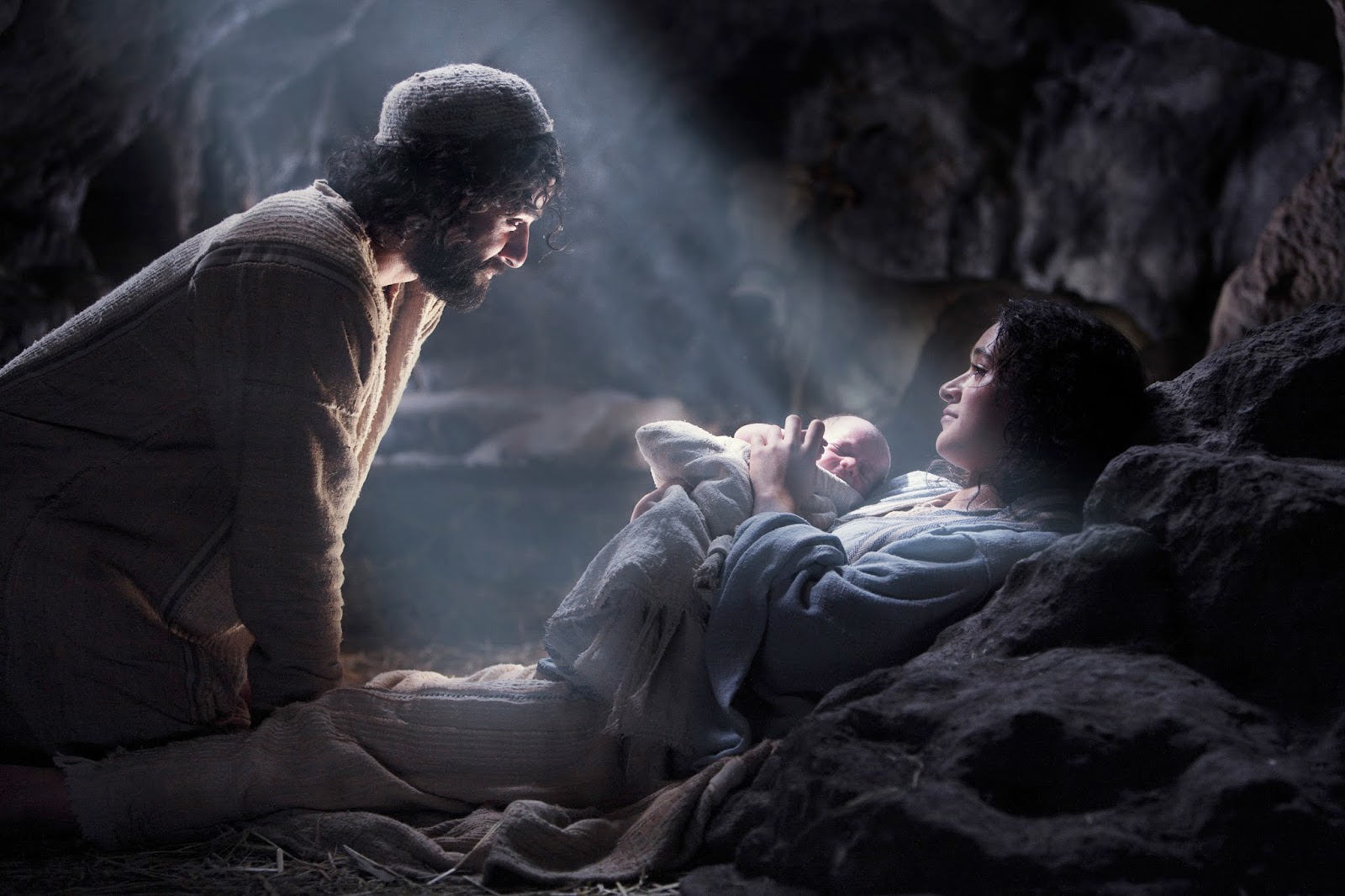
A Christmas Poem: Cave of Wonder

From the film The Nativity Story (2006), rated PG
Wrapped in secret, underground
Sleeping infant makes no sound
Bed of straw and stench of beast
Greatest born to family least
 
Rapt in secret, working man
Virgin mother, shepherd band
Wise men from a country far
Worship Him by light of star
 
Wrapped in secret, hunted one
Earthly might fears Godly son
He has come to seek and save
Born below to rise from grave
 
Rapt in secret, angels sing
Glory to the King of kings
Strength made helpless; selfless love
Here below shows God above
 
Wrapped in secret, greatest gift
By our hands of swaddling stripped
Hung upon a lifeless tree
Sacrifice for you and me
 
Rapt in secret, we the poor
Kneel in before Him evermore:
Blest be home and blest be feast
And blest are we, His servants least
 
J. Thorp
December 2015

A God-Size Space

This morning’s thought comes courtesy of St. John of the Cross via Deacon Ralph Poyo, whom our parish staff had the pleasure of following on retreat yesterday, and who never actually mentioned St. John of the Cross by name.

Jesus tells us throughout the Scriptures that we must leave everything behind to follow him. Certain of these passages seem particularly harsh: “Let the dead bury the dead;” “No one who sets his hand to the plow and looks to what is left behind is worthy of the kingdom of God.” I have struggled with these passages over the years, but in the wee hours this morning, lying in the dark, I had a brief moment of clarity.

Dcn. Ralph reminded us that choosing to be a disciple of Christ (in particular, Christ crucified, since Jesus himself tells us that in order to be a disciple we must pick up our cross and follow) is a black-or-white, all-or-nothing choice. He asked us to imagine, on one hand, Jesus suffering on the cross, and on the other hand, a table filled with all these little icons of the people, places, and things of this passing world that matter to us: our spouse, children, family, and friends; our pets, possessions, and pastimes; our worries, anxieties, and sins.

Of the two, we are called to choose Christ—you shall love the Lord your God with all your heart, soul, mind, and strength—but it’s hard to embrace the cross and even harder to carry it any distance. So we are tempted to walk to the foot of the cross and break a chunk off from it, to shape that piece of the cross into another little icon representing our Christianity, and to place it on the table with the rest, our tiny God, lost in a sea of idols.

St. John of the Cross writes of the tremendous longing God has for union with us (and vice versa). He wants to live within us, but before He can enter fully, He needs a God-size space. And since our God is infinite and eternal—the source of being for everything—the only space big enough is complete emptiness. Nothing else fits where God fills.

I have thought about this before in terms of the little pieces of the world we cling to or the tiny sins we allow to continue because “they aren’t so bad.” But early this morning, it occurred to me that even clinging to the good things of this world—my wife and children, my vocation as a husband and father, my job, and the parish that I love—can push God out.

This does not mean I must give these things up, only that I let them go to make space for God. If I can empty myself completely and seek Him alone, He who is the source of all good things will fill me, and like Job, I will regain what seemed lost, and more!

God is indivisible, the ultimate All, and we cannot claim just a piece of Him—“But seek first the kingdom of God and his righteousness, and all these things will be given you besides” (Matthew 6:33).