MELEE! The Necessity of Close-Combat Evangelization to Secure the Kingdom

Indeed, the word of God is living and effective, sharper than any two-edged sword, penetrating even between soul and spirit, joints and marrow, and able to discern reflections and thoughts of the heart. No creature is concealed from him, but everything is naked and exposed to the eyes of him to whom we must render an account. – Hebrews 4:12-13
 

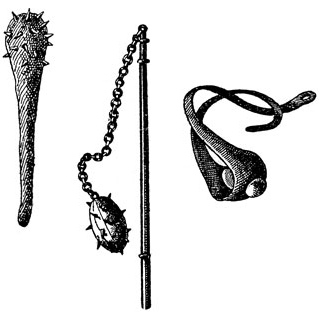
As much as I was impressed with the high-tech precision of the Navy SEALS portrayed in Act of Valor—and moved by their sacrifice for our country—I am generally more deeply affected by portrayals of the blunt savagery of older wars. I can marvel at the mathematical elegance of a sniper kill from a mile or more distant, until I recall James Michener’s account of a Polish peasant walking to meet armored and mounted invaders, carrying a length of ash wood he had induced to grow snugly around a few pieces of jagged flint, forming a homemade mace. The time required to grow your own weapon might be long enough to steel yourself to bludgeon an armored man to death, and another, and another. It seems to me that a man who would kill in this way must have the courage of his convictions. There is no hope of distance or anonymity; he must be willing to look his enemy in the eye and get his hands dirty.

* * * * *

Three recent experiences inspired this essay. [Blogger’s Note: This essay was written in 2012, to be read and critiqued in a men’s group.] The first was the continuation of a friendly debate regarding the best way to engage and challenge non-believers (here and here), in which a friend of mine indicated that the older he gets, the more he feels that polite arguments and sustained discussions are not worth his time. The second was an unexpectedly difficult Lenten struggle to hold my tongue, and the third was a men’s group’s opposition to the Health and Human Services (HHS) mandate. All three of these experiences have in common the issue of when and how we should engage those who think, feel, or believe differently than we do.
Continue reading

Learning to Receive

The other day, a friend stopped by to tell me about a tremendous and totally unexpected blessing for him and his family—a potentially life-changing opportunity, the culmination of months of surrender, trust, and striving to God’s will even when it didn’t seem to make sense.

The opportunity was so good, in fact, that it was hard to look at it squarely and accept that it wasn’t a mirage. If this was God’s plan all along, what was the purpose of roundabout way in which it had come about?

We talked about several possible reasons for his long and circuitous journey, then I said, “Maybe it’s not fruitful to try to figure out in hindsight what God was doing. You and your bride discerned well at the time; maybe now is just the time to say, ‘Thank you, Jesus.’”

He laughed and shook his head: “That seems like good advice.”

It does. Maybe I should take it myself.

Continue reading

In Big and Small Ways, Hope Prevails

In recent months it has become apparent that I am a Worrier. Everyone has concerns, and sometimes those concerns get the better of us—but I actively pursue potential problems no matter how unlikely they may be, then chew and chew and chew on them.

I try to pass it off as a strength—foresight leads to preparation, which benefits my whole family. But the truth is less noble: Mostly, I just don’t want to appear late, ill-equipped, or foolish. Despite my best efforts, I am still trying to measure up. But to whose standard?

Jesus warns us against worry:

“So do not worry and say, ‘What are we to eat?’ or ‘What are we to drink?’ or ‘What are we to wear?’ All these things the pagans seek. Your heavenly Father knows that you need them all. But seek first the kingdom [of God] and his righteousness, and all these things will be given you besides.Do not worry about tomorrow; tomorrow will take care of itself. Sufficient for a day is its own evil.”

Matthew 6:31-34

The saints also warn us:

“Anxiety is the greatest evil that can befall a soul, except sin. God commands you to pray, but He forbids you to worry.”

St. Francis de Sales

“Let nothing perturb you, nothing frighten you. All things pass. God does not change. Patience achieves everything.”

St. Teresa of Avila

“Pray, hope, and do not worry.”

St. Padre Pio

I know this, and yet I persist in losing time and sleep, humor and hair, while fretting about the future and all its possibilities and challenges.

In the past several weeks, God has been working on this aspect of my conversion, especially in two areas of our marriage in which I am not only likely to worry but also to drive my bride nuts: travel and money.

Continue reading

A Life Well-Remembered

I remember, many years ago, sitting with Dad in a homemade ice-shanty-turned-deer-shack on the Lofgren farm in Michigan, where we used to hunt. It was muzzleloader deer season, snowy and cold, and we had a little porcelain-coated gas heater to keep us warm while we watched and waited. Dad was slicing an apple with his pocketknife and placing the slices on the top of the heater, where they hissed, filling the shack with the smell of the roasting fruit.

We ate them once they were soft and warm, and talked quietly together. My father is not a religious man; that day he told me he didn’t believe in an afterlife, but that heaven and hell are how people remember you. To his way of thinking, if you were a good person and took care of your family and your neighbors, you would be loved, missed, and remembered well. You would live on in the hearts of others, and that would be heaven.

If you didn’t, you would not be missed, and your memory would fade—or worse, you would be despised in retrospect. That would be hell.

I don’t share this view personally. I believe in a real and eternal afterlife, and I trust in our merciful God to see the goodness and beauty my father has brought into this world. But in the meantime, I want to give Dad something he can use here and now: a glimpse of his “heaven” as it stands today.

Most of our family and close friends know by now that my dad has both Parkinson’s Disease and dementia. If you hadn’t heard, please know that we didn’t intend to keep you in the dark. It’s not the easiest subject to broach, especially for our emotional clan. Parkinson’s and the resulting effects on his hands and mobility have been problems for several years now. The dementia diagnosis is a newer thing. Over the past few years, Dad’s short-term memory has declined and sequential thinking has become more challenging. More recently he has begun to imagine things.

Continue reading

Embracing ‘Already but Not Yet’

A few years back I was blessed to participate in the Catechetical Institute (Class of Padre Pio) at Saint Andrew Catholic Church in Elk River. I expected it to be a great learning experience: a deep dive into the what and why of Catholic teachings. I did not expect it to be as convicting, converting, and hopeful an experience as it was.

The Catechism of the Catholic Church (CCC) is a systematic overview of the Catholic faith with lots of references to sacred scripture, saints’ writings, and other Church documents that flesh out the teachings in more detail. But the overall theme of the book—and the foundation of all Church wisdom and teaching—is God’s plan of salvation, culminating in the life, death, and resurrection of Jesus Christ.

One of the great mysteries of that plan, emphasized again and again throughout the institute, is the sense of already, but not yet:

Continue reading