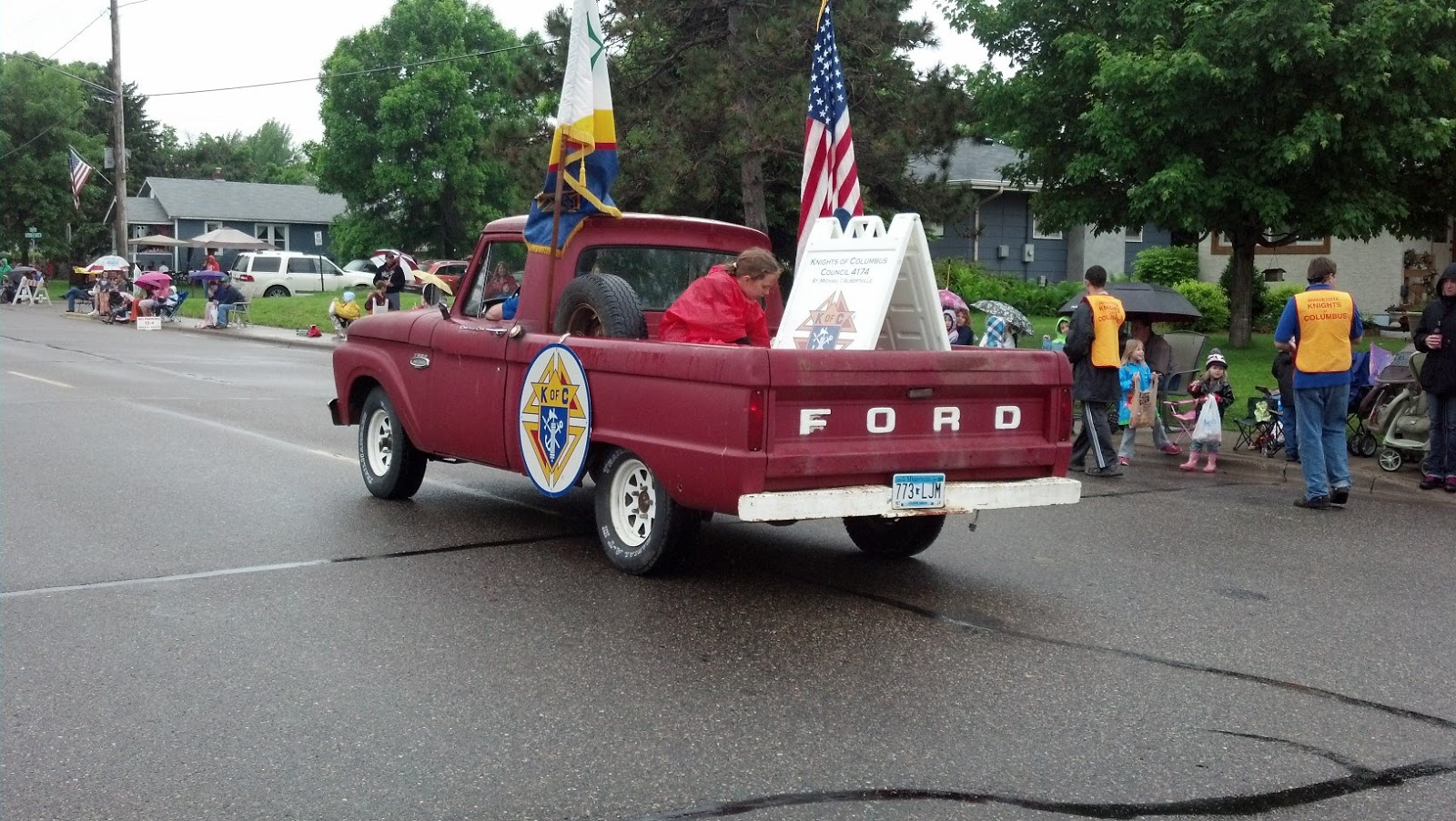
Rosa Represents

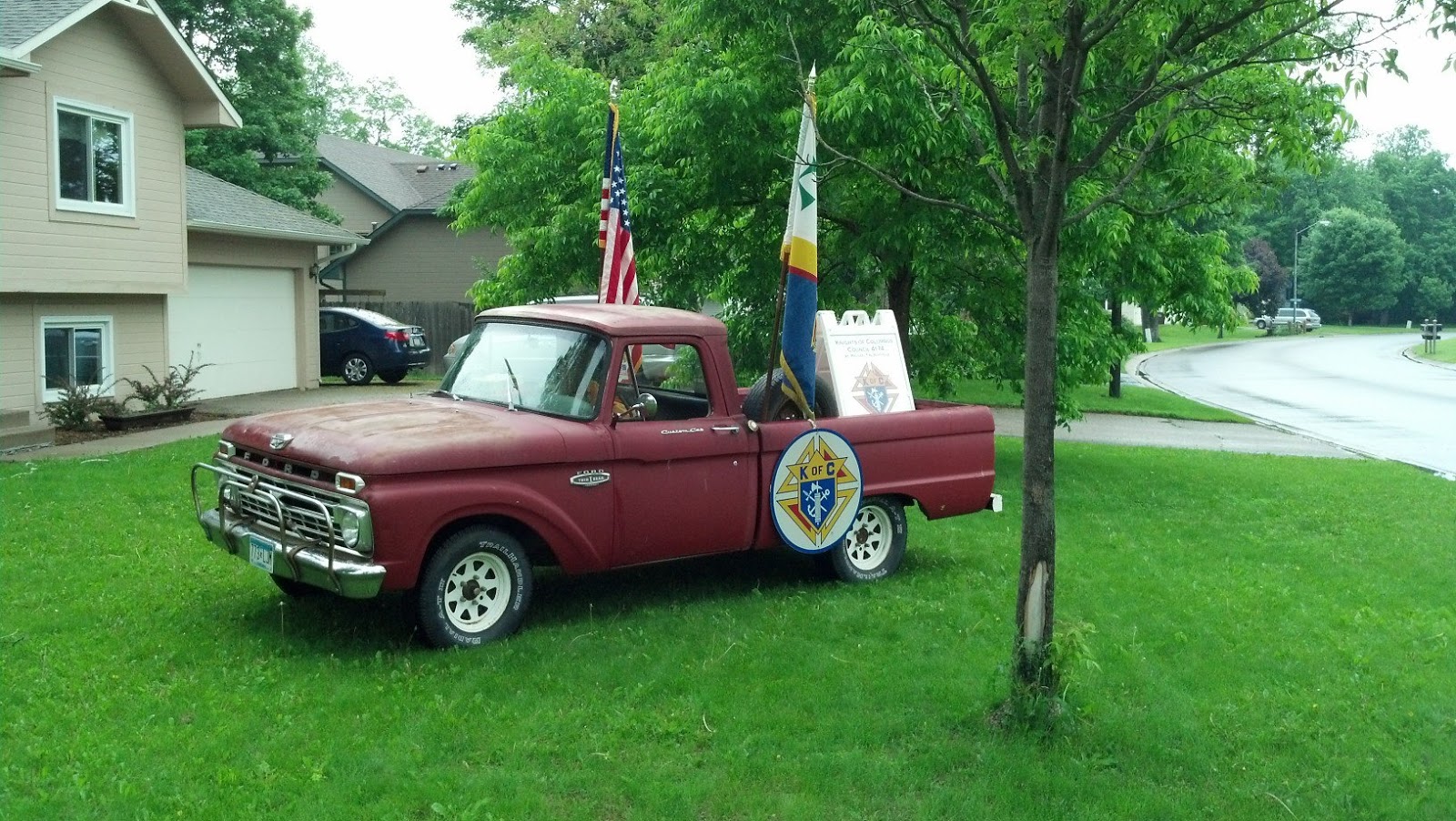
Rosa, ready to go.

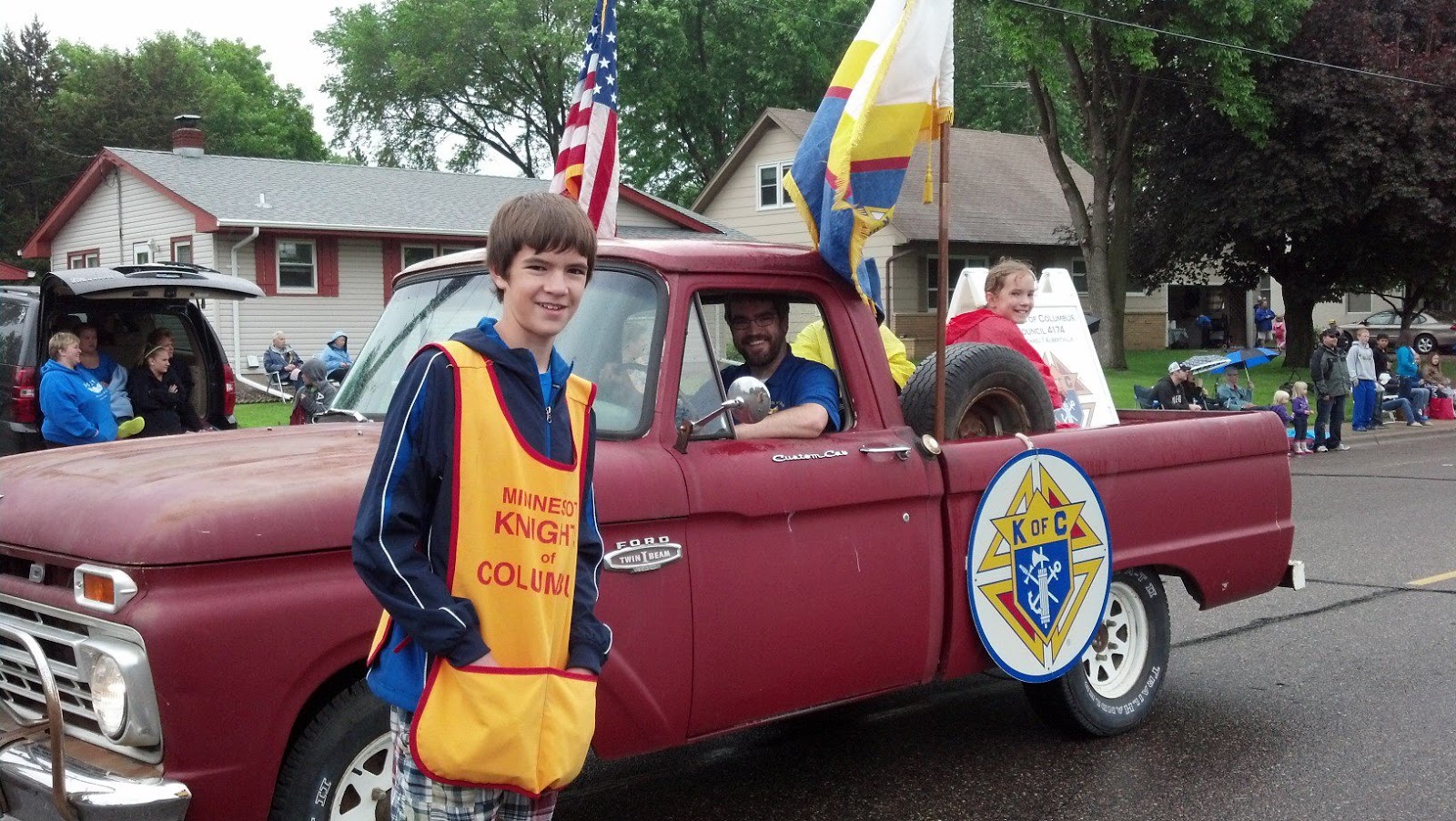
I took Rosa out for an afternoon on the town this past Sunday.  We appeared together in the Albertville Friendly City Days Parade, representing Knights of Columbus Council 4174, with fellow KCs and Catholic youth (including Bren, Gabe, Rose, and Trev) passing out Tootsie Rolls to the crowds.

Parade rest.

She drew a lot of looks and compliments, particularly among gentlemen of a certain age, who might have known someone like her in their younger days. The younger men took notice of both her beauty and her age and were respectful, save one young hoodlum, still red-faced and drowsy from the previous evening’s festivities, who bellowed, “C’mon, light ’em up! Let’s see what kind of power the old Ford’s got.”

Rosa ignored him entirely in favor of a little boy waving enthusiastically from the other side of the street. I leaned out the window, smiling, and said, “She’s got a 240 straight-six. This is about it.”

Show some respect, young man. She’s forgotten more miles than you’ve travelled.

Another young man, clean-cut with Buddy Holly glasses, looked her up and down and said, “’66?”

“Yup,” I said, and he nodded appreciatively.

Were she a woman, guessing her age would be considered uncouth, but for a pickup, it’s a compliment. What might be an adulterous attention to her curves and lines were she human is for Rosa a sign of her authentic, ageless beauty – she is noticed, not because she’s hot, but because she’s classic.

To that end, when we were preparing for the parade, I flew the flags and hung the KC emblems on the side, then grabbed the box of streamers, spangles, and bows left over from last year’s float. I looked from the box to pickup and back, then returned the box to the garage. She’s impressive enough in her own right. Who doesn’t love a modest girl who’s comfortable in her own skin?

Looks just as good going…

Advocating for Life-Giving Love

What can happen when you say “Yes”…

Blogger’s Note: The links below are to good stuff, but not necessarily kids’ stuff. Use discretion.

Probably the most transformation part of my conversion to Catholicism — not just going to church on Sunday, but full-tilt “this is who I am and how I try to live” conversion — has been the reorientation of my thinking on the topics of marriage, sexuality, and procreation. See, the Catholic Church is perhaps the one institution on Earth that has refused to divorce these three things from each other…and when Jodi and I were preparing for marriage, I was not entirely on board with that.

In the years since, my thinking has changed — and along with it, my life, my marriage, my family, my entire conception of who I’m called to be.

Now Jodi and I speak at retreats for engaged couples, sharing with frankness how we were, in fact, where they are — crazy in love, uncertain about parenthood, frightened by the Church’s teachings, and unready to “risk” a baby. (What an awful phrase, in retrospect.) We share the Truth we’ve come to know as best we can — but I’m always looking for new ways of going about it. And once in a while, I stumble across really good stuff.

So — if you’re struggling to understand or explain the Church’s teachings marriage and sexuality, check out these links:

  • NFP Doesn’t Work…You Have So Many Kids!: Read your Genesis: fertility is the original blessing from God — and if it ain’t broke, don’t “fix” it! This blog post hits the nail on the head with humor and truth to spare.
  • How Premarital Sex Rewires the Brain: a simple, biology-based explanation for why relationships that get too serious too quickly last too long, crash so hard, and hurt so bad.
  • After Steubenville: 25 Things Our Sons Need to Know About Manhood: a mother’s poetic and heart-wrenching response to the teen sexual assault that made national headlines.
Not long ago, an old friend asked if I still had big plans for my career, as a writer, or maybe running for office. He had known me years before when I used to daydream about such possibilities. I told him that these days, if I raise my sons to respect women and my daughters to respect themselves, I’ll have done alright. 
Some kids are too young to hear this sort of material — but as parents, when the time is right, we’ve got to share it. I firmly believe it’s the only way we can redeem the culture. I’m grateful that, judging from the links above, others feel the same.

Book Break: Captivity and Freedom

I recently completed two biographies of great Americans, set roughly two hundred years apart. Both books tell stories of oppression, resistance, and the struggle for freedom. Both are great books, in very different ways. I’ll offer a few quick thoughts on each, but in short: read them!

American Cicero: The Life of Charles Carroll
by Bradley J. Birzer

American Cicero tells the story of the bastard son of a wealthy colonist who is sent abroad for a Jesuit education, is formally named his father’s heir, and returns home to Maryland to become one of the early advocates for independence from Britain and one of the foremost shapers of the fledgling American republic. If you aren’t a history buff, you may not know (and if you aren’t a Roman Catholic, you may be surprised to learn) that in his day, Charles Carroll was well educated and capable (not to mention from the wealthiest family in the colonies) and could neither vote nor serve in public office — because of his “papist”tendencies and “Romish” influences. He is also portrayed as a devout Englishman who nevertheless saw independence as a necessary fresh start for the English constitution and English law, which were being usurped and corrupted by the government elected to uphold them.

Carroll initially took the public stage by writing under a pen name in the newspapers of his home colony of Maryland (the most anti-Catholic of the lot in his day), earned the trust and admiration of Washington, Franklin, and others among the founders, and outlived them all — and relatively few have heard his name. Here is a man who, with all his money, couldn’t buy a vote (and would never have tried); who advocated against democracy and in favor of a republic based on his reading of history and the times; and who drew on the ancient Greeks and Romans and his own faith tradition, as well as contemporary thinkers, to propose limits on the power of both the government and the “mob” in order to preserve those rights. In my review of Triumph: The Power and Glory of the Catholic Church, I asked if the author’s apparent preference for the monarchies of old was personal, or somehow tied to the Church — I think you can begin to see a sensible philosophical connection here, in Carroll’s dismay at the more populist, democratic leanings of some of his contemporaries. (This is not your high school’s American history!)

The author is the Russell Amos Kirk Chair in American Studies, Professor of History and Director of the Hillsdale College Program in American Studies,  and is also the author of  J. R. R. Tolkien’s Sanctifying Myth: Understanding Middle-Earth. Birzer tells the story as much as possible though Carroll’s own public writings and private letters, and this is an academic history, so it is not a breezy read.  Nevertheless, I thoroughly enjoyed getting to know this relatively unsung Founding Father. I enjoyed Birzer’s ability to connect Carroll’s thinking to his education and core values.  This book is well worth the effort!

For additional perspective on the book and the author, check out this interview with Ignatius Insight.

Unbroken: A World War II Story of Survival, Resilience, and Redemption
by Laura Hillenbrand

This is a true-life tale of Gumpian proportions: a young misfit from a working-class Italian family (complete with a doting mother and an impeccable older brother) graduates from thieving prankster to Olympic track star and meets Hitler in the 1936 Olympics. A gifted athlete (on track to be the first man to break the four-minute mile) has his athletic career cut short by World War II and becomes a bombardier on a B-24 in the Pacific Theater, surviving a temperamental plane, numerous missions, and long odds while enjoying the celebrity of being both an athlete and an airman. A World War II veteran endures weeks adrift in a life raft with two wounded comrades, battling starvation and dehydration, sharks, madness, and occasional strafing, only to come ashore in Japanese territory and become a prisoner of war. A POW is singled out by the Japanese for his celebrity and made to endure physical, mental, and emotional tortures for more than two years of captivity. A survivor of Japanese prison camps returns home and marries a vibrant, blue-blooded beauty despite warning signs that the war has taken a psychological toll.

Any one of these story lines could make a novel or a movie in itself — the fact that all of them really happened to one man is almost too much to be believed. Louis “Louie” Zamperini is still alive, 96 years old and active decades after he should have been dead so many times. He comes from an earlier time when track stars and airmen were celebrities, and, like Norman Borlaug, is an unsung Great American who should help us redefine “hero.”

Louis Zamperini

This is not a book for the young or faint of heart — the treatment of POWs by the Japanese is brutal and horrifying, and the book includes scenes of inhumanity you may not soon forget. In this respect, it called to mind two other books I wrote about not long ago — James Clavell’s Shogun and Shusako Endo’s Silence. I recall past conversations with previous generations about how veterans of the World Wars came home and went about their lives, but veterans of later wars began to report emotional scars and psychological impacts. The implication, in some of these conversations, was that men have softened — but Unbroken makes a distinction, based on historical data, between the mental health of POWs in the European theater and POWs in the Pacific theater. This led me to ponder whether, in wars with Eastern cultures, Westerners are encounter philosophies with such different rules (or no rules at all) that we are, in fact, ill-equipped to deal with them.

The author, Laura Hillenbrand, does great work writing a biography you can’t put down, with a level of historic detail that does not diminish the readability of the book, but lets you know that she did her homework. Internet evidence suggests Louie Zamperini’s story may soon become a movie. Don’t wait for the movie — you’ll miss the chance for a fresh read of an exceptional book.
Serious About Writing…

Back in early December, I announced that I was suspending this blog and taking it off-line. I likened my writing career thus far to standing on my head for show: requiring modest skill; impressive at first, then amusing, before becoming repetitive, uncomfortable, and unnatural. I even went so far as to declare, “ I won’t call myself a writer again until I write something worthwhile, and I don’t know what it will be.”

Those who know me well know I have a tendency to take myself entirely too seriously. I was in a bad spot at the time: way too busy at work, home, and church; unable to make a satisfactory start on the annual Christmas letter; and unhappy in my work. Some several things needed to give — but this blog was not one of them.

As a full-time husband, father, and director of communications, this little corner of the internet is one of the few places I actually do write stuff that people read. The people who matter most to me are here, but they aren’t the only ones — consider that this tiny, rhyming prayer is the most viewed post on my site, in large part due to readers (or skewed search results) from Russia. A favorite web site of mine, The Art of Manliness, posted an article awhile back entitled, “How a Man Handles a Miscarriage.” I read the post and the appreciative comments, before adding a comment of my own and sharing a bit about our little Jude. Men came and read, and though they left no comments, who knows whom it touched?

In fact, if I want to be truly serious about writing, I would not permit myself to be limited by the potential for monetary gain. A few weeks ago I was looking through the Catechism of the Catholic Church to see specifically what the Church teaches about property rights — and learned that while she makes no bones about supporting the right to private property, she is insistent that we steward our property and talents for the greater good:

“In his use of things man should regard the external goods he legitimately owns not merely as exclusive to himself but common to others also, in the sense that they can benefit others as well as himself.” The ownership of any property makes its holder a steward of Providence, with the task of making it fruitful and communicating its benefits to others, first of all his family.

Goods of production — material or immaterial — such as land, factories, practical or artistic skills, oblige their possessors to employ them in ways that will benefit the greatest number. Those who hold goods for use and consumption should use them with moderation, reserving the better part for guests, for the sick and the poor (CCC 2404 and 2405).

I read and re-read it: Goods of production, including practical or artistic skills, “oblige their possessors to employ them in ways that will benefit the greatest number … reserving the better part for guests, for the sick and the poor.”

A “serious” writer , then, should speak the truth, regardless of gain or loss, for the good of those who need to hear or whomever will listen.

It’s good to be back.