Book Break: Triumph

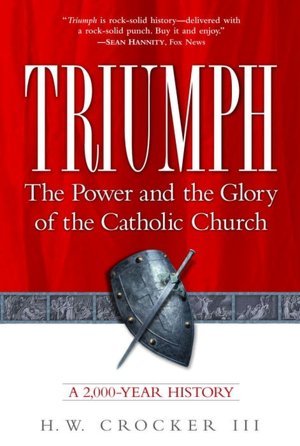
The title of this book tells you exactly what to expect. Triumph: The Power and the Glory of the Catholic Church by H.W. Crocker III was recommended to me by two or three different friends within a single month, which I found hard to ignore. It presents a well-referenced but “popular” history of the Catholic Church, written with a confident pro-Catholic bias, presumably for a Catholic audience. It was an enjoyable jaunt through the Church’s history, and it will give fire to the lukewarm. It will not, I predict, win the hearts and minds of many non-Catholic readers, should they choose to pick it up, because most will not finish it.

As I said, I enjoyed the book, but found it to be very uneven in quality. Of course, any history of an institution as old and rich as the Church cannot be confined to 427 pages without leaving out a few details. For the first half of the book, Crocker bounds through the centuries, focusing his attention on the most colorful or heroic defenders of the faith, painting a fascinating portrait of the Catholic Church ascending, but also justifying the shortcomings of its leaders in a way that borders on “the end justifies the means” at times, and dismissing sin within the Church as no worse than what was happening elsewhere, a standard I’m not sure Christ would have supported. This is not to say that the book is inaccurate — and historical context is important — but the ease with which war and wickedness are noted and discounted is disconcerting when we are called to be perfect, as God is perfect. If not perfect, we should at least be penitent…

Crocker’s unfiltered bias, wit, and sarcasm reach a fever pitch with Martin Luther and the Reformation. References to “the Hitler in Luther” and “Luther’s Khmer Rouge” suggest the author’s motivation is stirring Catholic pride and outrage rather than advancing scholarship in Church history. The criticism of Luther, Calvin, and other Protestant “fathers” is sometimes humorous, occasionally disturbing, and rarely if ever even-handed. I hope we would not tolerate a similar treatment of our priests.

The second half of the book seemed more balanced, although I’m curious if the support expressed for strong monarchies and an educated upper class over more democratic ideals is a true reflection of the 18th and 19th century Church or the author’s own preferences. I guess I have more reading to do in the regard. But the stance of the Church against the tide of liberalism, relativism, materialism, and all the other -isms encompassed in modernism did cause a warm swelling in my breast. There is wisdom in the Catholic Church, and an intellectual tradition that embraces the arts, the sciences, and the classics and needs not fear the world…if only more of us were better versed in it. I have made that a goal of my own, and Triumph provided further inspiration to pursue it.

This book is every bit as pro-Catholic as so many other accounts of world history are anti-. Personally, I would’ve liked to have seen more of the Church’s intellectual tradition itself in the book, and less of characters, wars, and political intrigue. I’d love to hear your thoughts on it, but if you read it, know what you’re getting into — especially if you are Protestant!
Book Break: How We Decide

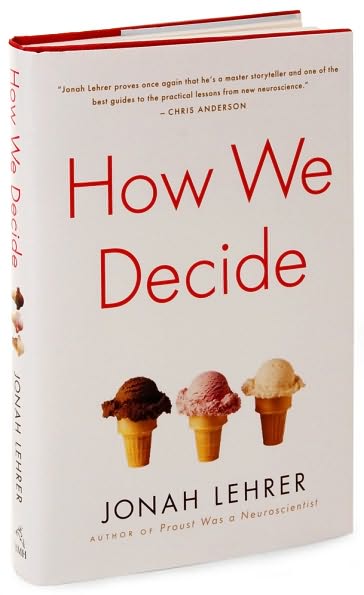
My latest work reading, completed just this week, was Jonah Lehrer’s How We Decide, an engaging and easy-to-read account of the brain science (as we currently understand it) behind our decisions. Drawing on ancient philosophy, modern psychology and neuroscience, and examples as diverse as military conflict, professional sports, gambling, and shopping, Lehrer exposes the strengths and weaknesses of our emotional and rational thought processes — and shows each to be inadequate without the other.


The book was a relatively quick read, understandable and action-packed, which is not always easy to achieve when writing about science. The stories used to illustrate key strengths or weaknesses of the ways in which we think are sometimes suspenseful, sometimes tragic, and always fascinating, and several times I saw myself in the concepts illustrated by the book: recognizing what I would do in a situation before I know why; looking for patterns where there are none; over-thinking in some cases, and making snap decisions in others that prove to be simply (and obviously) wrong. 


One of the more fascinating discussions, given the endless run-up to the 2012 elections, is the problem of confirmation bias, which stems from our own certainty and our resulting tendency to discount opposing evidence and emphasize that which supports our biases. Even among “non-biased,” so-called experts — for example, seasoned political journalists and commentators — the problem of overconfidence in one’s expertise causes their predictions about political results and world events to be worse than random chance. (The Wall Street Journal ran an article by the author explaining this in more detail.) Another had to do with a phenomenon called the anchoring effect, in which the brain stores potentially meaningful information that can unconsciously influence unrelated decisions. This was illustrated by an experiment in which participants were asked to recall the last two digits of their Social Security number, then were asked to write down the maximum amount they would pay for a variety of diverse items up for “auction” — and subjects with numbers on the higher end of the spectrum (00 to 99) recorded bids that were on average 300 times higher than those on the lower end. (This is the effect exploited by car dealers who post an inflated asking price on a car, which will invariably be reduced, but also subconsciously raises the amount you’re willing to pay.)


If you read Malcolm Gladwell’s The Tipping Point or Blink, you know the type of book this is. I found The Tipping Point interesting, and Blink a bit more personally revealing and useful — this book snatches the ball from Blink and runs with it. I recommend it highly, with only one caveat: the chapter on moral decisions, I think, makes a mistake in straying from psychology and brain science to comment on religion, but only shallowly. Lehrer points out instances in which the rational parts of our brain, left to their own devices, fail in making or explaining moral judgements. Often we just “know” right from wrong. He makes no real attempt to explain this “knowing” in a scientific way, aside from a vague reference to “basic primate morality” that evolved as primates became more social creatures and became aware that causing pain in another of their species was somehow bad for both the victim and the social group in general. He then dismisses religious morality as mis-ordered: 


“Religious believers assume that God invented the moral code. It was given to Moses on Mount Sinai … But this cultural narrative gets the causality wrong. Moral emotions existed long before Moses. They are writ into the primate brain. Religion simply allows us to codify these intuitions, to translate the ethics of evolutions into a straightforward legal system.”


In addition to the laughability of a “straightforward legal system” based on Judeo-Christian religious values in this day and age, there is a bigger problem here. Lehrer is mistaken to think that the faithful believe morality was invented by God at the time of Moses — as though He were just some wise and benevolent being who showed up on the scene and tried to help Moses and the Jews out. Lehrer misses the transcendence of God, in which creation, order, love, and justice are all of a piece, and he misses the chance to discuss the concept of Natural Law, another (and perhaps better) explanation for what he calls “moral emotions…writ into the primate brain.”


Even so, this chapter and the entire book are compelling, thought-provoking, and even entertaining at times — read it if you have a minute.

Living with Unbelief

“The new rebel is a Skeptic, and will not entirely trust anything. He has no loyalty; therefore he can never be really a revolutionist. And the fact that he doubts everything really gets in his way when he wants to denounce anything. For all denunciation implies a moral doctrine of some kind; and the modern revolutionist doubts not only the institution he denounces, but the doctrine by which he denounces it. … In short, the modern revolutionist, being an infinite skeptic, is always engaged in undermining his own mines. In his book on politics he attacks men for trampling on morality; in his book on ethics he attacks morality for trampling on men. Therefore the modern man in revolt has become practically useless for all purposes of revolt. By rebelling against everything he has lost his right to rebel against anything.” – G.K. Chesterton

I have a friend from high school – an intelligent and articulate husband and father who reads widely, is well informed on a wide range of issues, and is fearlessly outspoken. I admire these things about him. He is also the closest to a conspiracy theorist of anyone I know. He appears to be skeptical of the government, the media, and the motives of nearly everyone he encounters who is unknown to him or disagrees with his perspective. I can live with that – but I can’t live like that.

In the Ben Stein documentary Expelled—a interesting film with numerous serious flaws, in my opinion—one of the atheist academics says that he rejects the idea of a higher purpose or meaning to the universe, and indeed, rejects free will. He has suffered a brain tumor, and says if it comes back, he will shoot himself in the head.

My first thought was, “Will he?”

How does he know? What if the chemicals and synapses line up differently? What if his neurons compel him to look into the sight organs of those of his species with whom he has chemically bonded, and some subconscious part of his brain gives rise to the unbidden hallucination that these “others” matter to him? Will he override those impulses, knowing that they are false and irrational?

I suppose he won’t. He has no free will, so he can’t override anything. I’m not sure how he professes to believe anything. His choices (er, potential life paths) are two, as far as I can see: either choose nothing, ever, to see whither his impulses lead (they will perhaps compel him to eat, drink, breed, and die, like an animal) or to insist upon his beliefs, but act otherwise – to live as though he had decisions to make, even as he says he doesn’t. He will regard this as perfectly rational. And if he kills himself, those who love him shouldn’t mourn or blame him. It’s nobody’s fault.

I see a similar (not identical) problem with the diehard skeptics and conspiracy theorists. It is reasonable, especially these days, to look around and think the deck is stacked against us. It is prudent, then, to proceed with caution and with our eyes open, doing our best to build a good life, and protect what we have and those we care about. But how much is too much? When you see the government, and those who are wealthy or powerful, and the political structure, and the healthcare system, all as false or corrupt; when you are ready to quit participating in government “of the people,” however flawed it may be; when you are skeptical of transcendental Truth and dismissive of religion – what’s the next step? Secession? Revolution? Or marriage? Can you justify bringing children into such circumstances? I admire my friend’s tenacity in uncovering possible lies and conspiracies, but how, then, does he live his knowledge? On which false information does he act? And what will he teach to his children?

In my college days, I called myself agnostic, thinking this was the most intelligent way to regard God. After all, how could anyone know the unknowable? Only later did I realize that I was hedging – that I didn’t have the courage to believe in God or not. I found, over time, that I could not disbelieve and believe at the same time. I could claim to be an agnostic, but I had to live as a believer or a non-believer.

Devout skepticism, like hard determinism, diminishes the possibility of a credible life without contradiction. The diehard skeptic knows only that he’s skeptical – everything else is uncertain. But I suspect that my friend, like me, has made his choice. He’s a good man, a devoted husband and father, and he genuinely cares about others. He must see something of value in this world, in this country, in his marriage and family, which makes him persist in the face of his doubts. Is it God? Love? Freedom? I don’t know. But he doesn’t behave like an unbeliever. I believe he wants to make the world a better place – and to that extent, his heart is a believer’s heart. It’s a step – forward, in my opinion.

Life In The Bubble, Redux

We had some friends over last Friday evening for a fall chili feed. The week was busier than we’d hoped, so up until the moment our guest began to arrive, we were still cleaning, cooking, and prepping…plus managing our kids, our dog, and our jobs. With 30 minutes to go, I was sincerely wondering if this little “get-together” was gonna be worth the effort.

Our friends began to roll in, bearing snacks and sweets, beer and wine, to complement the spread we had started in the kitchen. These were all our friends and all from St. Michael Catholic Church — and most of them knew many of the others, but I’m not sure if anyone but Jodi and me and Fr. Richards knew everyone. We said grace as a party, sampled chilis and home-brewed beers, and talked about kids (had we invited whole families, the dozen or so couples would have had more than 70 children in tow), work, school, politics, hunting, and most importantly in The Bubble, our shared faith. The men ultimately congregated in the basement, and at one point, I walked in to hear a good friend of mine relating how, at a retreat, I once stopped mid-witness, smacked by the Holy Spirit, tearful and trembling and grinning, to tell the men on that retreat, “You guys gotta try this!” Upstairs in the kitchen, three or four life-giving women of our parish were gathered near the sink I was trying to access, talking frankly about how God’s will manifests itself in our lives. I listened a moment, then quietly said, “I love you people.”

From 6:30 to midnight, our house was packed to the rafters with beautiful, prayerful men and women. Father was the first to head home, but he blessed us, upstairs and down, before he left for the night. There were friends missing — some who were going hunting or had other obligations, some we forgot in our own whirlwind of busy-ness, some who live states away in their own little bubbles — but we spent the evening basking in personal warmth and genuine love, and even the ache of their absence helped us to feel complete.

Was it worthwhile? Definitely. Scarcely a waking hour has passed since that I have not paused a moment, thought of one of these dear friends, smiled, and said, “I love you people.” And I do. We hope this will become an annual event, and we will do our best to invite all the others…

I’ve always been a big-headed, geeky, heart-on-my-sleeve kind of guy, with no athletic talent, a poor sense of direction, and few other manly aptitudes upon which to hang my hat. I’m old-fashioned, idealistic, and a hopeless romantic. I write for a living; I don’t follow sports closely; and I don’t drink much or tell off-color jokes (anymore). Often I feel like I don’t fit in. Except here, in The Bubble. Here, Jodi and I have met men and women, our brothers and sisters in Christ, who understand exactly where we’re coming from, and what we hope to be.

What a blessing. What a life.