Burning Love

Last weekend, to celebrate the end of summer, we had a little campfire in the backyard. I had thrown an old birdhouse onto the fire, which was finally beginning to break down, with flames of blue, and yellow, and orange. It was a beautiful night, and for the first time in ages, we all sat and did nothing but visit with each other: about the coming school year, the dancing flames, the smoke rising to the stars. 


Then Gabe said something curious: “There’s a flaming heart in the fire.”


It was the remains of an old barn-wood board from the birdhouse. Emma saw it, too, and noted that she was, at that very moment, wearing her “Burning Love” t-shirt, featuring a red heart like a torch and St. Paul’s words from 1 Corinthians 13:4-7:


Love is patient,
love is kind.
It is not jealous,
is not pompous, it is not inflated,
it is not rude, it does not seek its own interests,
it is not quick-tempered,
it does not brood over injury,
it does not rejoice over wrongdoing but rejoices with the truth.
It bears all things, believes all things, hopes all things, endures all things.


We were marveling at this coincidence, when Trevor noticed something else. “Look,” he said, “there are three nails in it…just like Jesus.”


Sacred Heart of Jesus, we entrust our family to You. Look down upon us and reveal to us the treasures of love, goodness, and grace in Your Heart. Forgive our sins and fortify our weakness, that we may serve You faithfully as You deserve. These favors we ask for ourselves and for every family in our neighborhood and homeland. Heart of Jesus, pierced by a soldier’s lance on Calvary, be our refuge in life and our gateway to Paradise. Amen.


(Pro) Life, Without Religion, Part 2: A Little … Something

Inspired by recent ultrasounds of our tiny child resting peacefully in utero, last month I shared my response to a common abortion-rights argument: “It’s my body; it’s my choice.” In that post, I argued that, in no way could an embryo or fetus be considered the mother’s body, or even part of the mother’s body.

The question remains, then: what is it? A few possibilities come to mind: it may be a bit of foreign debris or tissue; it may be a tumor (benign or malignant); it may be nonhuman organism (like a parasite or symbiotic microorganism); or, it may be Homo sapiens – a human organism. I’ll address these possibilities one at a time:

  • Foreign debris or foreign tissue. If an embryo were nothing more than a bit of foreign matter that had somehow found its within the woman, it makes sense that her body would respond accordingly, targeting the embryo in the same way it might a sliver or a piece of shrapnel, either to eliminate it from the body or encapsulate and neutralize it. Of course, an embryo consists of living cells, so the body does not react to it as thought it were a simply a foreign object. If an embryo were living, foreign tissue, it makes sense that the woman’s immune system might react negatively to it, in the same way that it might reject a donor organ. In fact, in the vast majority of cases, the woman’s body does the opposite, suppressing it’s own immune system and laboring to provide a protective, nurturing environment and nutrients to encourage growth and development of the embryo. It is true that in certain cases (e.g., an Rh-negative mother carrying an Rh-positive fetus), the woman’s immune system may react to presence of Rh-factor in the fetus’s blood, sometimes leading to death of the fetus – however, most of the population (approximately 85 percent, I believe) is Rh-positive, so such a reaction is certainly not the norm. Nor does it change the fact that the woman’s body continues to try to accomodate the fetus even as antibodies in her blood attack the fetus’s red blood cells.
  • Benign or malignant tumor. I’ve heard it more than once “It’s just a ball of cells.” Actually, I did a little reading for this post to help ensure I’m using the right terminology, and learned that tumors are more commonly defined as a neoplasm that has formed a “lump” – and a neoplasm is a new and abnormal growth or proliferation of cells not coordinated with the body’s healthy tissue. Is an embryo a neoplasm? It is certainly a new proliferation of cells, but typically (left to its own devices), its growth is in clockwork coordination with the healthy tissue around it; in fact, the surrounding, healthy tissues of the woman’s body (left to their own devices) change to become more accommodating to the new growth – again, encouraging growth and development. To quote Arnold Schwarzenegger in Kindergarten Cop: “It’s not a tumah!
  • Parasite or other nonhuman organism. An embryo or fetus certainly derives nutrients and protection, and at some cost the woman in whose body it resides – but is it a parasite (like a tapeworm) or some other symbiotic nonhuman organism (like our gut flora and other bacteria that exist on or in our body and are beneficial or neutral to our health and well-being)? First, consider that non-human organisms (parasitic or otherwise) are not native to us nor do they spontaneously generate within us. Instead, they are acquired. Even our gut flora are acquired at birth and rapidly afterward, from our mothers and the environment. An embryo, on the other hand, is not something caught from another person or acquired from the environment which then colonizes the uterus. And while it takes the introduction of a male gamete to fertilize an egg and ultimately form an embryo, even sperm cells cannot be considered parasites or symbiotic organisms – they have a short-life span and cannot reproduce themselves or “colonize” the woman on their own; those that do not fertilize an egg ultimately die off and are eliminated.
  • Human organism. To review, start where you like: a zygote, an embryo, or a fetus. Clearly these are not non-living things; they are living cells that use nutrients and multiply. If it were merely foreign tissue or an infection, the woman’s body would work to destroy it – no abortion necessary. If it were a parasite or symbiotic organism, it would be acquired externally, not formed internally from two cells whose sole function is reproduction. Now, consider that when a sperm and egg unite and form a zygote, the result is genetically identifiable as human – 23 pairs of chromosomes is the norm, but even some variation in this number (as in the case of Down Syndrome), when permitted to develop, can result in a viable independent organism that we would recognize as human. Some will argue that a skin cell, or an eyelash, or a cancer cell might be alive and genetically human, but we kill those all the time; certainly that isn’t murder, is it?  Of course not. But as we’ve already established, an embryo clearly is not any part of the woman’s body (it’s not even a genetic match) nor is it a tumor (it is developing in coordination with the woman’s body and the result will be a viable, independent human organism). Without a doubt, an embryo is a living, human organism.
Even some abortion supporters make it this far. At this point, the arguments become much more philosophical: abortion supporters claim is that this human organism is not a human being – it is a genetically human living thing, but only a potential human being. This raises a fundamental question: What makes a human organism a human being? I’ll share how my pre-religious mind tackled that question in my next post on this topic.

The Second Third, Week 38: Being Cross Versus Bearing Cross

I’ve had a number of conversations in recent months about the delicate ethics and art of downsizing one’s list of Facebook friends. Some are aghast that I would ever do such a thing; others wonder why I would accept the Facebook friendship of someone I might later “unfriend” in the first place. I try to assure them that, in most cases, it isn’t personal. I generally accept friend requests from anyone I am acquainted with; if, after the initial reconnect, we appear to no longer have anything to say over a period of several months, I may unfriend them. “Unfriend” is an unnecessarily harsh term – as I see it, we are just as close as we were before Facebook; we just don’t have to wade through extra content not meant for, or meaningful to, us.

In a few rare instances, however, I have unfriended folks on Facebook because being around is just too difficult. Perhaps our views are so different that I find myself constantly biting my tongue to not start a fight. Perhaps they expect too much interaction, when I don’t feel as connected or close. And truth be told, this happens in the real world, too. The older I get, the more disinclined I am to spend time around people who inspire tension or unease in my life.

I struggle a bit with this. Occasionally, I’ll feel an “unfriendly” impulse, only to, upon further reflection, realize that I am simply being impatient or selfish, and that I must take a deep breath and respond to this person as all people deserve..with love. But it’s a fine line between bearing a cross and loving my neighbor or my enemy, and simply being cross – enduring the company of a person who, without reservation or apology, pushes all my buttons and brings out the worst in me, to the chagrin or detriment of those for whom I care.

The other day I left my office and walked to rest room, passing, in the process, a person who had long been a thorn in the side of my colleagues and I during a previous job. With welcome relief, I noted that my blood pressure didn’t rise when I saw our former adversary; in my new role, these past conflicts were no longer relevant, and so the person was just a person, and I was free to have no opinion.

That, to me, is what I hope to better embrace in my Second Third: who to embrace, who to avoid, and when to gracefully bow out and feel free to have no opinion. I hope the latter option because increasingly prevalent, because each of the former two is exhausting in its own right.

The Adjustment Bureau

A young, popular New York City politician suffers an unexpected electoral defeat. Suddenly he finds himself face-to-face with the girl of his dreams – a strange woman he’s never met before – in an unlikely place. Their time is short, the attraction is palpable enough for a sudden, passionate kiss, interrupted by campaign staff. She exits quickly. He has only her first name and these few moments. He delivers the speech of a lifetime, and from the jaws of defeat, snatches superstardom and frontrunner status for the next open Senate seat in New York state.

In a city as vast as this, he could never find this beautiful stranger using only her first name – but chance throws them together on a city bus, and it’s clear this is something special. Too special, in fact. He was not supposed to see her again. A group of grim, dark-suited G-men snatch him from his workplace to inform him: they are with the Adjustment Bureau, and this love affair not in The Plan. Whose plan? The Chairman’s – but you know him by many names.

What follows is a fast-paced, but coherent sci-fi romance that turned out to be the perfect mix for my bride and I – with Matt Damon doing a low-key Bourne, trying to outsmart and outpace adversaries who are nearly (but not quite!) omnipotent and omnipresent, and who are bent on keeping him from what he feels sure is true love. More than once he is ripped abruptly from Emily Blunt’s life, re-finds her, and works to regain her trust, unable to tell her what’s really going on.

It’s a solid, entertaining movie, with some language and sexuality (including two instances of a word neither Jodi or I thought was permitted in PG-13 films). And it’s thought-provoking after the fact: at one point, Damon’s character asks a more sympathetic “adjuster” if they are angels. This is not an idle observation, since the underlying problem in the movie is the problem of free will versus predestination. The film proposes a world in which beings who are less limited and more powerful than humans direct the world according to a grand scheme they themselves do not entirely comprehend. From what little I’ve read, this is in close keeping with Catholic traditions and teachings about angels – except that in the film, the adjusters suggest that they function to override human free will, which, unfettered, produced the Dark Ages and the World Wars, but with their guidance (i.e., free will only with regard to small, day-to-day choices), yields peace, happiness, and productivity. (Hmm…that sounds familiar.)

I don’t believe angels, according to Catholic teachings and belief, have the option of taking free will from us. They operate more subtly and keep the world operating according to plan…but we still choose. We make our beds, and we lie in them.

In the film, the very aggressiveness and implacability of the adjusters seem to increase our hero’s resolve and drive him to his climactic decision and the film’s resolution. It’s almost as if the adjusters themselves are off-plan…and as if that, in fact, is part of the plan.

(Pro) Life, Without Religion, Part 1: It’s My Body!

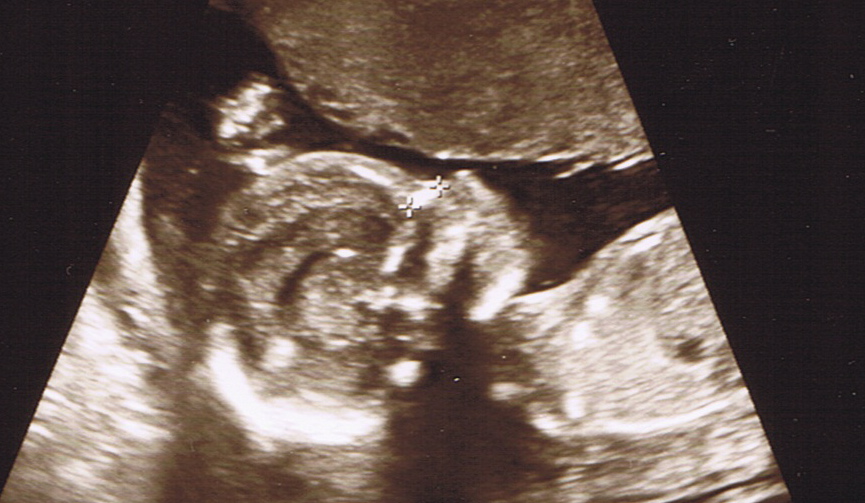
This morning Jodi and I saw the face of an angel — our angel, a tiny new Thorplet, just 11 ounces now at 18 weeks of development. Our baby pulled away from the attempts to examine his or her feet, just like all of our children, but otherwise kept uncooperatively still, making it difficult to get a good look at the tiny, chugging heart. When the sonographer was finally finished her thorough examination, she took the photo above: a tired wee child, hand above head, resting peacefully.

I’ve always loved ultrasounds. In part, it’s the geeky wannabe scientist in me, but mostly, it’s the wonder and sweet jealousy of seeing our tiny baby alive and safe inside the love of my life, and knowing that yeah, I can pee standing up, but I’ll never feel life moving within me. This was a level-2 ultrasound: given my bride’s so-called “advanced maternal age” (I wouldn’t begrudge her a right cross next time someone says that…not this time, but next time…) they offer it as a way of taking a closer look at how both the baby and the mother are progressing. We turned down all the other tests and genetic screening, but taking a closer look at our little one and Jodi, especially given the size of our babies, seemed like a good idea.

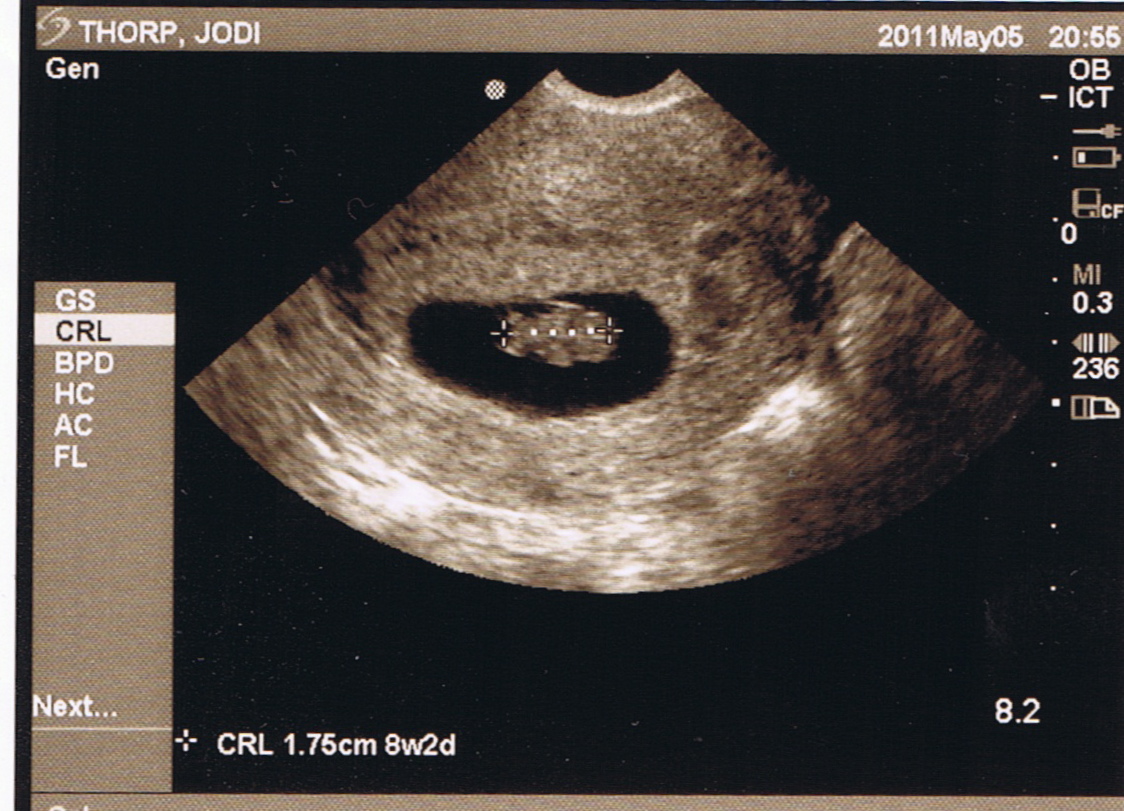
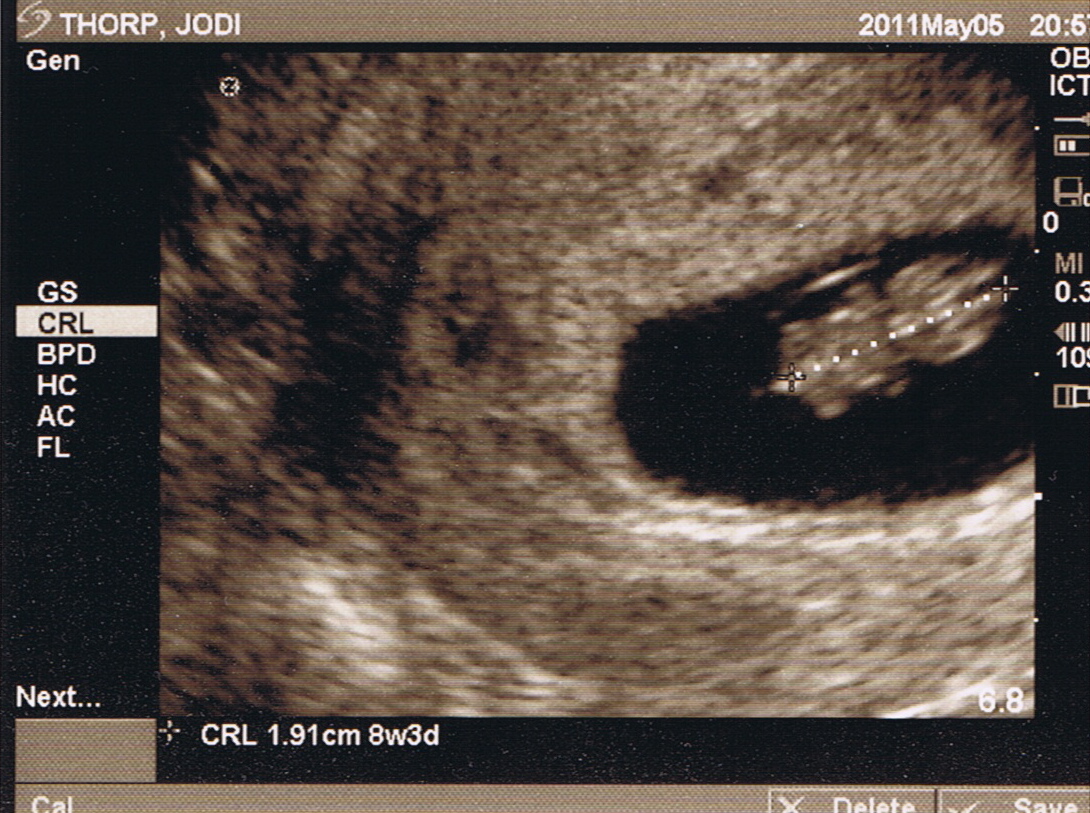
The photo above was the highlight of the hour or more we spent in a dimly lit room with the sonographer. It was worth the wait, but to be honest, I was more excited about these two images:

These show our baby at just eight weeks of development. We’re looking down on him or her from above, with an absolutely Thorpian head to the right, and a torso with four tiny limbs extending to the left and down in the lower image. This was a thrill, not only because we lost a little one last fall and were hoping for an “all systems go!” from our doctor, but because there on the screen was a tiny person, less than two centimeters long, with a beating heart and legs and arms that moved independently of any thought or command from Jodi or me. A child the size of my fingertip who, just before Christmas, we will be blessed to welcome and trusted to raise.

Some people say miracles are impossible; others believe they happen, but only rarely. I believe miracles happen daily, all across the world. I’ve got photographic proof.

As we drove home from the earlier ultrasound, I was reminded of an extended argument I had once, on a political blog in South Dakota, with a staunch and pseudonymed liberal who dismissed me and two of my friends as Bible-thumpers for being against abortion. I explained to him that, on the contrary, I studied physical anthropology and human evolution in college and was anti-abortion well before I became a practicing Catholic. I articulated to him a set of arguments against abortion, completely independent of religious belief or church doctrine, and asked, then begged, then dared and taunted, him to engage me on them. He would not.

What came back to me as we drove home was the first argument I offered to him. As I recall, he insisted, on behalf of women everywhere, that “It’s their body; it should be their choice.”

“Which part of their body is it?” I asked.

An abortion removes something from a woman’s body, without a doubt. If what is removed is her, or some part of her, then it should share both her gender and her genes, and she should be somehow physically diminished, something less than the whole and functional woman she was before the procedure. If she had her gallbladder removed, for instance, or a toe, a mortician or coroner might note such a thing upon her death.

A woman who has a “successful” abortion, however, emerges physically intact, but no longer pregnant. What is removed, though taken from within her, and attached to and dependent on her, is not her — not genetically, and not logically. (In my online arguments, I moved from what a fetus isn’t, step by step, to what it is, over several exchanges. In time, I think I’ll do the same here.)

This was made clear again to me when I saw our tiny infant, wriggling in amniotic bliss, at eight weeks of development. Jodi had no say in the flailing of those tiny arms and legs, and that tiny heart beat in part because of, but not for, her. No choice on her part, short of violence, could have stopped it.

And of course, it was made clear yet again today when we saw that beautiful profile at the top of this post. There’s a reason that the Knights of Columbus and other Catholic and pro-life organizations are investing in ultrasound machines for clinics and teaming with expecting mothers to show live ultrasounds of their babies to middle- and high-school students. There’s no better way to recognize the humanity of others than to see them face to face.