Road Trip Review, Part 3: What We Saw

We saw 12 states on our road trip to and from the Keys: Minnesota, Wisconsin, Illinois, Kentucky, Tennessee, Georgia, Florida, Mississippi, Alabama, Arkansas. Missouri, and Iowa. We saw mile after mile of beautiful woodlands, farmlands, and ranch lands that grew greener and greener as we travel south, and one long strip of hard gray asphalt littered with local fauna.

Most prevalent among the roadkill corpses were armadillos: we began to see them in Tennessee on the downward trip, and left off again in Missouri, I believe. Scores of dead armadillos, and nary a live one — when they venture out and whether they are overconfident in their armor or just that thickheaded, I’ll never know.

The armadillos appear to be substantially less bright than even iguanas: in the Keys we saw countless big green lizards along the highway, and only one dead: a brilliant green juvenile hit by the car in front of us. (We also saw one run across a dusty parking lot in front of a car, and if you ever see an iguana running full-tilt, its four legs windmilling from its sides, you won’t forget it!)

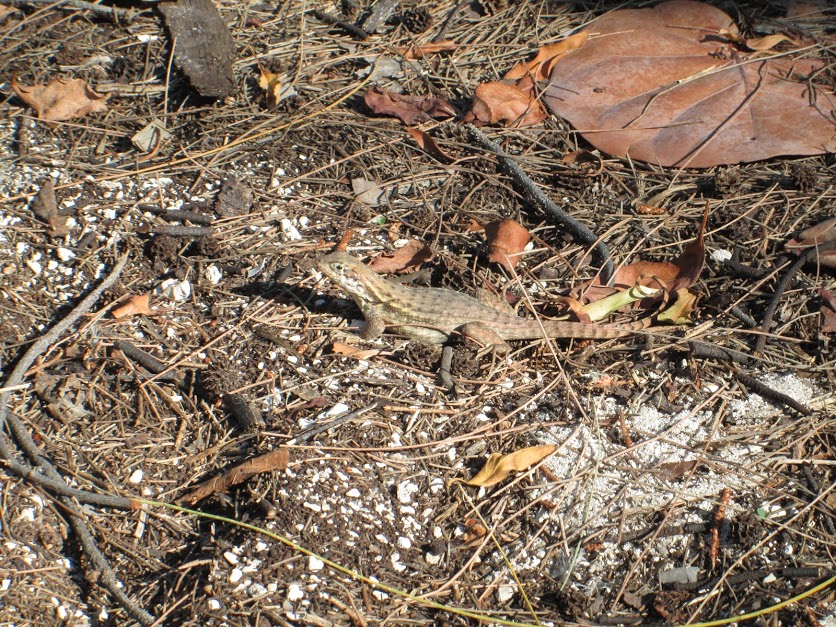
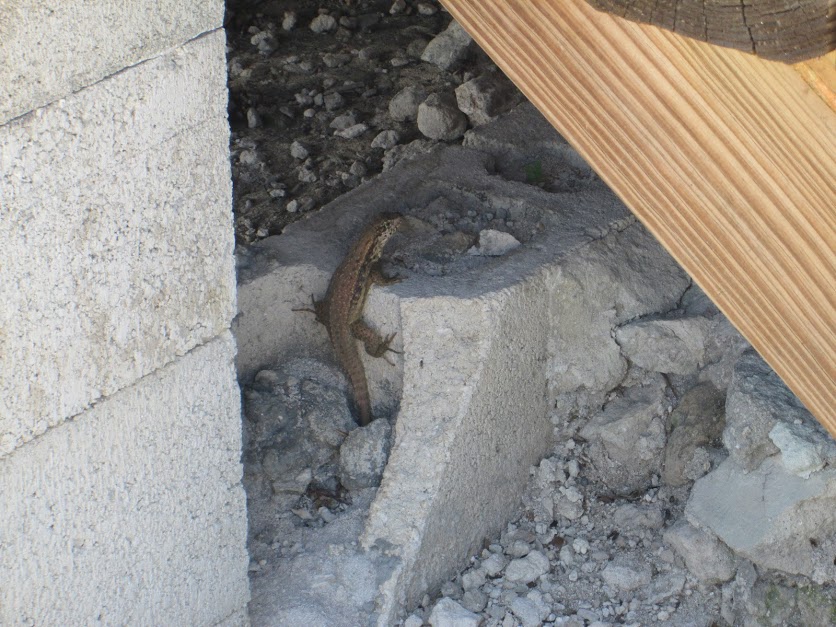
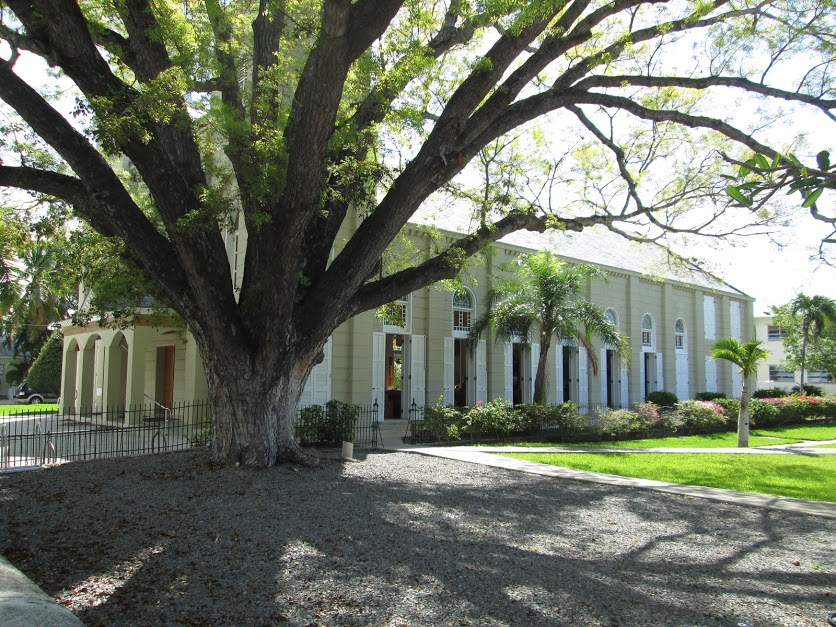
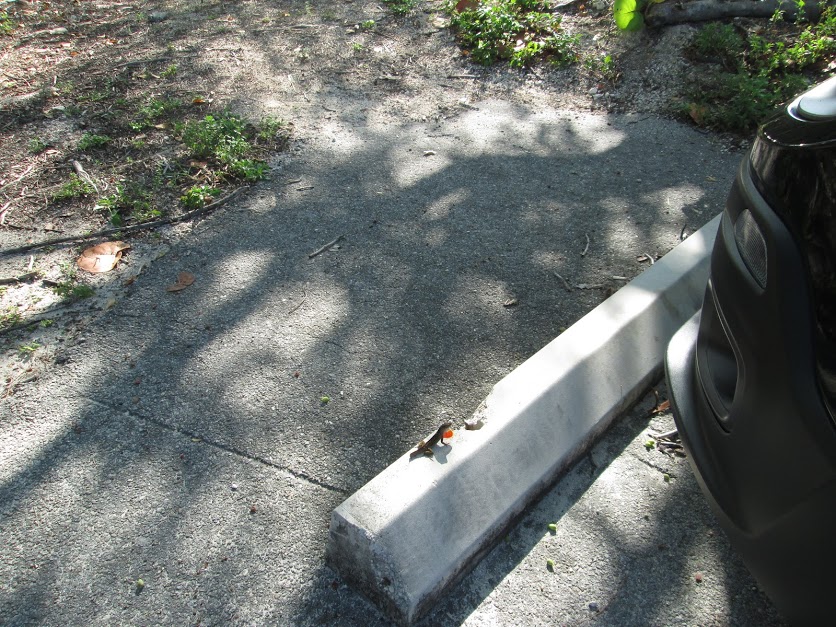
As a former lizard lover — I had an iguana named Ike as a teen — this was a thrill, but although we saw a couple up close, either we didn’t have a camera in hand or they were too hidden for decent shot. We also saw numerous brown anole lizards (my first lizard, Zeke, was of this variety; a family member brought him home, probably illegally, from Florida when I was in middle school) and a couple of curly-tails (my second lizard, Max, was a captive-bred curly tail) — and the kids spied a green anole outside the the Basilica of St. Mary, Star of the Sea, on Key West. (Click photos to enlarge.)

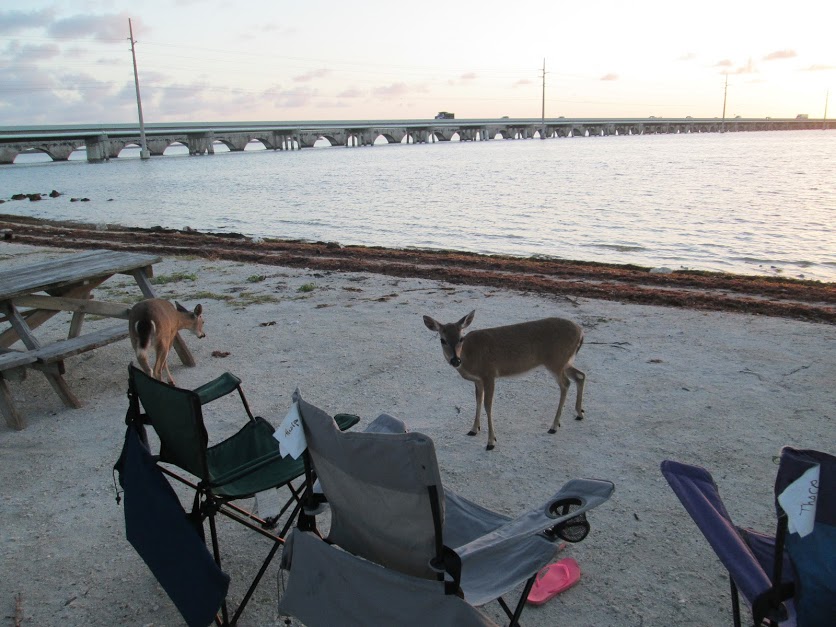
We saw countless species of palm trees. We saw the Key deer mentioned yesterday, of course, including a little velvet-antlered buck, and an endless variety of birds, from the ever-present grackles, crows, and buzzards, to a crowing parade of roosters and clucking chickens on Key West, to black-headed gulls, brown pelicans, American white ibises, and countless other sea birds. We saw endless horizons of grass and water, and signs warning us of bears and panthers crossing. We saw great everglades turtles sunning themselves on the road’s edge.

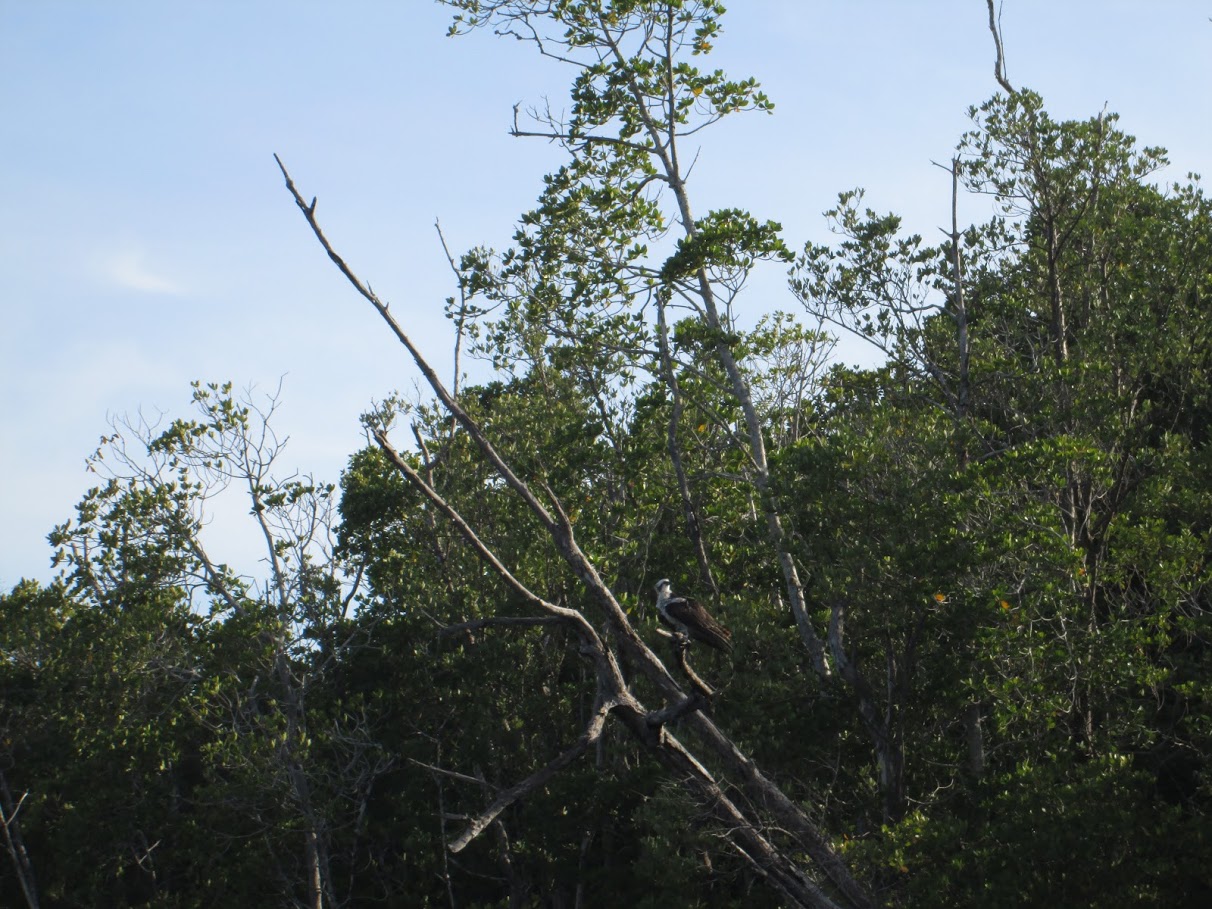
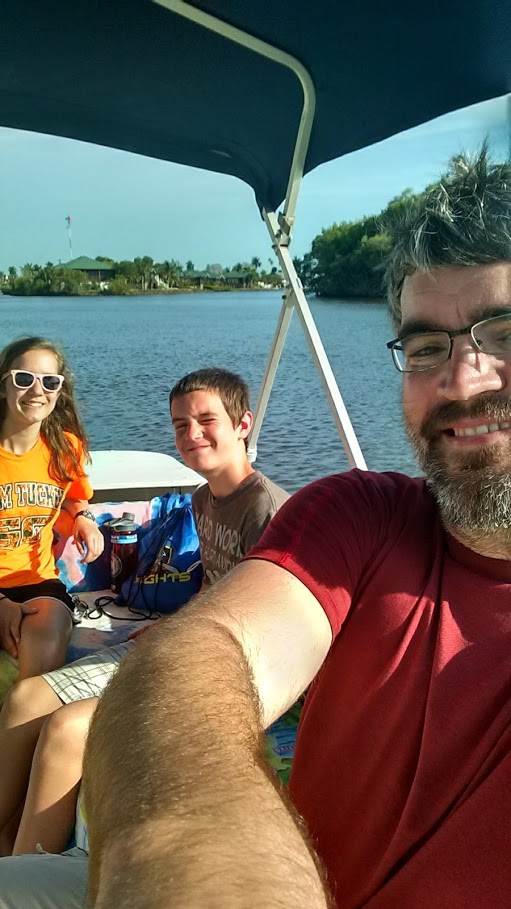
Our Everglades boat tour warrants special mention for wildlife, of course. We discussed the typical airboat tour, but the kids wanted to go whale-watching, too. Airboat rides are noisy affairs, and gators being relatively prevalent (we saw a half-dozen in the canals along the highway to Everglades City), we opted for a sunset tour with Allure Adventures through the maze of mangrove islands and out to the Gulf. It was just the three of us and Kent, our guide and captain, and before we even left the dock, he spied a manatee surfacing in the river beyond. We got three brief glimpses of the great sea cow as it moved quickly down the river — they move surprisingly fast for their bulk! As we set out on the boat, we saw an osprey eating a fish, and shortly after we emerged into the mangroves, we saw a pair of dolphins hunting in the shallows among the mangroves — again, only fleeting glimpses, as they were too focused on food to jump and play in our wake. (And again, it was amazing how quickly they could move, in this case, in water only a few feet deep.)
Captain Kent then took us to a stretch of Everglades National Park beach accessible only by boat, with the most amazing powdered white sand (a luxury for tired feet) and the rattle of thousands of seashells with every wave that touched the shore. This island was essentially a sand bar built up along a knot of mangroves, trees with aerial roots that reach down into the water, so that most such islands have no soil at all, except the sea bottom. We saw raccoon tracks in the sand: the only land animal that lives on these mangrove islands, the raccoons down there are not nocturnal, but tidal, according to Kent — they feed at low tide, whatever time of day. We also saw conch shells large and small (illegal to harvest), a horseshoe crab carapace (likely the raccoon’s meal at some point), and a couple dead starfish awash among the seashells. I stepped barefoot among the grasses growing on the island and discovered sand burs grow there, as well.

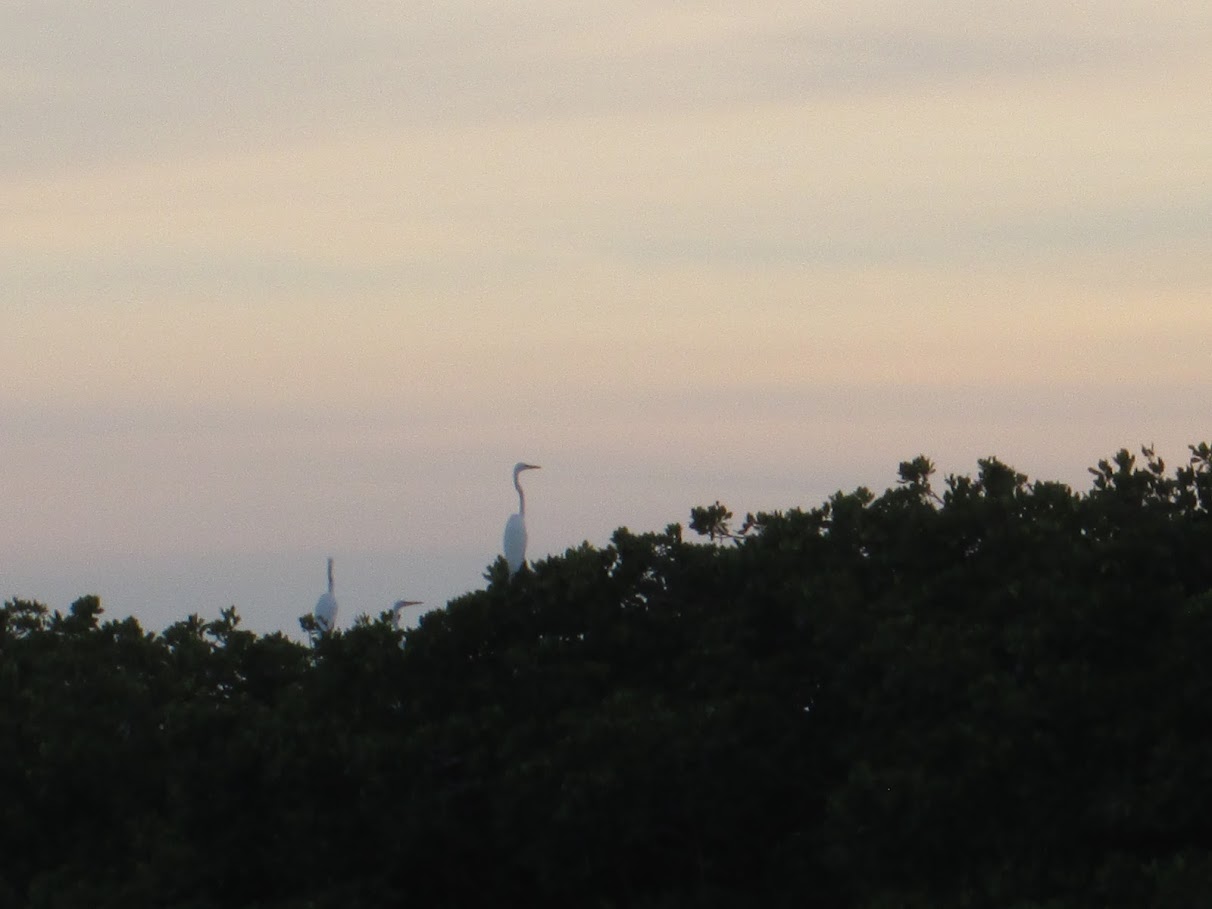
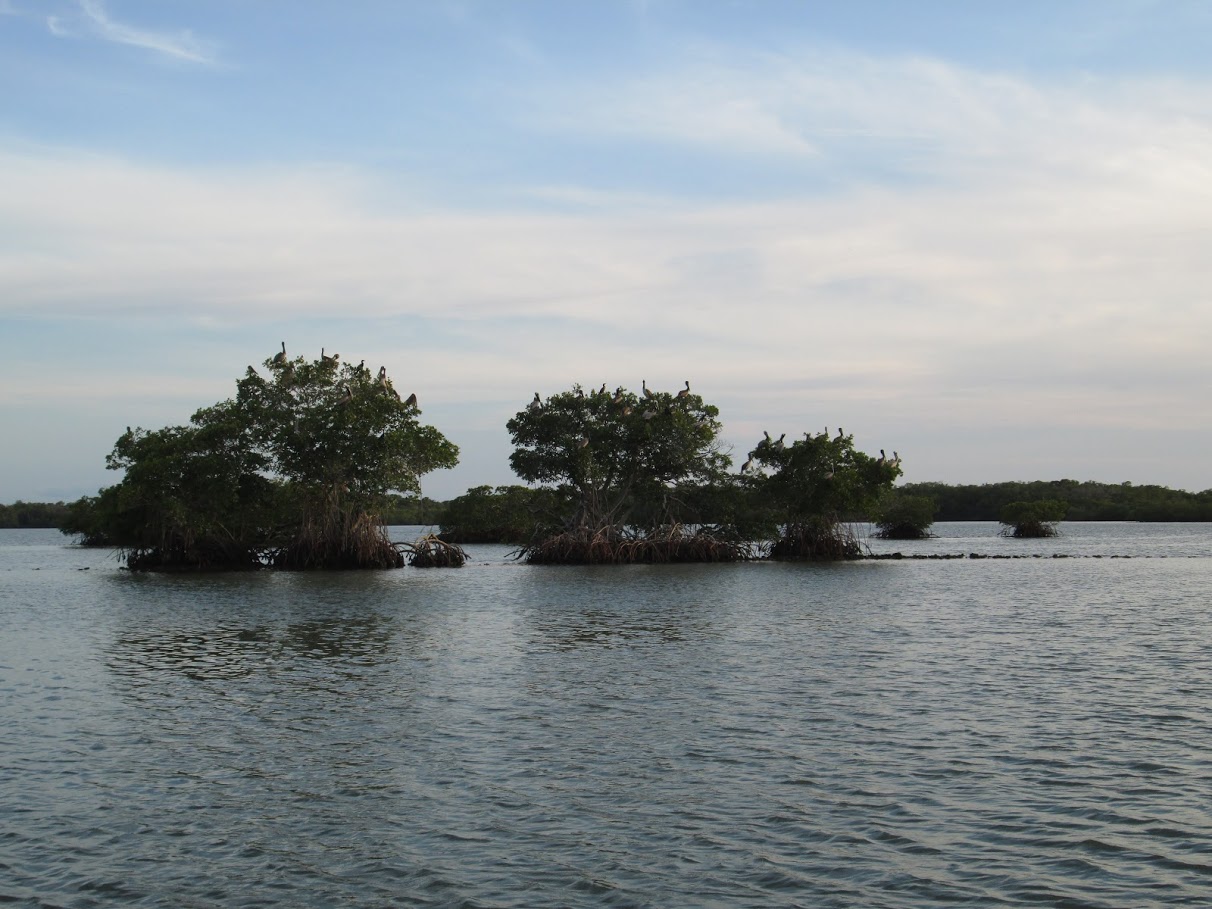
We boarded the boat again and took a winding and at times treacherous route through the channels among the mangroves, in search of more dolphins. Alas, it was not to be. Finally, toward sunset, Captain Kent followed the egrets and pelicans to their evening roosts: a squawking, croaking, clicking rookery of sea birds awaiting nightfall. Countless pelicans, cormorants, and egrets, and two roseate spoonbills made an appearance as we watched the sun drop behind a clouded horizon. On the boat ride back to the dock, we saw two osprey darkly eyeing the water. Captain Kent was a delight — knowledgeable and entertaining — and his obvious love and concern for the wildlife and ability to navigate the maze of mangroves at speed were impressive!

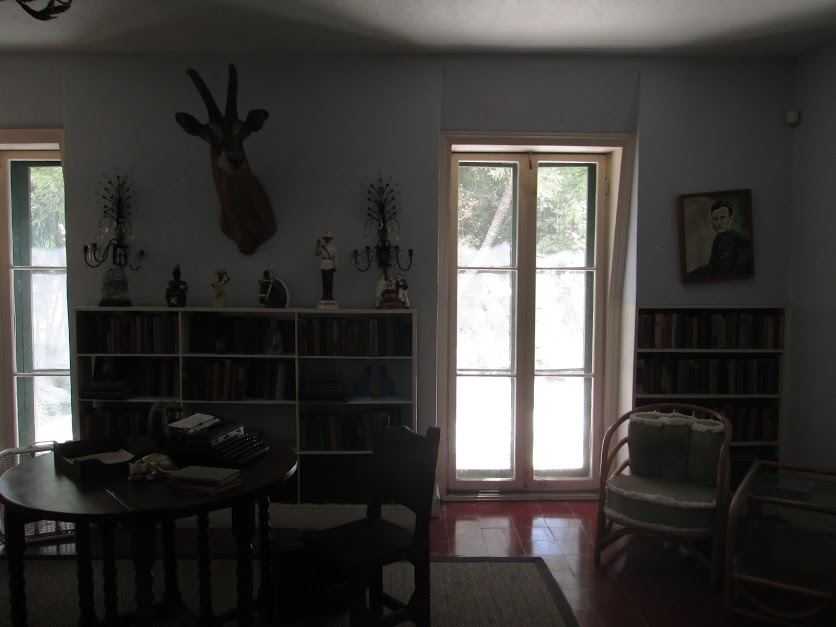
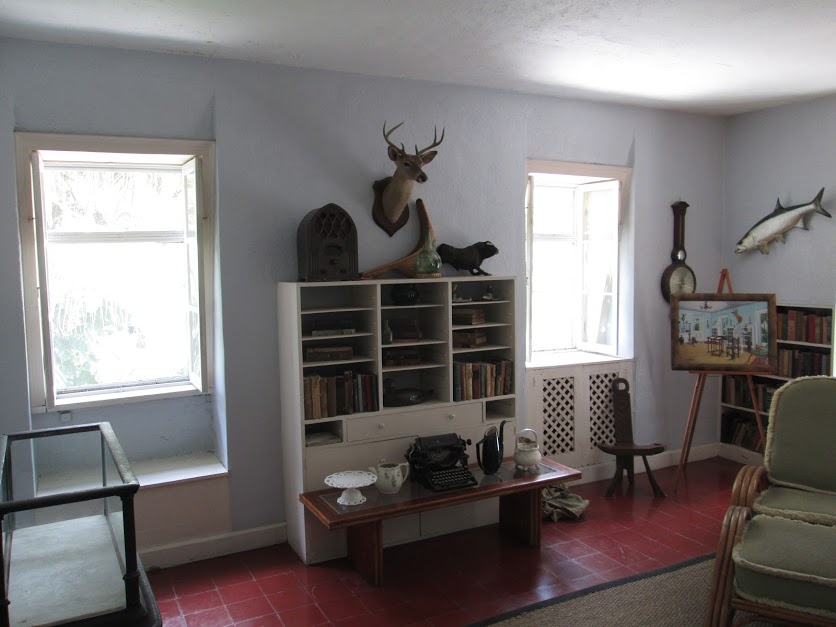
What else did we see? We saw Hemingway’s House on Key West, with countless artifacts and his office just as he used it — and a sun-tanned, silver-haired Hemingway lookalike on the beach before sunset. We saw the Basilica mentioned above, with doors along both sides where windows ought to be, open to the sunshine and breezes — a welcome haven from the sun and pavement of bustling Key West. We saw schooners and yachts and fishing boats, and a crew making a show of unloading their catch for the cameras of tourists. We saw kitschy souvenir shops, high-end art and fashion shops, and a funky clothing and music store called Good Day on a Happy Planet, in which a boisterous bohemian woman sold us coconut and bamboo wind chimes (for Jodi) and a nice cigar-box ukulele (for the family) — we stopped through in the morning, and when we returned for the uke in the afternoon, she actually cheered and sang to us in front of her other customers!

We saw the long and short bridges connecting the islands to the mainland. We saw people fishing, biking, tanning, swimming, and sailing. We saw glimpses of Miami and Atlanta from the freeway; the headquarters of Jodi’s former employer, Randstad, nearly overlooking the Chatahoochee; and St. Peter Catholic Church in the heart of Memphis. We saw the highest concentration of Baptist churches I could imagine in rural Alabama, and met Randy and Pat, the breeders of handsome hunting and working Airedales, distant cousins to our late Boomer. We can’t wait to get back down and come home with a pup, hopefully before snow flies!

I’m sure we saw other things — and I haven’t even touched on the food yet! — but that’s enough for today’s recollection!

Road Trip Review, Part 2: What We Did and Didn’t Do

Before we left for the Keys, I sought the advice of people I knew had been down that way, as well as the wisdom of the Web. I quickly ascertained that the further one travels toward Mile Marker 0, the more “local color” we would be likely to encounter as far as bohemian eccentricities go, and the more the spirit of carnival would take over after dark.

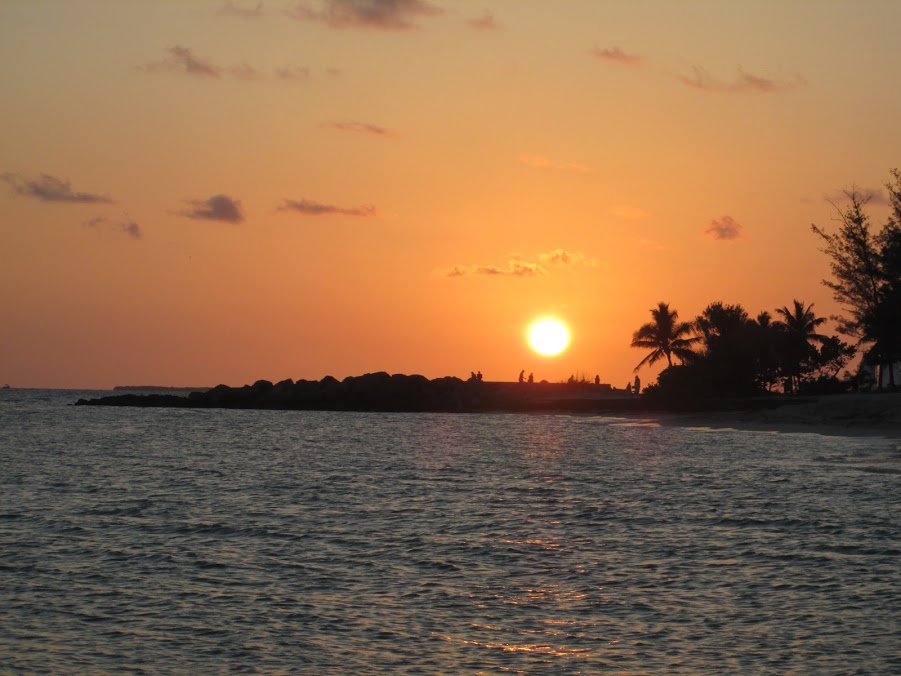
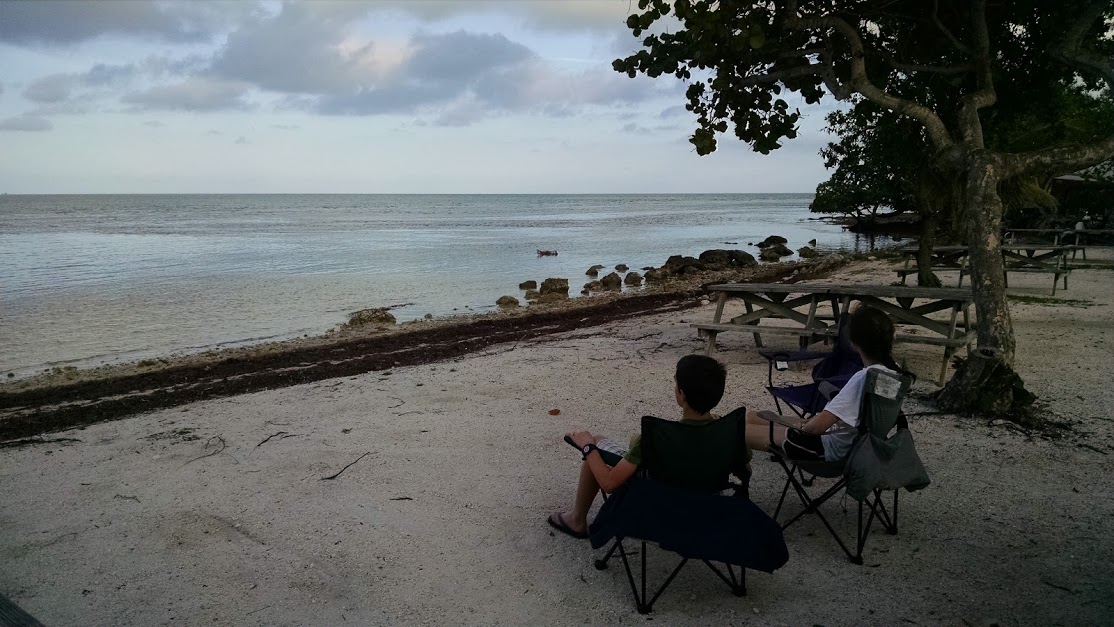
So despite the tradition of watching the sun got down en masse on Key West and applauding the light show as it ended, we avoided the crowds at sunset, finding a quiet strip of beach with one or two other families and lots of crabs and​ seabirds among the rocks. (Click the photos for a better view.)

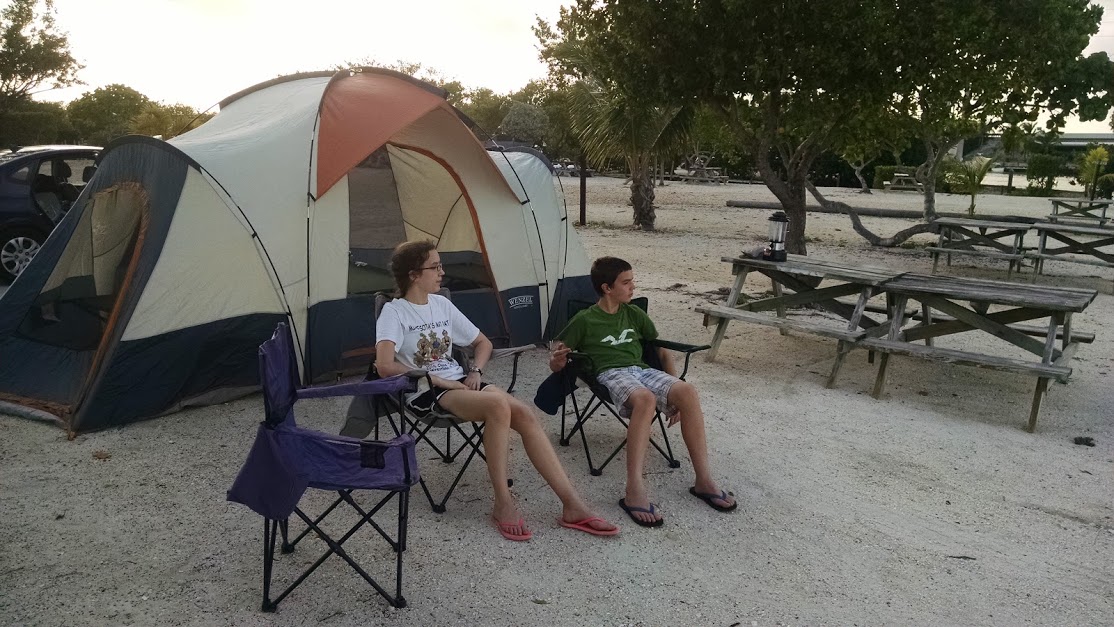
To save money, we spent our two nights in the Keys in a screen tent on the beach at Big Pine Key Fishing Lodge at Mile Marker 33 ($180 a night for a motel versus $50 for a tent). The weather was pleasant enough when we arrived Tuesday night, and we set up the tent in sunshine with a cooling breeze coming off the channel. We checked the weather forecast, and tossed the rain fly in the corner. 
We went to supper, and when we came back to the camp site to turn in for the night, the breeze has freshened to a steady wind, causing our dome tent (n) to lean away from the water in the fashion demonstrated below:
before dinner: n
after dinner: n
This tent, mind you, is more than 20 years old, with flexible, fiberglass poles that have split before in inclement weather and have been repaired. Yet it appeared to be holding its own, and we turned in to enjoy nature’s air conditioning and try to sleep. We lay on our cots looking through the screened portion of the dome roof at the moon and stars above. It was beautiful.
Sometime before midnight, the moon darkened behind the edge of advancing clouds. The neighbors, two sites down, had come back to their tents late and were joking and laughing. It was after “quiet time,” but the sounds were joyous, not overloud and not obscene, so I lay back and listened and smiled. Then the sound of wind changed, enough that Trevor sat up to look outside. I rose, too, to see a wall of cloud advancing across the channel and to smell rain in the air.
I checked the weather on my phone: 12 mph winds predicted, and a chance of rain. One of the neighbors had brought forth a guitar and had begun to sing. I lay back to listen.
Within about 15 minutes the wind freshened even more, pulling a stake near Emma’s cot, allowing the tent to flap noisily and rousing her. Tiny raindrops pattered against the seaward side of the tent. (Thankfully we had chosen to face the front toward the water, so the screen was on the lee of the tent, away from the wind.) I began to feel a light misting from the droplets hitting the door screen, so I zipped shut the window flap on the door. This, of course, caused the tent to catch still more wind, and I have no doubt that from the outside our tent looked like a comma, or a overfilled sail!
From the inside, we had the sensation of sailing the skies in a lightly built box kite. Nevertheless, there were no storms in sight and no perceptible danger aside from a tent collapse, so I lay down to try to sleep and urged the kids to do the same.
And we did. The wind and rain pelted the front of the tent, but never the screened-in back, and the poles bowed but did not break. Ultimately we drifted off, and the rain ceased, and the stars reappeared. In the hours before sunrise the breezes died almost completely, and we were introduced to no-see-ums. But that is another story.
We stayed at a fishing lodge, but due to time and money constraints, did not fish. We saw the endangered Key deer (a knee-high subspecies of whitetail for which Big Pine Key is famous), but did not pet them, although they were not shy. We visited Hemingway’s House and the Basilica of St. Mary, Star of the Sea. We saw the southernmost point marker (just 90 miles to Cuba), but did not wait in line for a photo. We ate great food and passed a brewery or two, but they did yet offer bottles, cans, or growlers, so we brought none back. We went on an Everglades boat tour, but not an airboat into the gator-filled grasslands.  In short, we did what you do in south Florida and the Keys, but in our own way. More to come!

Memento Mori, or Don’t Get Comfortable!

Last week I shared a humorous post about my general lack of physical fitness, in which I declaimed, “I am weary from too much rest—so comfortable it hurts.” At the time, I meant this merely in the physical sense, but this morning the spiritual meaning resonates.

We are creatures of will and intellect, but inertia is mindless. An object at rest tends to stay at rest, and so, too, a man who behaves like an object. When we rest, we often “veg,” which is to say we give up our human and even our animal nature in exchange for potting ourselves, mindlessly, in the sun. Bloom where you’re planted is a mantra today, but we are not flowers or fruit trees. It feels good to soak the golden rays, but, lacking chlorophyll, we are not fed in this way—not for long! We are planted only at the end, and then under a stone.

Also last week, I mentioned that our family is pursuing Marian consecration. Thus far Fr. Gaitley’s book has focused on three saints who, in their separate but similar ways, gave themselves completely​ to Christ through Mary: St. Louis de Montfort, St. Maximilian Kolbe, and Mother Teresa. What struck me this morning was the sense of urgency each of these saints has:

  • St. Louis de Montfort advocated Marian consecration as “the surest, easiest, shortest, and most perfect means” to become a saint.
  • St. Maximilian Kolbe formed his Marian “army,” the Militia Immaculata, with the express goal of bringing the entire world to God through Christ under the generalship of Mary, and to do so as quickly as possible.
  • St. Teresa of Calcutta sought to satisfy the thirst of Jesus for souls and love, and to do this in the best possible way.
Notice that none of these three were satisfied with merely doing a job, or even doing it well.They sought to hear God’s call, to answer it daily, and to act with urgency, in the best way possible to bring about His will. They were not sedentary, physically or spiritually. They did not bloom where they were planted, because they never permitted themselves to be planted. They acted, each moment, as Mary would—as Christ would!—with great love, and with their eyes fixed upon eternity and the fate of the souls they encountered.
Too long have I acted as though good enough is good enough, as though I have time to spend (or not) as I please. If sainthood is the goal, let us pursue it with vigor. God willing, we’ll have eternity to rest!

Just the Four of Us

For the first time in more than 20 years—near as we can figure—my mom, dad, sister, and I are alone together in my parents’ house.* The last time this happened, according to Jill’s recollection, was just before I left for South Dakota to marry Jodi. Jill was pregnant with my niece and goddaughter Kayla (hence the asterisk above) and couldn’t travel; she recalls sitting together in the loft overlooking the great round beams of my folks’ house, talking with me and giving me a old penny from her coin collection that had belonged to Grandpa Thorp. I don’t recall the exact moment as clearly as she, but I have the penny still, and the timing seems right.

And now here we are again, just the four of us, talking and laughing together. Births, holidays, weddings, funerals. Decades pass like minutes. We are entirely different people than the last time, and just the same.

I’m not sure I have a point tonight, other than to commemorate this day and note the speed with which time’s arrow flies, the swift fluidity of life, and the beautiful permanence of family.

Who Is This Mary?

When Brendan came home from college for Easter, one of the first things I noticed was a coarse metal chain around his wrist. It is a sign and reminder of Marian consecration, a total gift of self to God through Mary—a symbol of slavery, but of a good and holy kind—which says he is devoted to doing God’s will in the most perfect way he can, and that he is following his Blessed Mother’s lead in this.

Our local church has undertaken a parish-wide push for Marian consecration this month, using a 33-day self-guided mini-retreat published by Fr. Michael Gaitley as the book 33 Days to Morning Glory. Jodi, Gabe, Emma, Trevor, and I have undertaken this journey together, in hopes that we, too, will be chained to our Lady in mid-May.

The daily readings in this book are short, but thought-provoking, helping us to better understand why Catholics so venerate and so often turn to the Virgin Mary. What struck me this morning is this question: If Mary was sinless, married to a saintly carpenter, and raising a sinless Son, how is it that she was not known better in her day? I know how drawn I am to certain families in our community—families that strive for holiness even as they struggle with all the typical family dysfunction. How is it that Mary and the Holy Family didn’t have a constant throng of people at the door?

Several answers come to mind. First of all, perhaps people did flock to the house in Nazareth, but in the same way we do today. Perhaps they were exactly the sort of family that neighbors were drawn to: mothers confiding with Mary during play dates and nap time, men seeking Joseph’s advice as he worked in his wood shop, parents nudging their children to get to know Jesus because He seemed like a nice boy. Perhaps people realized they were an exceptional family, just not the Holy Family.

But how could they not have seen it?

Well, Mary’s perfect humility comes to mind. I tend to want recognition when I do good work or suffer in some way. Mary, I imagine, would have drawn no attention to herself, and even moreso than our other saints (who were, in fact, sinners), she would have downplayed any recognition she received as due to God and not herself.

And finally, we sinners have a tendency to project our weaknesses onto those around us. No doubt there were those around the Holy Family and Mary who thought they couldn’t possibly be as good as they appeared. The movie The Nativity Story does a great job of illustrating the effect of Mary’s unplanned pregnancy on people’s perception of her, culminating in people scowling from their doorways as Mary and Joseph begin their journey to Bethlehem. (They can feel the eyes upon them, and Joseph jokes to Mary: “They’re going to miss us!”)

Then it occurred to me that these three thoughts might characterize our response to Mary today, as well. We may turn to her as a friend and confidant, or even as a mother, without truly considering her virtue, her proximity to God, her influence as Queen of heaven and earth—without regard for her role as the model and mold of discipleship and humanity. We might not recognize her as powerful, the new Eve and the saint closest to her Son in all respects, because all of this results from a simple, humble yes: complete obedience and submission to God. And we may simply not think she’s “all that”—however good she may be, she’s not God, so why should we let her stand in between us and the Source of life, holiness, and joy?

My answer to this last question is simple: I know how often I’ve lost God, sought Him alone, and failed to find or reach Him. I know I need help. Who better to turn to than the creature like me who loved God best and followed Him perfectly?