A Walk on the Waves

At once Jesus spoke to them, “Take courage, it is I; do not be afraid.” Peter said to him in reply, “Lord, if it is you, command me to come to you on the water.” He said, “Come.” Peter got out of the boat and began to walk on the water toward Jesus.

– Matthew 14:27-29

Today is my last day as a parish employee. I have been profoundly blessed to work for the Church I love, in the church I love, with people I love, for a community I love, for the past three years. My father always preached, Leave it better than you found it. I pray I’ve done so. I know I’m better than you found me.

Today I leave the boat for a walk upon the waves.

Over the past several weeks, as my departure became known, I’ve heard a number of variations on the following: It’s brave of you to step out in faith like this. It’s such a powerful witness of trust: going where the Lord leads you. I’m sure you are on the right path and I can’t wait to see where it leads! Continue reading

Aesthetic Witnesses: Using Beauty to Build the Kingdom

Art must make perceptible, and as far as possible attractive, the world of the spirit, of the invisible, of God.”

The quote above is taken from Pope John Paul II’s “Letter to Artists,” published on Easter Sunday in 1999. I’ve been reflecting on that letter in terms of the saint’s call, beginning in the late 1970s, for a new evangelization, and also in the context of young Karol Wojtyla’s cultural resistance efforts with the Rhapsodic Theater during the period of Nazi control of Poland. The more I reflect, the more convinced I become that the arts—visual, literary, theatrical, and musical—as well as beauty defined more broadly, are ideal tools both of evangelization and of Catholic resistance and encouragement today.

Beauty in evangelization

Beginning with the artist as an image of God the Creator, St. John Paul II makes a strong case for the special vocation of the artist in service to the true, the good, and the beautiful; their ideal role as revealers of the Incarnation and the Good News; and the necessity of art to the Church and vice versa. Continue reading

Nothing Safe

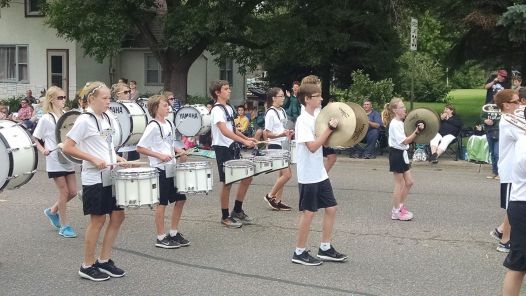
This past weekend was Albertville Friendly City Days, our little town’s version of an annual summer festival, featuring  a softball tournament, a pedal-power tractor pull, the Miss Albertville competition, live music, carnival rides and games, fireworks, clowns, and more. The highlight for our family each year is the parade — one of the biggest and best in Wright County, with more than 100 entries including several marching bands. The past few years we’ve enjoyed the spectacle from a beautiful old home on Main Street, right next to the announcer and judges booth, so everyone is looking and performing their best, and candy is tossed by the handful. This year we enjoyed the additional treat of Trevor’s debut as a percussionist in the STMA Middle School Marching Band, playing quads (technically quints, I suppose, since his drum harness has a tiny fifth tom, not just four).
19095554_10211398666936902_6245668699463826280_o

Trevor and bandmates marching

Earlier we had been discussing what we love and don’t love about Friendly City Days. Lily was strongly urging that we walk down to the carnival and at least check out the rides; Jodi and I weren’t anxious to do so. A friend agreed with us: Traveling carnival rides especially made her nervous, she said — so much so that she has been known to pay her children not to go, still spending less for peace of mind than she would have for ride tickets. She even shared a story about a girl who was scalped when her hair got caught during a ride on a classic old Tilt-a-Whirl.

13413740_10208066541475848_7740465260764804086_n

Jodi and Lily sliding

Although we rode the Ferris wheel, the carousel, and the giant Fun Slide last year, by and large, we agree. Anything that’s moves and spins and is not bolted down is just asking for someone to get hurt. Or throw up. Or both.

On the other hand…

What is it about a Tilt-a-Whirl, anyway? I used to love that ride: the unsteady motion of the platform, the off-kilter slide into your friends as your car tilted and spun sideways, first one way, then the other. Yeah, sometimes people puked (I never did), but that was part of the excitement — the sense that anything could happen, at any moment. You felt alive.

Dead people don’t barf.

I think I’ve discovered that ride was so appealing — and why I don’t care to do it anymore. Think about it: what else do we experience that is tilted, spinning, unstable, and potentially dangerous; that sends us careening into the people closest to us; that makes us laugh, cry,  and hurl?

We don’t need some old carnival clunker. We spend all day, every day, on a massive, unhinged Tilt-a-World. As a kid, the simulating is stimulating. As adults, it’s too real, like when you’re watching The Office and can’t laugh because you actually lived through that particular episode.

And it’s not safe. This world is broken, grimy and off-balance, hurtling through the cosmos, and run by grubbing scoundrels, leering ne’er-do-wells and lazing doofuses. We’ll never make it out alive — and yet, here we are: leaning, laughing, spinning…

So let go. Whatever you’re clinging to can’t keep you safe anyway. Let’s throw our hands up and enjoy this ride — together!

Featured photo at the top of the post: Abandoned Tilt-A-Whirl By Derrick Mealiffe from Toronto, Canada (Wet n Wild) [CC BY-SA 2.0], via Wikimedia Commons
 

Book Break: Manalive

“Madness does not come by breaking out, but by giving in; by settling down in some dirty, little, self-repeating circle of ideas; by being tamed.” 

– G.K. Chesterton

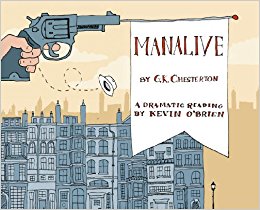
I’ve quit believing in coincidence. When seemingly random events culminate in a meaningful way, providence is my line now. Such was the case when I was searching the Great River Regional Library website for an audiobook to accompany me to and from Michigan over Divine Mercy weekend. I searched for several titles by name, and several topics by keyword, to little avail. Then I stumbled across an audio version of G.K. Chesterton’s Manalive, narrated by athiest-turned-Catholic and Theater of the Word founder and actor Kevin O’Brien.

I didn’t know what the story was about. That it was Chesterton told me it should be good — but as I’ve said before, Chesterton can be too clever by half at times, and I’d never tried his fiction before. I put in a request for this book and for Mark Twain’s biography of St. Joan of Arc, and Manalive arrived first.

I hesitate to say too much. It is the story of an apparent madman or idiot who invades a British boarding house and turns the humdrum lives of the inhabitants upside down. Ultimately, he is accused of insanity, theft, polygamy, and murder  but how can a man as wicked as that make others feel so alive for the first time in years?

On the other hand, why would such a joyful simpleton  a holy fool  carry a revolver among his holiday luggage and playthings? Our protagonist has a mission, which sounds ominous and, indeed, mad: “I am going to hold a pistol to the head of the Modern Man. But I shall not use it to kill him – only to bring him to life.”

Like Myles Connolly’s Mr. Blue, which I reread over Holy Week, the book portrays a man who had dedicated himself to a worldview that the world has little use for and who pursues it at whatever cost. As a result, he makes us think about our own worldview and priorities. Manalive is chock full of great Chesterton quotes and paradoxes and memorable characters made moreso by O’Brien’s theatrical reading, voicing each of the characters as clearly as if he were several people himself.

By way of criticism: The work does wax poetic at times – particularly the introductory chapter – and at all times Chesterton’s presence is felt in the thoughts, wit, and turn of phrase of the characters. I would also be remiss in not pointing out Chesterton’s use of racial and ethnic stereotypes and language, particularly in drawing the character of  Moses Gould. In the context of this story, it was unsettling, but it struck me more as a product of his time than of strong personal animus. As to his actual views of minorities, I need to read more.

By way of endorsement: I listened to it start to finish on the way to Michigan, again on the way home from Michigan, and yet again on the trip back from Florida with Rose and Trev. It has climbed to the upper heights of my list of favorite stories — and if you want a fictitious explanation for why I’m leaving a good job at the church for a nebulous next step involving writing, this is it. I could not have stumbled across a better novel to bolster and encourage me in this time of transition.

That, friends, is providence.

A Father’s Joy

 One of the highlights of a relatively laid-back (for once) weekend was heading into the Cities for the 10 a.m. Mass at the Cathedral of St. Paul. Jodi, Trevor, Lily and I did this because the University of Mary contingent (including Brendan) from the March for Life in Washington D.C. was planning to attend Sunday Mass there at that time, as well.

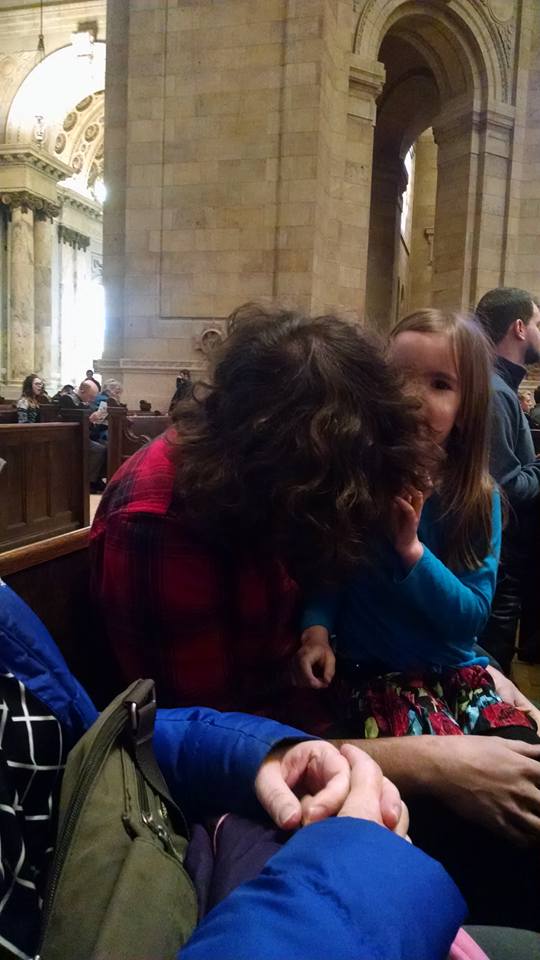
We arrived moments before the buses rolled up. We stood on the sidewalk and peered through the tinted glass, trying to glimpse the woolly-headed college man we knew to be our own. Instead we saw his STMA classmate, Anna, who grinned and waved joyfully at us — and who got a bear-hug from Lily when she got off her bus. We waited for several minutes then, scanning the lines of students emerging from the buses, until at last a bearded, lumberjack-looking fellow in red-and-black plaid emerged and came our way.

Lily didn’t see him at first; when she did, she ran to him, and I don’t think it was my imagination that her voice caught in her throat as he swept her up. Several of his college colleagues smiled at the hairy young man and his little princess — and I did, too.

It was good to see him, even briefly: good to see him safe and sound, to see his patchy beard grown long enough to cover the bald spots, to see his hair growing still more Robert-Plantish, to see the sense of peace and comfort he has surrounded by his friends. The center sections of the Cathedral had been reserved for UMary, much to the surprise of the regular Sunday Mass goers, and it was good to see so many Minnesota families and friends turn out to greet the pilgrims and pray with them. It was good to see hundreds of college-age men and women enter a Catholic church in quiet reverence, kneel and pray, and receive the Holy Eucharist together.

Lily stayed as close as she could to Brendan — closer even than Jodi. Olivia and her brother Kyle came, too, and sat with us — and after Mass (after a massive group photo at the Cathedral rector’s request) we stood and visited a long while, soaking up what time we could with the young man so like and so different from our eldest son.

When they left to get on the buses, we went downstairs in the Cathedral to show Lily and Trevor, among other things, the massive Lego model of the building. Then we went out to lunch (far more affordable with just two children). While finishing at Chipotle, we got a text from Gabe that the bus from St. Michael and St. Albert was nearly back from D.C., as well, so we hustled home. Jodi dropped Trevor and I off so she would have room in the car for the teens and their stuff, then she and Lily headed to the church. A few minutes later she arrived with Gabe and Emma, joyful and tired, ready for home-cooking and a bed. For a moment it felt like years since we had seen them — and there they were, suddenly, as though they’d never left. I hadn’t noticed feeling partial until the moment I felt whole again. After we visited a bit, I lay down for a nap — and I took a father’s joy in just hearing their voices and noises of their passing as I drifted off to sleep. They were home and the world was centered once again.