Poured Out In Love

 Each year during Lent, the Church focuses more intentionally on the Passion and Death of Jesus. How strange it seems that, during the very season we are trying to examine our lives and conform ourselves to Christ, we are also focused on Jesus at His lowest: beaten, humiliated, tortured. Jesus tells us in no uncertain terms that, to be His disciples, we must deny ourselves, pick up our cross, and follow Him—but surely we can stop short of whips and spears, thorns and nails, can’t we?

We are each a unique image of God, and each called to follow Christ in a unique way: to pour ourselves out in love for those around us. Most of us won’t be called to martyrdom in the bold and bloody sense—though some of us may. Most of us won’t be called to leave behind family and friends for foreign missions or cloistered religion life— but, God willing, some of us will.

Instead, most of us will be called to holiness in the context of ordinary, everyday lives: working, raising a family, pitching in where we can. This may seem easier than facing blades or beasts in the Coliseum, but I’m convinced it’s not. St. Josemaria Escriva warns us, “Many who would willingly let themselves be nailed to a Cross before the astonished gaze of a thousand onlookers cannot bear with a Christian spirit the pinpricks of each day! Think, then, which is the more heroic.”

To make a once-for-all choice for Christ, in the heat of the moment, facing certain death and eternal glory, seems downright doable compared to 70, 80, 90 years of making a million moment-by-moment choices to love the person in front of us, in every circumstance. Daily discipleship is difficult—and it’s made more difficult when we attempt to carry crosses we were never meant to bear.

Think about it: Each of us is called to be a disciple, and each disciple is called to pick up his or her cross and follow Christ. But since many people choose not to be disciples, we have a lot of crosses lying around, waiting for someone to drag them away. All these crosses can make it difficult to discern which is ours. They can cause us to stumble and fall. They can cause us to neglect our own cross in a misguided effort to clear the path.  But if we take the time to identify our own cross—the one God made precisely for our particular strengths and weaknesses—and if we shoulder it and keep our eyes fixed on Jesus, who walks the path ahead of us, He will show us the way.

This, at last, is discipleship: Not to drive ourselves into the ground trying to do everything for everyone, but to ask God what He wants from us, to listen for the answer, and to resolve to do exactly that—to embrace the cross the Carpenter has crafted with each of us in mind, and leave the others.

Imagine a parish of such disciples, all doing exactly what God has asked of them—no more, no less—and all moving the same direction, pouring themselves out in love on a world that desperately needs it.

Such a parish would change the world, because unlike time and energy, love never runs out.

It’s the Little Things

I often worry about what my wife and children, family and friends, and even those of you I don’t know, think of me. Am I doing good work? Setting a good example? Who sees me at the grocery store—and what do they see? Who walks down my street and hears me thundering away at my poor children? Am I letting them down? Am I letting you down?

You know the old song: You’re so vain/you probably think this song is about you/you’re so vain. Yeah. I tend to think the song is about me. Like all of you don’t have better things to do than watch for me to stumble. I used to think, At least I’m not prideful—I’m worried I’m going to let people down!But now I see what twisted pride convinces a guy that everyone is looking at, paying attention to, and judging him.

I bring this up because Lent is on the horizon. In Fr. Mike Schmitz’s video reflection, Preparing for Lent, he cites three common mistakes people make in their approach to Lenten sacrifice:

  • Take on a very easy sacrifice that will have no spiritual impact whatsoever
  • Take on a very hard sacrifice just to see if they can do it
  • Take on a two-fer–use Lent as a reason to fix a broken resolution or to do something you should have been doing all along

I have done made all three of these mistakes over the years: trying to break old habits during Lent, but for myself, not for God, or piling on the sacrifices and prayer practices until I couldn’t help failing, then cutting back and simplifying to the point that I became an unprofitable servant, only giving to God the minimum due. And all the while, I’ve wondered: Who’s watching? Who’s judging

Who cares? The point of prayer, fasting, and almsgiving Lent is to draw nearer to God and to detach from things that keep us bound to our earthly lives. We should ask, What in this world is keeping me from Christ? What can I do to more closely follow Him? —and listen to the answer.

Jodi and I used to tell our youth group in Michigan that if they thought of a sacrifice and had a sinking feeling in their hearts because they didn’t want to give that up, it might be the right thing. It doesn’t have to be earth-shattering. In fact, once I started thinking in terms of the little things, I realized that this is where the real work is. I’m no longer a slave to those big, serious, mortal sins that used to weigh me down, but I have countless little attachments and anxieties that crowd God out of my life.

Do you, too? Pick one, and let it go this Lent. Replace it with a simply prayer practice (maybe genuflecting more slowly and reverently before the tabernacle or monstrance, as though the King of the Universe is present—because He is!) and self-giving (how about a loving compliment to each person we interact with?).

Uh, oh. I’ve got that sinking feeling…

Note: Lent begins on Wednesday, March 1, with Ash Wednesday. Watch Fr. Mike Schmitz “Preparing for Lentand collect bonus points for watching “4 Reasons for Fasting“…

Same Guy, Different Year

I don’t know about you, but 2016 caught me off guard. The new year leapt from behind our Christmas tree in the early morning darkness to find me unprepared and unresolved, the same shuffling sinner as last year, stumbling to the kitchen, rubbing my eyes and searching for coffee.

And now I notice Lent and Easter creeping up. Ash Wednesday, February 10, is less than three weeks away. In past years I would have broken multiple resolutions by this point and would be tempted to use Lent to get back on the horse—fasting, for example, in order to lose weight rather than gain perspective.

Since I’ve made no resolutions, however, I’m headed toward Lent with no agenda other than the humbling realization that this year’s Jim is much the same as last year’s. And in recent weeks I’ve noticed two sins within myself that, in the past, I have failed to confront and that need to be uprooted.

The first, I learned just last weekend, is a form of vanity. I worry, overmuch, about what people think of me. Not simply in terms of appearance, though if I’m honest, that’s a part of it. I worry that I’m making a bad impression, that I’m being misunderstood, that I’m coming off as a judgmental know-it-all or a sentimental fool. As a result, I want to do good work, but not always for God’s sake or even for your sake. I want to do it for my sake, so I can feel good about me.

This is hard to admit, as it’s not a particularly manly sin. All of us have the need for affirmation—but I get affirmation from so many of you and from God in prayer. Worrying about every misstep and stewing over every sideways glance or offhand comment to the point that I forget the Father smiling down on me is an evil that must be uprooted.

The second, I fear, is more humbling than the first. Between my work life and our home life, I am as busy as I have ever been, and yet I feel God pulling me toward other things He wants me to do. And I’m resisting, because Lord, I don’t have time—something’s got to give!

Then it occurs to me: perhaps I’m that something. Perhaps God wants more of me.

And then the panicky flutter starts up in my chest, like a moth realizing too late that he’s inside the shade and that beautiful Light burns. I can’t do this, I think. I’ve got to get out of here!

Yes, you can, says God. Stay with me.

I realize one of two things must be true: either I don’t truly believe God can help me, or I don’t believe He will. The first I recognize as rubbish immediately: He’s God; He can do whatever He sets His mind to.

The second is equally rubbish: He is Love and always wills the good of His people. I know this. I do.

But do I trust Him?

I’ve got a long Lent ahead of me. May your sacrifices be fruitful, drawing you nearer to Christ!

O Death, Where Is Your Sting?

At long last, we celebrate Easter, and the resurrection of our Savior, Jesus Christ! Perhaps you’ve been steadfast in prayer, heartbroken and sincere in penance, and generous in alms-giving. Or perhaps you feel you’ve done too little, too late, for our Lord — perhaps you’ve slipped in your Lenten commitments or find that Easter has crept up on you almost unawares.
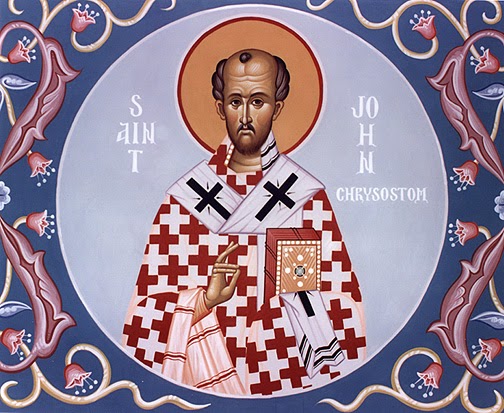
Either way, take comfort in the Easter homily below from St. John Chrysostom. Drawing on the gospel of Matthew, chapter 20, he reminds us that we never come too late to God and always receive full payment!

Easter Homily by St. John Chrysostom

Let all pious men and all lovers of God rejoice in the splendor of this feast; let the wise servants blissfully enter into the joy of their Lord; let those who have borne the burden of Lent now receive their pay, and those who have toiled since the first hour, let them now receive their due reward; let any who came after the third hour be grateful to join in the feast, and those who may have come after the sixth, let them not be afraid of being too late; for the Lord is gracious and He receives the last even as the first. He gives rest to him who comes on the eleventh hour as well as to him who has toiled since the first: yes, He has pity on the last and He serves the first; He rewards the one and praises the effort.

Come you all: enter into the joy of your Lord. You the first and you the last, receive alike your reward; you rich and you poor, dance together; you sober and you weaklings, celebrate the day; you who have kept the fast and you who have not, rejoice today. The table is richly loaded: enjoy its royal banquet. The calf is a fatted one: let no one go away hungry. All of you enjoy the banquet of faith; all of you receive the riches of his goodness. Let no one grieve over his poverty, for the universal kingdom has been revealed; let no one weep over his sins, for pardon has shone from the grave; let no one fear death, for the death of our Saviour has set us free: He has destroyed it by enduring it, He has despoiled Hades by going down into its kingdom, He has angered it by allowing it to taste of his flesh.

When Isaias foresaw all this, he cried out: “O Hades, you have been angered by encountering Him in the nether world.” Hades is angered because frustrated, it is angered because it has been mocked, it is angered because it has been destroyed, it is angered because it has been reduced to naught, it is angered because it is now captive. It seized a body, and, lo! it encountered heaven; it seized the visible, and was overcome by the invisible.

O death, where is your sting? O Hades, where is your victory? Christ is risen and you are abolished. Christ is risen and the demons are cast down. Christ is risen and the angels rejoice. Christ is risen and life is freed. Christ is risen and the tomb is emptied of the dead: for Christ, being risen from the dead, has become the Leader and Reviver of those who had fallen asleep. To Him be glory and power for ever and ever. Amen.

He is risen, indeed — let us feast and rejoice this day like no other! Alleluia!

Book Break: Holy Week by Jerzy Andrzejewski

Somewhere along the line these past few years I picked up an English translation of the short novel Holy Week by Polish author Jerzy Andrzejewski. I bought it knowing almost nothing about the book or the author, because I used to study Polish in college, as a tribute to my maternal roots, and because Polish literature can be hard to come by. Andrzejewski is perhaps best know for his novel Ashes and Diamonds, which was turned into a well-known Polish film of the same name by Andrzej Wajda, who has also made a film version of Holy Week. I saw the movie version of Ashes and Diamonds in college and liked it, so I took a chance on the book.

The novel tells the story on the Warsaw Ghetto Uprising and the tragic burning of the ghetto and elimination of Warsaw’s Jews during the days leading up to Easter of 1943 — from the perspective of a handful of Poles whose lives are variously entangled with each other’s and with a young Jewish woman trying to evade the Nazis and their Polish informers.

It has stood on my shelf for a at least two Holy Weeks now, until this past Tuesday, when I took it up on a whim. It is a short novel — just 125 pages — with four chapters covering each day from Tuesday to Good Friday. I took this as a sign and read it a chapter a day, finishing the book’s final chapter this morning.

This is a provocative book that reads a bit like watching a play. The Polish characters reflect the range of Polish responses to the uprising and “liquidation” of the Jewish inhabitants. Most display some level of antisemitism, ranging from mealy-mouthed rationalization of the it’s-complicated variety to thankfulness that the hated Nazis are nevertheless solving the Poles’ “Jewish problem” for them. Only three adult characters avoid being painted with this brush: 
  • Devout Catholic wife and expecting mother Anna, whose unquestioning morality enables her to help her husband’s Jewish friend even as her faith in God and her husband begins to waver;
  • Idealistic and aggressive Julek, who insists upon doing what he little he can to aid the Jewish uprising and points out others’ equivocations: “I know perfectly well what it means to suit one’s anti-Semitism to one’s tastes. We merely find the so-called methods distasteful. The point is there shouldn’t be any methods in the first place!”; and
  • Well-to-do landlord Zamojski, who at least avoids aiding the the anti-Semites, but who may himself be concealing his Jewish heritage.
The juxtaposition of Irena’s struggle to survive and the ever-present cloud of smoke and sounds of gunfire and explosions from the ghetto against the backdrop of Polish Christians enjoying spring and preparing for the Easter holiday as best they can lends the novel an almost surreal atmosphere. The story was written and published quickly and courageously in 1945, and was not popular among Poles, whose nerves were too raw and wounds were too fresh, and who found the various expressions of racism and nationalism rang uncomfortably true. Even today, this book pricks the conscience, making the reader reevaluate how he or she perceives others and wishes to be perceived — and what circumstances might limit their charity on behalf of a neighbor who is unlike themselves.
The book reads like an English translation from the original Polish — certain expressions do not ring true to American ears, but make sense in the Polish context — and the story will end too abruptly (and without sufficient resolution) for some tastes. Still, it is a quick and thought-provoking read. If you are interested, it is available through the Great River Regional Library in St. Michael, or you can borrow my copy.