A Father’s Joy

 One of the highlights of a relatively laid-back (for once) weekend was heading into the Cities for the 10 a.m. Mass at the Cathedral of St. Paul. Jodi, Trevor, Lily and I did this because the University of Mary contingent (including Brendan) from the March for Life in Washington D.C. was planning to attend Sunday Mass there at that time, as well.

We arrived moments before the buses rolled up. We stood on the sidewalk and peered through the tinted glass, trying to glimpse the woolly-headed college man we knew to be our own. Instead we saw his STMA classmate, Anna, who grinned and waved joyfully at us — and who got a bear-hug from Lily when she got off her bus. We waited for several minutes then, scanning the lines of students emerging from the buses, until at last a bearded, lumberjack-looking fellow in red-and-black plaid emerged and came our way.
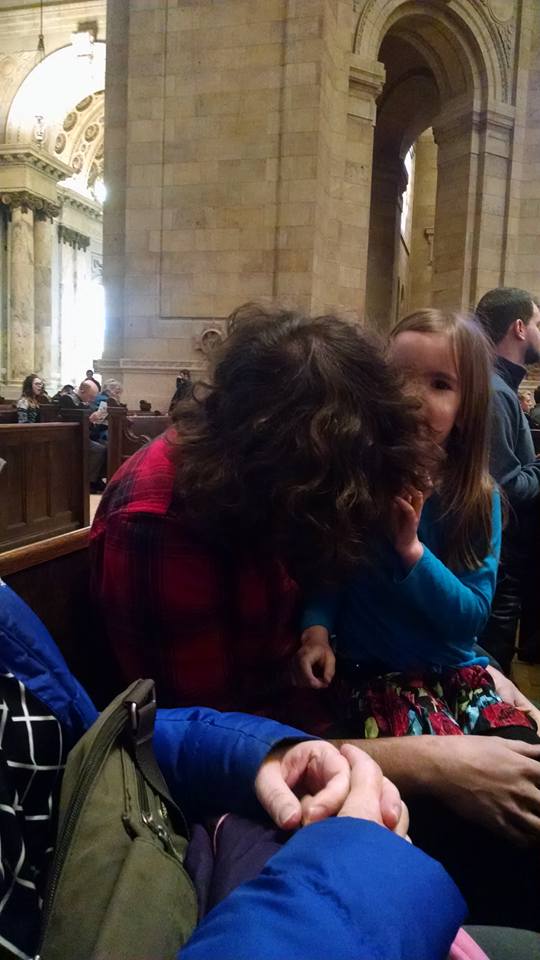
Lily didn’t see him at first; when she did, she ran to him, and I don’t think it was my imagination that her voice caught in her throat as he swept her up. Several of his college colleagues smiled at the hairy young man and his little princess — and I did, too.

It was good to see him, even briefly: good to see him safe and sound, to see his patchy beard grown long enough to cover the bald spots, to see his hair growing still more Robert-Plantish, to see the sense of peace and comfort he has surrounded by his friends. The center sections of the Cathedral had been reserved for UMary, much to the surprise of the regular Sunday Mass goers, and it was good to see so many Minnesota families and friends turn out to greet the pilgrims and pray with them. It was good to see hundreds of college-age men and women enter a Catholic church in quiet reverence, kneel and pray, and receive the Holy Eucharist together.

Lily stayed as close as she could to Brendan — closer even than Jodi. Olivia and her brother Kyle came, too, and sat with us — and after Mass (after a massive group photo at the Cathedral rector’s request) we stood and visited a long while, soaking up what time we could with the young man so like and so different from our eldest son.

When they left to get on the buses, we went downstairs in the Cathedral to show Lily and Trevor, among other things, the massive Lego model of the building. Then we went out to lunch (far more affordable with just two children). While finishing at Chipotle, we got a text from Gabe that the bus from St. Michael and St. Albert was nearly back from D.C., as well, so we hustled home. Jodi dropped Trevor and I off so she would have room in the car for the teens and their stuff, then she and Lily headed to the church. A few minutes later she arrived with Gabe and Emma, joyful and tired, ready for home-cooking and a bed. For a moment it felt like years since we had seen them — and there they were, suddenly, as though they’d never left. I hadn’t noticed feeling partial until the moment I felt whole again. After we visited a bit, I lay down for a nap — and I took a father’s joy in just hearing their voices and noises of their passing as I drifted off to sleep. They were home and the world was centered once again.


The Still, Small Voice of God

There was a strong and violent wind rending the mountains and crushing rocks before the LORD—but the LORD was not in the wind; after the wind, an earthquake—but the LORD was not in the earthquake; after the earthquake, fire—but the LORD was not in the fire; after the fire, a light silent sound.  When he heard this, Elijah hid his face in his cloak and went out and stood at the entrance of the cave. –1 Kings 19:11-13


It is Tuesday afternoon, and I am writing from home. This column should have been done and in already. It is not, because even a job working for the church is not as important as some things.

Around 9 p.m. last night my youngest son threw up, and my bride informed me she didn’t feel well either.  Between 9 p.m. and 2 a.m. or so, my son was sick probably two dozen times. Jodi did not get as sick, but was as sleepless as Trevor—and I tried to stay clear so that hopefully I could handle little Lily in the morning and keep her from catching whatever this was.

I rose and prayed with Jodi at 5:30. She felt a bit better, and Trevor was sleeping, at last.  At around 6, Emma was sick the first time, and by 8, Lily was complaining that she didn’t feel well either. I was getting ready for work—Day 2 with our new faith formation coordinator, Andrea Zachman—but had the sinking feeling that it was only a matter of time before it hit me, and that my colleagues might rather I stayed home. I was torn—I felt fine, but so had Trevor and Emma before it hit, and I had plenty of work to do. Lily seemed fine, but if she were on the verge, I didn’t want her spreading it to her friends and their families. Jodi was torn, too—she didn’t feel great, but had a mountain of work waiting for her and didn’t feel she could afford to miss a day.

And as fate would have it, we had a blanket of fresh snow on the walk, cars, and roads.

Ultimately we compromised: we both went to work briefly to take care of a few things and bring some additional work home to do around our other duties. We were out of several basic food items in our house, so I fought the blowing snow to stock up on a few things—and now here I sit, writing furiously.

We are all called by God—do you hear Him? I often imagine the God of the prophets speaking to them in a deep, thundering voice, but that’s not what we hear in first Kings, above. Elijah recognizes the Lord in “a light, silent sound”—other translations say “a sound of sheer silence” or “a still, small voice.” God whispers, as it were, drawing us close with his words, into an intimate conversation with Him.

Unfortunately, the noise of the world too often drowns Him out. We hear the voices of our colleagues and bosses ringing in our ears; the ringing of the phone and ping of emails, IMs, and texts…the traffic report…the weather…and nothing of the still, small voice of God.

Excuse me a minute: my other high-schooler, Gabe, just called—he’s sick and can’t drive himself home. Jodi and I need to go get him and the Suburban.

We are all called to a first and universal vocation of holiness. Most of us are called to live out that first vocation in terms of a second vocation to marriage and family life—we sanctify ourselves, our spouses, and our children by imaging God Who is Love. Everything else we do and are come in below that. We are created from Love, and Love is our purpose and end. That’s all. That’s enough.

Because that’s everything.

So Grateful Tonight…

Yesterday morning we loaded the Suburban, picked up Bren’s girlfriend Olivia are 7:45 a.m. Central time, and headed to Bismarck to fetch our eldest from University of Mary. Olivia rode shotgun (five bucks who can explain why I decided to call her “Coach”) to the campus, and we played the letter game, the license plate game, talked, sang along to the iPod, and ate Hardee’s for lunch in Jamestown, N.D.

We reached UMary and Gabe and Olivia retrieved Bren from his dorm. He came out with a box, a backpack, a duffle bag, a cased guitar, an uncased mandolin, and his heavy Carhartt jacket. We had room for the duffle bag and the guitar–but we stuffed it in, crossed the river into Mandan, and headed south by southwest to the Dennis Ranch in Red Owl, S.D., for supper. Bren and Olivia held the guitar at bay with the backs of their heads. At dusk the deer were moving along the roads; darkness fell quickly, and fog rolled in, so we lost time peering in the the gray-black, watching for movement.
We finally rolled up to Robert and Cindy’s new log house around 6:30 Mountain Time. The whole clan was there, waiting, including Fr. Tyler, who escaped his parishes for a Thanksgiving with his folks, his brothers Tate and Chance, and their families. Cindy, Hope, and Cass finished dinner, wrangled kids, and entertained Jodi, Emma, Trevor, and Olivia, while Bren, Gabe, and I help Robert and his sons move in a massive plank table edged in natural bark just in time for Thanksgiving. We enjoyed burgers and hotdogs, chips and salads, carrot cake, and Emma’s best oatmeal caramel chewies, and good beer (90 Shilling , picked up in Mandan). 
We visited and laughed together until around 9:30 or so, while Lily and little ones explored every corner of the  then rearranged the gear in the Suburban and loaded up for the Venjohns. Gabe needed night driving hours, so he took the wheel, with me navigating. The fog was thick, cutting our speed in half at times, but we rolled into Black Hawk and the house on Suzie Lane at 11:30  or so.  The adults were asleep, but cousins, greeted us. (Such is life: these days the adults turn in early, and the kids stay up to greet the latecomers.)
I woke this morning at 3:30, then again around 5 or so. Dozed until a little after 6, then showered and came went upstairs. Grandma Venjohn was next up, then one by one the rest of the family rose: everyone here but Jason and Carmen, who were hosting her family in Sioux Falls. Carmel rolls and coffee (and a little orange juice) for breakfast. Chris and Tally ran a Turkey Trot in Rapid City. Grandma, Matt and Brenda, and Brad and NaCole worked on snacks and dinner and watched the parade on TV, while Grandpa and our crew headed to 9 a.m. Mass at Our Lady of the Black Hills.
Their regular priest, from Poland, was sick; the old priest who celebrated Mass looked familiar, and his deep baritone and easy humor called to me from the past. Finally, halfway through the Mass, Jodi whispered, “I think that’s Fr. Bob from Wall,” meaning the priest who was at the Catholic church in Wall, S.D., when we first met and she first lured me back to Mass. I knew as she said it she was right.
He’s on oxygen now, and didn’t stand for his homily. He reminded us we are a thanks-giving people, and that Eucharist means Thanksgiving–then he told the story of a Thanksgiving day in the service, spent in the shadow of an armored personnel carrier in the Mojave Desert, eating MREs. The men were hot, the food (pork and beans) was crummy, and guys were already scarfing it down when their leader asked Father is he would bless their meal. So he did–and it struck him that we expect to feast on Thanksgiving, and to give thanks for all we have, but some people don’t have. He ended the petitions the deacon led with “For all those who only have pork and beans today, we pray to the Lord” and then, “For those who wish they had pork and beans today…”
During the sign of peace, I never more sincerely wished peace to those around me–and I’ve never felt more blessed to receive the Eucharist. We spoke to Father afterward. He didn’t remember us, of course, but knew we knew him, and (I hope) felt the love we have for him.
We got home just in time to watch the Lions-Vikings game. Gabe, Emma, and Trev were wearing Honolulu blue and were heckled by the bulk of Jodi’s family, who are diehard Vikes fans. It was a good game; Lions won a bit before dinner, and we prayed together over the food.
Not pork and beans, but turkey, ham, potatoes, stuffing, rolls, and squash. We ate, we played games, visited more, and some of us dozed. When the girls finally decided it was time for pie, we called Brendan upstairs to sing to him–he turns 19 today. Five different pies (apple, pecan, cherry, pumpkin, and pumpkin cheesecake) and real whipped cream. Brendan got a fleece blanket in UMary colors, three books, a capo and electronic metronome for his guitar, cards, and money. Some of us took a walk, others played Shut the Box and other games. At one point I went downstairs to find Bren, Olivia, and Gabe starting a rosary, so I joined in. Such peace–and such joy that they do this by choice.
We ate a little more a little while ago. Now most of the family is playing cards: Phase 10 in the dining room; Texas Hold’Em in the kitchen. I’m surrounded by voices and laughter and love. Such joy. So grateful tonight.
And we’re here ’til Sunday.
Friends and family, I love you and am grateful for you. God bless you tonight and always.

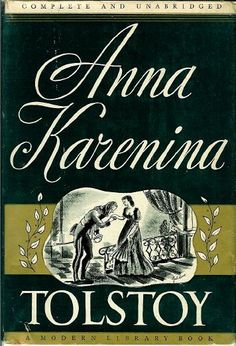
Tolstoy, or Three Things to Love About Anna Karenina

Blogger’s Note: Several years ago, I agreed to my friend Jacqui’s challenge to read 15 Classics in 15 Weeks. Though 15 weeks is long past, the end is near, this being number 14 of 15.

I am not like other men (or at least, not like many that I know). I have just past my forty-second birthday, and just read Leo Tolstoy’s immense novel Anna Karenina, by personal choice—and I loved it. 

My friend Fr. Tyler (from the Prairie Father blog) recommended it to me as “the greatest love story ever born in the mind of man and put to paper.” He has never led me astray in terms of fiction, but other men might not see that as a recommendation. I mentioned to a friend a week or so ago that I was reading it, and asked if he had ever. He laughed and said, “Ah…no.”

“It’s a great book,” I said, and again he smiled: “I don’t doubt it.” And that was that.

It is a big book (736 pages in my edition, with narrow margins and smallish type), full of Russian names and nicknames—Anna Arkadyevna Karenina, Konstantin “Kostya” Dmitrievich Lëvin, Prince Stepan “Stiva” Arkadyevich Oblonsky, Russian place names and politics, and Russian aristocrats who flavor their conversations with French and occasionally German. (Thank goodness for Google Translate!)

Despite these difficulties, I struggled to put it down. It manages to be an amazingly detailed portrait of time, place, and people, and yet remarkably universal and relevant to this time and place: 21st century America and even the 2016 election. It is heartbreakingly tragic, and incredible hopeful and uplifting. It is newly ranked among my favorite books of all time.

Without further ado, Three Things to Love About Anna Karenina:

  • Complexity of Characterization: Tolstoy sees his characters clearly and portrays them in all their complexity. Think of this: Anna is written as captivatingly beautiful; men and women alike can’t help but respond to her appearance and charm—and neither can you. This beauty could seem stereotypical or convenient for the sake of the story. It could be hammered away at like a one-note tune. But Anna is never simply beautiful.* She is captivating and tragic: people are drawn to her and repelled; her passions are apparent; her motives unknown even to herself. Tolstoy makes you love her and despair, much like her husband. And all of the characters are this way. Tolstoy is a keen observer of people: his descriptions are not of men, but of  intellectual men, simple men, dashing and pasty men, dandies and duds (sometimes within the same character).The worst have their qualities; the best have their faults. None are flawless, and so we believe in them.
  • The Art of Pacing: Tolstoy’s novel is peopled by people, and they live as we do, in time, lost in thought and out in the world. He details the lives, habits, thoughts and appearances of his characters and weaves together different story lines in a way that is simultaneous clear and keeps the reader wanting more. I had to fight the urge to flip forward when he jumped from one thread to another. As a writer, I realized in reading this that I rush everything: descriptions, details, day-to-day life. I leap from scene to scene, dialogue to dialogue, crisis to crisis—and only sketch the people involved. Tolstoy takes the time it takes. I could learn something here.
  • Religion and Culture. In March of 2011, I wrote of The Brother Karamazov, “Dostoevsky does not shy away from religion and philosophy, permitting his characters to speak at length (and in character, so not always clearly) about the existence of God, morality, humanity, science, psychology, justice, the state, and more. I was struck by how a book written circa 1880 could have so much to say about our world in 2011.” Replace Dostoevsky with Tolstoy and 2011 with 2016, and it applies here. I have been struck throughout this challenge by the fact that the true classics of literature capture the universal condition of humanity. They are not old, but timeless. It’s a pity that increasingly these books appear not to be read.
One final note: What I loved most about the book (but didn’t share as one of the Three Things, because it’s so personal to me) is that I saw myself in it. Anna’s story is obviously the focus, but the protagonist of the main parallel story, Konstantin Levin, is an idealistic, emotional man who wants to understand how the world works, but when he engages in society, in politics, it makes no sense. He drives himself to the brink by contemplating what it all means; he wants marriage and family and life in the country—and yet he struggles to enjoy these things with all the pressures he puts on his heart. 
The description of Levin before and during the birth of his first son brought me to tears. (I am not like most other men.) And finally, this:

I’ll get angry in the same way with the coachman Ivan, argue in the same way, speak my mind inappropriately, there will be the same wall between my soul’s holy of holies and other people, even my wife, I’ll accuse her in the same way of my own fear and then regret it, I’ll fail in the same way to understand with my reason why I pray, and yet I will pray—but my life now, my whole life, regardless of all that may happen to me, every minute of it, is not only not meaningless, as it was before, but has the unquestionable meaning of the good which it is in my power to put into it!

My list of 15 classics has changed somewhat over time; my next and final book will be much shorter: The Violent Bear It Away by Flannery O’Connor. Back soon!
—–
* I’m free-associating now: we recently watched an old Western on Netflix, The River of No Return, with Robert Mitchum and Marilyn Monroe. God bless Monroe, but she is a kind cinematic shorthand. She does what’s required: sing, seduce, weep, laugh, but her role in the story is, as our elder daughter once characterized her job as a toddler, to sit here and look beautiful. Anna is not that. At all.

And the Heavens Respond

We have no love at all except that which comes from God. All love in this world is, as Dante writes, “the Love that moves the sun and other stars.” For as St. John the Evangelist tells us, God is love; and as Moses learned, God Is Who Is—He is Being itself, in whom we live and move and have our (own) being.  From this perspective, Love is the substance of being, its essence, its purpose, its end.

What does this Love look like? It looks like us, roughly—we are made in His image. But we are, most of us, broken and sinful, so the image is distorted. Let us look to Mary, then, as the created image, and to Jesus Christ as the begotten one. Let us look at these two and ask again: What does this Love look like?

It is pure, intense, obedient. It is courageous, honest, and merciful. It is boundless, bloody, and self-sacrificing. It accomplishes the Father’s will at whatever cost to itself. It never fails.

This is the universe in which we live. This is what we are made of, and what we are made for. The very dust of this world cries out in love, for love. And the heavens respond.