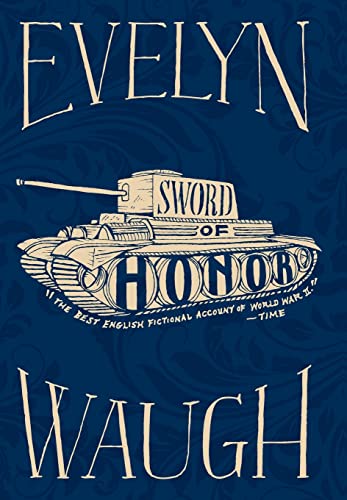
Book Break: Sword of Honor

Last month, I drove to Michigan and back on consecutive weekends. Roadtripping comes easily for me, especially with a good audiobook. During the winter, I saw an article on the Imaginative Conservative website about Evelyn Waugh’s Sword of Honor trilogy, and since I haven’t read anything by Waugh since Brideshead Revisited in 2011, it seemed like a solid choice.

In case you don’t know (I didn’t): Arthur Evelyn St. John Waugh is a British man; an author, journalist, and book reviewer; a World War II veteran; and a twice-married convert to Catholicism. Sword of Honor comprises three separate novels published in chronological order: Men at Arms (1952), Officers and Gentlemen (1955), and Unconditional Surrender (1961).

The books trace the wartime story of Guy Crouchback, the only surviving son of a once well-to-do Catholic family in England, who is floundering after his beautiful but promiscuous wife leaves him for another man (and another, and another) in the early days of World War II. Despite being older than most recruits, he joins the Army to escape his loneliness and reassert himself as a man—God willing, to do something meaningful with his life.

Continue reading

Byline: J. Thorp

I was doing some work for an old friend and former employer today and found myself reflecting on the wide variety of writing I’ve undertaken for pay in the past 30 years. Beginning as an undergraduate working in the Yale School of Music Concert Office, I’ve been creating marketing materials and writing profiles, features, articles, and speeches on everything from interior design to kung fu to the public impact of higher education.

So, just for kicks, here are a few recent bylines I’ve rediscovered. For those that are available online, I’ve included links.

Continue reading

Book Break: Technopoly

Now for something completely different: I haven’t been writing nearly enough and am way behind on books I’ve read and would like to share. Most of the books I share are fiction, spiritual, or both. Technopoly by Neil Postman is neither.

This book came to me as an unexpected Christmas gift from our son Brendan’s friend Nick, who was his roommate at University of Mary and is now a seminarian for the Diocese of Milwaukee. Brendan has always been a curmudgeon and skeptic regarding technology; Nick, not so much, until he started reading more deeply on the subject. Then, he started spreading the word, including by giving our family a lightly used paperback copy of Technopoly.

One of the concepts that intrigued me as a young anthropology major was the idea that, at a certain point, our ancestors began to compete technologically rather than biologically, meaning that, at a certain point, our ancestors crossed a threshhold and were no longer strictly beholden to their biology to survive—the fittest was not necessarily the fastest or strongest hominid, but may be the cleverest one, with the best tools.

I’m certain that, soon afterward, our ancestors saw another defining characteristic of our species: Our solutions to problems often cause other, unforeseen problems. Indeed we can see this in the anthropological record, with evidence of hominids using “tools” to club each other to death beginning nearly half a million years ago.

Continue reading

Never Just a Number

Note: This post appeared in the St. Michael Catholic Church bulletin for Sunday, October 18, 2020.

In case you haven’t notice, election season is in full swing. Pollsters, pundits and politicians are slicing and dicing the American people to predict what is likely to happening on Election Day and afterward. Republicans versus Democrats. Liberals versus conservatives. We are counted and calculated by culture, color and creed—to what end?

My son’s theology teacher recently gave me a copy of a book I’ve meant to read for years now: Society and Sanity by Frank Sheed. I started it last night, and for a book written in the 1950s, its relevance even in the first few pages is staggering. Sheed opens his book by making a simple and eloquent case: In order to create a society in which we humans can live together in peace, happiness and freedom, we must know what it means to be human.

We need a clear understanding of what we are and why we are before we can clearly conceive of our happiness and how to achieve it.

Continue reading

Worth Living

I am blessed this morning to be sitting in the morning sun, overlooking a lake, drinking coffee and listening to an abundance of birds of all shapes and sizes squabbling over breakfast. Swallows and sparrows, redwings and robins, hawks, herons and hummers, filling the air with a cacophony of sound. The blue of the sky is reflected in the rippling water; all else is gold and green, as from my perch I watch three varieties of squirrel cross-crossing the grass seeking food: sleek grays, feisty reds and bold chipmunks.

That God would grace creation with even one prototypical bird or rodent is nothing to sneeze at, and here are so many different kinds, each beautiful in its way—and each created for us.

Do you realize? We believe that all of Creation in its incredible variety was made, out of love, for us. God worked for six “days” establishing the order of the universe and the wonders of the living world, and then made us in His image, giving us stewardship of everything.

And behold, it was very good.

Continue reading