The past couple of days I’ve been plagued by memories: guilty recollections of past sins, glimpses of images I never should have seen, bits of off-color or debauched “humor,” lyrics to songs that should not be sung.
Beginning in college, this was my rebellion. I looked at, listened to, and watched whatever I wanted. And in short order, I proved the adage, “Garbage in, garbage out.” During much of my college years, I swore like a sailor; I told dirty jokes to old friends and new acquaintances, and I made excuses for my behavior—to others and to myself.
“It could be worse,” I said, and I knew I was right. I had a vivid imagination, and worse played out in my mind if I lingered too long on any impure thing.
Thanks be to God, over the first ten year of my marriage to Jodi, I weeded these things out of my life. Little by little I dropped the jokes, kicked my swearing habit, left porn behind, stopped watching racy movies, and cleaned up my taste in music. And beginning with one no-nonsense confession with Fr. Siebenaler, in which he politely but firmly questioned my resolve to actually amend my life and advised me to open myself to Jodi and ask for her help, I left off making excuses, and began instead to apologize.
So here we are, more than a decade later, and the Enemy is at work again: I find myself mindlessly mouthing the music in my head, only to realize it’s some obscene gangster rap fantasy or metal mayhem I laughed at as a younger man. In my mind’s eye I see images I haven’t looked upon in years, like a sin scrapbook I can’t help but leaf through, gazing at memories best forgotten.
That’s the first point of this ramble: you can’t forget. What your brain takes in is filed away for later reference. Every image, every word, is there, tying you to past experience. And those things you subject yourself to again and again, out of desire or habit? Your mind naturally assumes they are important, forging shorter, stronger connections so they can be easily accessed.
I can’t recall yesterday’s discussion with my bride, but I remember every detail of my past sins, with a clarity that repels the spirit and tempts the flesh anew. The Accuser seeks to set me against myself—but I know now I must seek every day, every moment, to purify both body and soul.
That’s the second point: The struggle against sin is noble and never-ending, to be sure, but all struggles are not created equal. The struggle of the rabbit in the snare speeds its demise; it kicks and thrashes against the noose, which only tightens against its efforts.
That was me, in the confessional all those years ago—declaring sorrow for my sins but unwilling to even attempt to remove my head from the strangling wire. The death brought about by sin cannot be escaped by panic, emotionalism, or bodily struggle. It is a spiritual struggle, requiring prayer, persistence, and genuine love of neighbor and of self. At some point, all the plans, safeguards, and accountability measures boil down to a decision: Am I going to stop doing these things or not?
How does one become a saint? Will it.
Finally, the third point: We don’t have to remain bound in these chains of memory, because God’s love is mercy.
This is not the first time I’ve struggled with recalling past sins and feeling old remorse and new temptation. The last time I remember it as strongly as this, our pastor, Fr. Richards, advised that I repeat the prayer, “Jesus, I trust in you.”
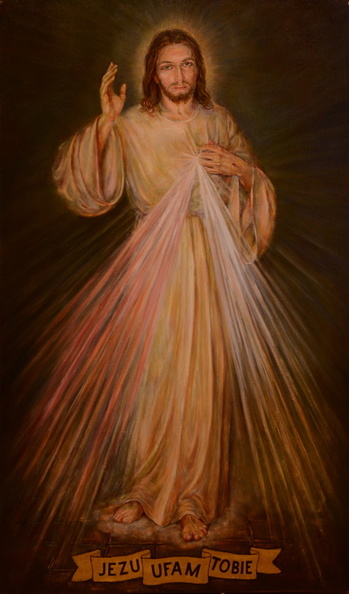
At the time he told me this, it didn’t click with me that these are the words of the inscription at the bottom of St. Faustina’s image of Divine Mercy. (“Jezu ufam tobie” in the original Polish, above.)
Jesus, I trust in you. I trust in your mercy. I trust that you have forgiven these past, confessed sins. I trust that you continue to forgive me. I trust that you love me.
We are washed clean in the blood and water that flow from His Sacred Heart. We need not linger in darkness or doubt. He loves us. He forgives us. He saves.
 Born Helena Kowalska in Głogowiec, Poland, in 1905, to a poor, religious peasant family. Felt called to religious life at an early age, but went to work as a housekeeper to help support herself and her family. Accepted to the Sisters of Our Lady of Mercy (OLM) in Warsaw in 1924, and in 1926, received her habit and the name Sister Maria Faustina of the Blessed Sacrament. Began having visions of Jesus as “the King of Divine Mercy” in February 1931, instructing her in His love and mercy, asking her to to paint His likeness with the inscription “Jesus, I Trust in You,” and to establish a feast of mercy in the Church. View a more complete biography here.
