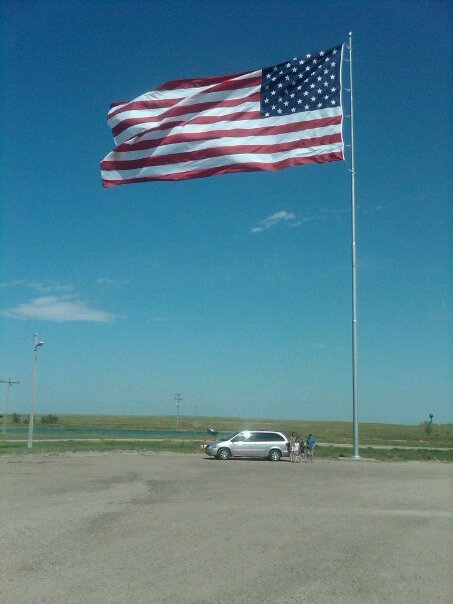
The Good Life

Jodi and I were talking the other day about making peace with what we have. She’s wanted a bigger house in a nicer neighborhood with more children the age of ours; I would like a bigger vehicle (like a Suburban) and think an Airstream like my sister’s would be great fun. Instead, this winter we’ll shoehorn a fifth child into a three-bedroom, mid-80s split-level and well-used Chrysler minivan…and when we want to camp, we’ll break out the tent.

Have we settled? In some sense, I suppose – but this new baby was a mutual decision and something the entire family wants more than a new house or car. Materially, we are fine with what we have.

Some folks want the best of everything, and in a free country, they are free to pursue it. As for me personally: I want to be left alone, to pursue my own version of happiness. I want a close, loving family; a good community; the freedom to worship God in the way we see fit. I want to hunt and fish when I can, to brew beer and to bake sourdough and to accidentally blow up my garage or make myself sick in the process. And I don’t need anyone to guarantee my medical care. I don’t need state-of-the-art treatment or extraordinary measures – I need a doctor I can trust and the ability to say “when.”

On this Independence Day, it occurs to me how blessed we are. It’s a wonderful thing to live in a country where all of these things are still possible: where Jodi and I can raise a Catholic family; choose a fifth child and not care about the gender; and do what we want with our money, our free time, and our health. It seems as though these things are at risk; that, like General Motors and AIG, our government has become both dysfunctional and “too big to fail” – and that regular folks are rapidly becoming, not the end, but the means. So today, let’s thank God that we live where we do, but recommit ourselves to the safeguarding the freedoms we celebrate – not state-run stability (which seems laughable during the current budget stalemate) but the risk and reward of happiness defined, pursued, and attained by we the people, as we see fit.

The Second Third, Week 32: Growing Up Dad

“Our similarities are different.”
– Dale Berra, son of Yogi

In my most recent Second Third post, I insisted I was becoming (rather effortlessly) more and more like my father. The interesting part, to me at least, is that the more I become like him, the starker our differences seem. Eventually we’ll be identical, and nothing alike at all!

It makes sense in a strange way. Part of Dad’s charm – and, I believe, a big part of why he looms so large in the lives of so many – is that he is thoroughly an individual. He looks how he looks, believes what he believes, and lives how he lives – and is completely unapologetic about it. You can take him or leave him, and he might prefer the latter.

I am not so thoroughly individualized. I still work in a collaborative and political environment in which one must be flexible and take alternative views (many, and often somewhat obscure, alternative views) into account. Dad is oak, not willow: straight, tall, deeply rooted, and hard; inspiring, hot-burning, and impervious to shifting winds.

We also have different aptitudes. Dad didn’t enjoy school, and wasn’t a voracious reader until later in life. He’s always been gifted with mechanical ability, spatial intelligence, and will power. In these ways I am his opposite—but (thankfully), I did inherit both his and my Mom’s persistence. Given time, I’ll make it work, make it happen, make it come out alright.

Nevertheless, I am growing into him. He is not a man of faith, but of deep conviction; my Catholic faith has led me to a similar place, in which the grays of young manhood are reconstituting into their constituent blacks and whites. His full beard and Amish-meets-mountain-man appearance have emerged in me as an unruly mop of hair and pincushion goatee, and jeans and western boots at work. His politics and inclination to be left alone are manifest in my politics and inclination to be left alone, and his willingness to be firm with his children and die for them in a heartbeat shape me more every day.

My sense of humor and involuntary tendency to play word games are his, too. One standard eye-roller for our kids: when someone says, “I’m too tired,” I ask, “Like a bicycle?” I also make up random lyrics to old songs, and spontaneously invert the first letters or sounds of word pairs…and then rhyme them to make new pairs. For example, Dad will call my mother “peety swie” and their dog, Maggie, “duppy pog” or a family favorite, “mirthless what.” (Don’t concentrate on the words; flip the first letters and sound it out…) An example from our house: I took to calling Emma Rose “Rosebud,” then “Boserud” – then ultimately “Nosecrud” if I want to get her goat. Should you find that cruel, consider that I was referred to as Dogbreath for much of my formative years. We played these games all the time when we were younger. Dad loved “runny babbit” well before I’d ever heard of the Shel Silverstein book.

I’ve been told I look more like him, sound more like him, move more like him. In my Second Third, I hope we will become just the same. Only different.

The Second Third, Week 25: No News Is Good News

Blogger’s Note (unnecessary): This Second Third post was supposed to come before last week’s post. Last week’s post wasn’t posted until yesterday. And both are a slow build of sorts, toward a completely different post that needs more time and stewing. In my head, it’s going to be great.

I mentioned in “Less TV Is Good TV” that I used to love to watch This Week with Sam and Cokie. I used to devour news: I worked as a journalist, then as a media relations manager; I watched Peter Jennings (and sometimes Tom Brokaw); I listened to Morning Edition and All Things Considered and supported NPR with my ears and my dollars. I daydreamed about launching a Slashdot-style web site trafficking in political news and rumors instead of tech stuff. I even had a name and a URL at one time: Rabblerooster. Get it? Like a “rabble-rouser” combined with a rooster…wake up and smell the coffee!

I used to get emotionally wrapped up in the news. Still do, in fact. I get angry, or choked up, or joyfully buoyant based on things happening half a world away, to complete strangers. And that’s beautiful…to a point. But over time I’ve come to realize that A) we’ve got plenty of news and compelling stories unfolding right next to us, and B) nobody’s got the straight scoop, so nobody’s giving it. I’d get riled about stories that were only half true, and wonder what I could really know for sure about what’s going on in the world…then realize that the only thing I can really understand and influence is what’s going on with me, right here, and to a lesser extent, with my family, neighborhood, and community. As a result, I installed tighter filters and began to tune out.

The timing was perfect, actually. TV news is entertainment now, and there are so many faster, easier sources of information. I try to track a variety of online news sources enough to keep tabs on what’s happening out there, and when something catches my eye or interest, I try to read accounts from the Right and the Left, then make sense of it myself. And I ignore a lot more “news” that I once would’ve obsessed over. And my heart is at peace.

I rarely watch TV news at all anymore. (I did flip it on the other night; I was in bed, setting my cell-phone alarm, when a friend posted something on Facebook about Bin Laden’s death. My laptop was already packed up for the morning commute, so I flipped on the tube.) I still listen to the news on the radio — I’ve always been an auditory learner (hence my regular attendance of college classes and lack of reading) and love good radio — but today I balance my NPR with Relevant Radio and Garage Logic, and keep my filters clean. And sometimes I willfully secede from the news stream. On a beautiful spring day like this one, for example, no news is good news.

Pre-Election Rant-A-Day 8: VOTE!

Blogger’s Note: This will be my final rant, for awhile, at least. To tell the truth, I finding the Rant-A-Day format completely exhausting. Not sure I’ll even be able to muster a little righteous indignation tomorrow, which is a pity, especially when watching election returns. I don’t know how the cable pundits do it day after day…

I had another long, ranting rant planned on a whole other topic loosely related to the election. But no. Just vote tomorrow. Vote as if you life depended on it, because maybe one day it will. Vote because someone fought and died so you could. Vote because someone fought and died because they couldn’t. Vote because your kids need that example. Vote because they need a future only you can give them.

Don’t like the major-party candidates? Me neither. Vote third-party, then. Don’t want to throw your vote away (or don’t like the third-party folks either). Me neither. Pick one. Hold your nose and have an opinion. (And next time, consider running!)

Want to gripe about the sad state of politics and government. Vote. Want to change the direction of a nation? Vote. Don’t miss this opportunity. Don’t cede power. Don’t give up control. Read up, get up, line up, vote.

Or don’t come cryin’ to me.

Pre-Election Rant-A-Day 7: Most Politics Should Be Local

Blogger’s Note: One more rant after this one, If I can get it together. Feel free to look at the past six, as well, and comment if you like. Or not.

“Excessive intervention by the state can threaten personal freedom and initiative. The teaching of the Church has elaborated the principle of subsidiarity, according to which ‘a community of a higher order should not interfere in the internal life of a community of a lower order, depriving the latter of its functions, but rather should support it in case of need and help to coordinate its activity with the activities of the rest of society, always with a view to the common good.'”

Catechism of the Catholic Church (CCC), 1883

It’s worth looking at the larger context of the quote above before Election Day — it’s food for thought whether you’re Catholic or not. Of particular interest is paragraph 1881 — “Each community is defined by its purpose and consequently obeys specific rules; but ‘the human person . . . is and ought to be the principle, the subject and the end of all social institutions.'” — and paragraph 1885: “The principle of subsidiarity is opposed to all forms of collectivism. It sets limits for state intervention. It aims at harmonizing the relationships between individuals and societies. It tends toward the establishment of true international order.”

Subsidiarity, according to Dictionary.com, means two things, both of which I am personally partial to:

  1. (in the Roman Catholic Church) a principle of social doctrine that all social bodies exist for the sake of the individual so that what individuals are able to do, society should not take over, and what small societies can do, larger societies should not take over
  2. (in political systems) the principle of devolving decisions to the lowest practical level

What we’re talking about, essentially, is local control. Who better than ourselves and our neighbors to solve the problems in our back yards? Who better to rally around the new mother, the unemployed father, the sick child, than friends and family, church and community? Why on earth should we send so much of our resources half a nation eastward to be reallocated when we have plenty to do here at home, and plenty of smart folks with similar goals to do it?

We waste so much time, energy, and money on the national campaigns and the race for governor, and too often can’t name our local reps, school board and city council members, or mayor. We want them to have our backs, but we vote for the state and national policymakers who pass the laws that tie their hands. Those in power take money out of local communities; local communities can either raise property taxes, cut services, or both; and we complain no matter what. Is it any wonder that our local officials who go on to state or national office mold themselves into professional politicians? It’s because that’s what we reward! We expect their service and support for local priorities, and are outraged when they fail or fall…but where are we the rest of the time? How many of us will go to the polls on Tuesday, look at the local races and vote for the two or three people we might know (or whose names we might recognize) and vote “incumbent” or party lines for the rest?

I’m as guilty as most: My big step forward in the last year or so was to cancel our once-a-week subscription to the Sunday edition of the Minneapolis Star-Tribune and reinvest a portion of that money into our local weekly, the North Crow River News. I’m slowly beginning to know who’s who and to get involved in community service at home, instead of at work in the Twin Cities. But I still wouldn’t know our mayor by sight and couldn’t name a single city councilperson.

Former Speaker of House Tip O’Neil is credited with the adage, All politics is local. In truth, politics should be local — but these days, most of politics looks coastal and feels feudal. We need to take personal interest in our local elections and vote to keep as much control as we can here at home. We should take care of our own.