(Pro) Life, Without Religion, Part 1: It’s My Body!

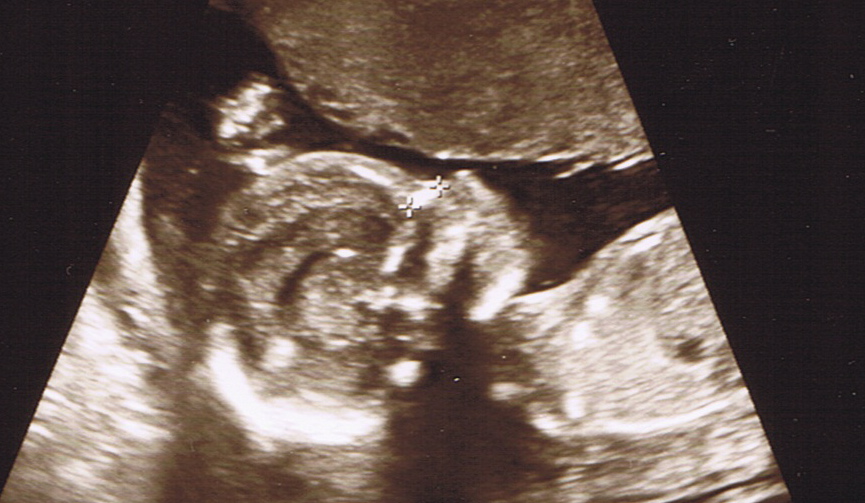
This morning Jodi and I saw the face of an angel — our angel, a tiny new Thorplet, just 11 ounces now at 18 weeks of development. Our baby pulled away from the attempts to examine his or her feet, just like all of our children, but otherwise kept uncooperatively still, making it difficult to get a good look at the tiny, chugging heart. When the sonographer was finally finished her thorough examination, she took the photo above: a tired wee child, hand above head, resting peacefully.

I’ve always loved ultrasounds. In part, it’s the geeky wannabe scientist in me, but mostly, it’s the wonder and sweet jealousy of seeing our tiny baby alive and safe inside the love of my life, and knowing that yeah, I can pee standing up, but I’ll never feel life moving within me. This was a level-2 ultrasound: given my bride’s so-called “advanced maternal age” (I wouldn’t begrudge her a right cross next time someone says that…not this time, but next time…) they offer it as a way of taking a closer look at how both the baby and the mother are progressing. We turned down all the other tests and genetic screening, but taking a closer look at our little one and Jodi, especially given the size of our babies, seemed like a good idea.

The photo above was the highlight of the hour or more we spent in a dimly lit room with the sonographer. It was worth the wait, but to be honest, I was more excited about these two images:
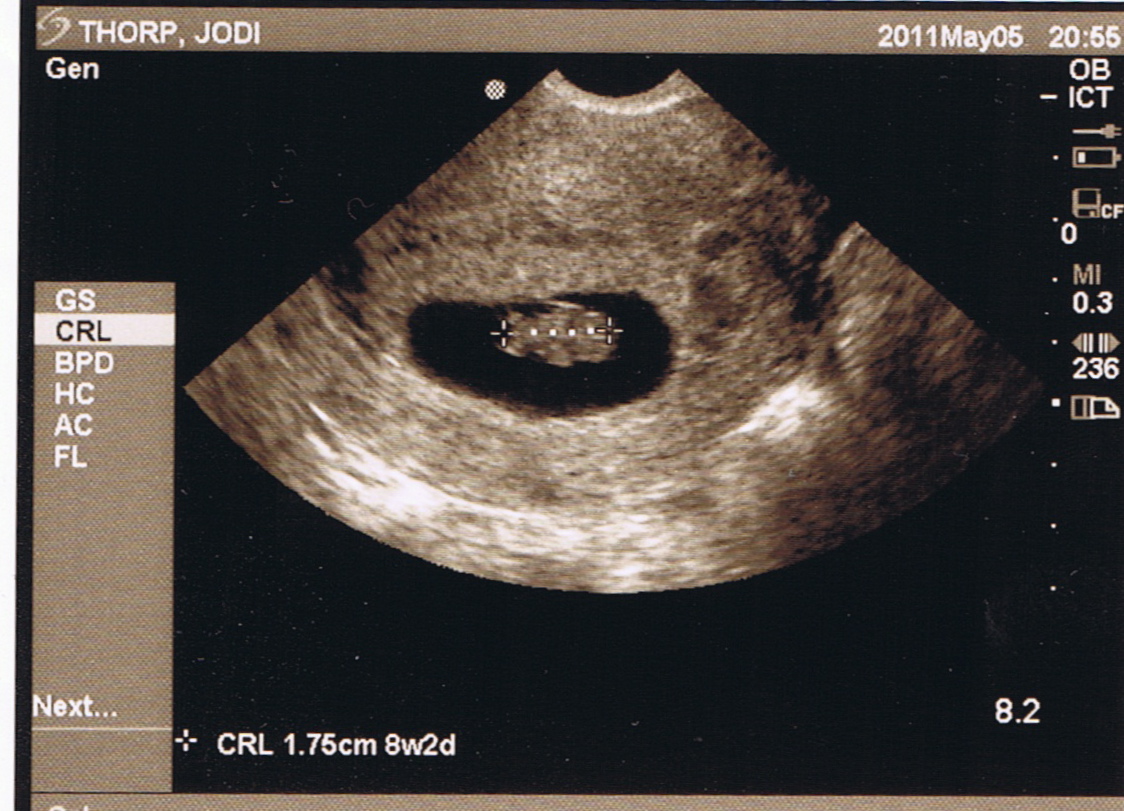
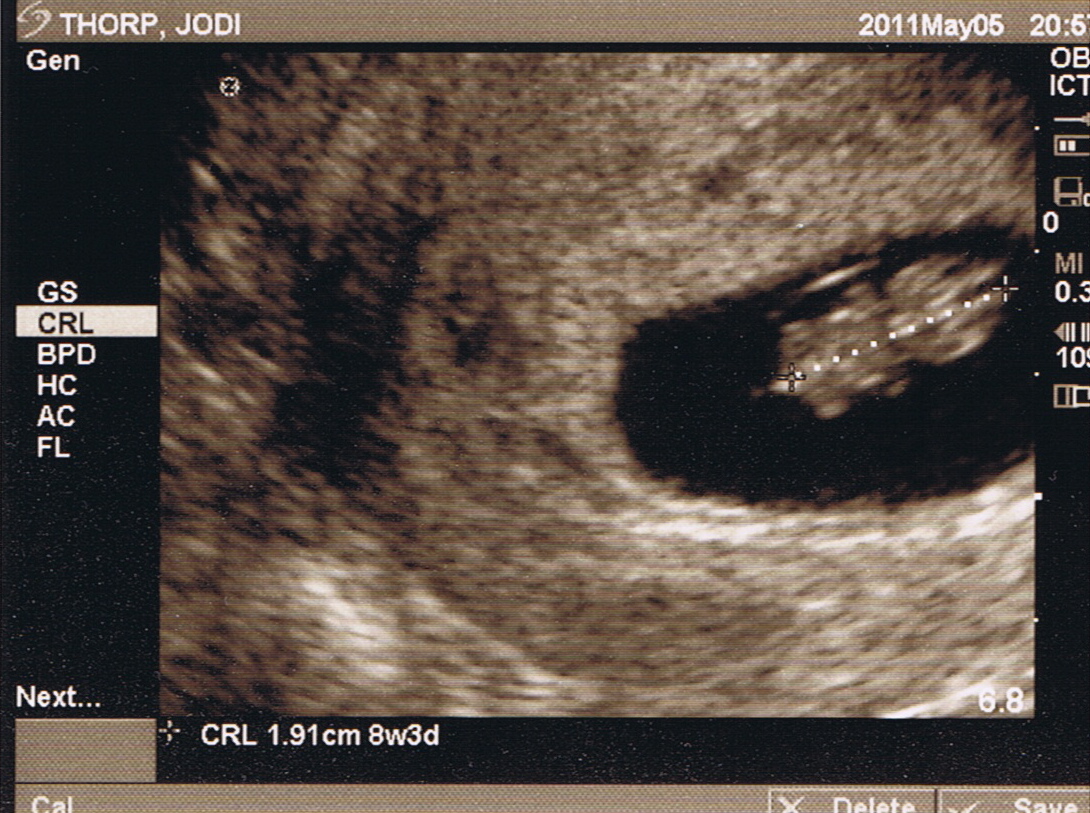
These show our baby at just eight weeks of development. We’re looking down on him or her from above, with an absolutely Thorpian head to the right, and a torso with four tiny limbs extending to the left and down in the lower image. This was a thrill, not only because we lost a little one last fall and were hoping for an “all systems go!” from our doctor, but because there on the screen was a tiny person, less than two centimeters long, with a beating heart and legs and arms that moved independently of any thought or command from Jodi or me. A child the size of my fingertip who, just before Christmas, we will be blessed to welcome and trusted to raise.

Some people say miracles are impossible; others believe they happen, but only rarely. I believe miracles happen daily, all across the world. I’ve got photographic proof.

As we drove home from the earlier ultrasound, I was reminded of an extended argument I had once, on a political blog in South Dakota, with a staunch and pseudonymed liberal who dismissed me and two of my friends as Bible-thumpers for being against abortion. I explained to him that, on the contrary, I studied physical anthropology and human evolution in college and was anti-abortion well before I became a practicing Catholic. I articulated to him a set of arguments against abortion, completely independent of religious belief or church doctrine, and asked, then begged, then dared and taunted, him to engage me on them. He would not.

What came back to me as we drove home was the first argument I offered to him. As I recall, he insisted, on behalf of women everywhere, that “It’s their body; it should be their choice.”

“Which part of their body is it?” I asked.

An abortion removes something from a woman’s body, without a doubt. If what is removed is her, or some part of her, then it should share both her gender and her genes, and she should be somehow physically diminished, something less than the whole and functional woman she was before the procedure. If she had her gallbladder removed, for instance, or a toe, a mortician or coroner might note such a thing upon her death.

A woman who has a “successful” abortion, however, emerges physically intact, but no longer pregnant. What is removed, though taken from within her, and attached to and dependent on her, is not her — not genetically, and not logically. (In my online arguments, I moved from what a fetus isn’t, step by step, to what it is, over several exchanges. In time, I think I’ll do the same here.)

This was made clear again to me when I saw our tiny infant, wriggling in amniotic bliss, at eight weeks of development. Jodi had no say in the flailing of those tiny arms and legs, and that tiny heart beat in part because of, but not for, her. No choice on her part, short of violence, could have stopped it.

And of course, it was made clear yet again today when we saw that beautiful profile at the top of this post. There’s a reason that the Knights of Columbus and other Catholic and pro-life organizations are investing in ultrasound machines for clinics and teaming with expecting mothers to show live ultrasounds of their babies to middle- and high-school students. There’s no better way to recognize the humanity of others than to see them face to face.

The Second Third, Week 33: Taking It All In

Blogger’s Note: Sorry so late. On the road in South Dakota.

In many ways, , our fifth child is a second chance of sorts for me. It’s been seven years since Jodi’s been pregnant. I was involved in the past: I attended doctor’s appointments when I could, encouraged my bride and cut the cord, helped with the older kids and the baby when practical, and generally tried to be a good dad. But even with Trevor — even though we thought we might be done having children — I never thought of it as over or that I’d miss anything.

But I did miss it. My wife is beautiful always, but uniquely so when pregnant, and the miracle of new life has not lost its wonder. So in my Second Third — since this may or may not ever happen again — I’m taking it all in: every appointment and ultrasound, the anticipation, the excitement of our children…and in December, God willing, every moment and change in our new growing baby. I cannot wait. Best. Christmas. Ever.

The Second Third, Week 27: New Growth on the Family Tree

Blogger’s Note: In my last Second Third post, I dug into the roots of my family tree. Today, let’s examine the newest blossom – and how we got to this point!

When Jodi and I first got together, she wanted six children, just like the family in which she grew up. I, on the other hand, knew I wanted children, but thought one or two would suffice. I had learned in my anthropology classes that large families were irresponsible — that our planet could not support humanity’s continued exponential growth, and that America’s resource-intensive consumer culture would drain the Earth even more quickly that other, faster-growing nations.

So I told Jodi, “We’ll see.” I knew that, over time, things would change. And they have. Earlier this week my bride and I announced the best thing to happen to our December since Christmas: the anticipated arrival of a fifth Thorplet.

The kids are ecstatic. Trevor longs to be a big brother; Emma has wanted to roll the dice on a little sister for years; Gabe adores all babies (and has verbally agreed with Emma that “we could use another girl around here,” which, given his history of rabid anti-sisterism, demands the question, “Use her for what?”); and Bren – our eldest, who wants his own room and has complained that our house is too small – has been grinning for days now. He knows just enough, I think, that this new addition is equal parts miracle, mystery, and science project to him.

* * * * *

My evolution into a father of five (six, when you count Jude, whom we lost last fall) began early on, with the way in which Jodi’s quiet faith drew me like a magnet. There is a peace about my bride that, I recognize now, is not of this world. Most of the time she is unworried, unflappable, confident that the world is unfolding as it should, despite appearances to the contrary. She led me slowly, steadily, to conversion – first, back to the Catholic Church, then to a previously inconceivable closeness with God, then to the gradual realization that marriage and sexuality are meant to be more than the “sum of our parts.”

On top of this spiritual conversion came four important, practical realizations. First, although we had planned to wait until we were more “financially secure” to start having children, we became pregnant with Brendan only about six months into our marriage – demonstrating that A) there is only one fail-safe way to not get pregnant and B) you’ll never be more or less ready than you are right now. Second, we realized that once you have your first, you might as well have more if you want ’em – you’ve got the baby gear, the mindset, and (when you’re young) the energy, plus the sooner you bring them into the house, the sooner you get them out! (For the past several years I’ve taken great pleasure in reminding my friends who waited to have kids that I’ll have all four of mine graduated before I’m 50. C’est la vie, I guess…) So we forged ahead – and Gabriel was born.

Now, I realized right out the gate that I loved being a dad. So when Gabe was born – at the point at which pre-child/Ivy-grad me would’ve said, “That’s it; no more – it’s the responsible thing to do.” – my heart was whispering girl-baby, girl-baby, girl-baby.

I struggled against this urge for awhile and came to a few other practical conclusions. First, although I have concerns about the wider world, our decision to bring another child into it – a child who would be well loved and well supported – would have little bearing on the allocation of resources in the world, but had the potential to sow peace and charity in a world in sore need of both. (For the record, we discussed adoption, as we have many times since, but felt our own limited resources could do more good raising our own children here in our own community.) Second, the more I thought about the social pressures in this country (and regulations in others) to limit families, the more I saw them as questionable means to a questionable end: a society in which freedoms were relinquished and families were engineered (and parenting outsourced) for the “good of the state.” Finally, I began to notice an inverse relationship between family size and per capita resource consumption in the families around us – put simply, most of the childless and only-child families I knew spent more, used more, wasted more, and still wanted more, than the bigger families I knew. Hand-me-downs, left-overs, gardens, and shared bedrooms conserve resources, too!

As if in affirmation of our choice, we were promptly blessed with Emma Rose. Shortly thereafter, we moved to Minnesota. We talked about a fourth child, but faced two challenges, one financial (the cost of daycare for four kids in or around the Twin Cities) and one psychological (the fact that most of our first friends and colleagues here thought it was ludicrous to have three kids, much less four). Fortunately, we had unwittingly settled in a veritable hotbed of Catholicism and big families—so when we had Trevor, we found that we also had support. Ultimately the families we met through St. Michael Catholic Church – and our tremendous priests brought us to an even greater understanding of what a blessing each and every child is: if you believe in God – if you believe that the world is unfolding as it should, despite appearances to the contrary – a new life here, there, or anywhere, is a gift meant to serve a Greater Good.

* * * * *

I remember once, early in our relationship, using the phrase risk of a baby. I was aghast as soon as I heard my own words…but it’s typical of the world today. In Genesis, God tells Adam and Eve, “Be fruitful,” but today, that original blessing is often regarded as a burden that we must sterilize in the act, or “fix” permanently. It reminds me of Christ on his way to the cross, speaking to the mourning women:

“Daughters of Jerusalem, do not weep for me; weep instead for yourselves and for your children, for indeed, the days are coming when people will say, ‘Blessed are the barren, the wombs that never bore and the breasts that never nursed.’” – Luke 23:28

So here we sit, in our Second Third of life, with number five on the way. No more thoughts of “a whole new life together” when we’re 50, but that’s okay – the life we have is pretty spectacular. And the good news is that it gets easier. Think about it: your first child is revolutionary; it completely changes everything you’ve known before. Number two is big – 100% increase over number one; double the trouble, etc. Number three? That’s only a 50% increase over what you have already; the biggest problem (if they’re small) is you only have two hands, so one parent can’t restrain them all at once. After that, number four’s a piece of cake.

And now, with a six-year gap between the baby and our youngest, the first four can raise number five. Y’know, folks in the Twin Cities this might be called ostentatious, unsustainable, even irresponsible – but in St. Michael and Albertville, it’s a comfortable starter family!

With Child

People everywhere are having babies, and it’s about time somebody said something. First, a question: do people say “with child” anymore? I kind of like it – it lends a certain gravitas to the proceedings. Moreso than, say, “preggers.” Try it: She’s with child. Now try: She’s preggers.

Totally different.

Second, a poem of sorts – something I wrote several years ago, when we got together with some friends, and the ladies started comparing bellies.

* * * * *

small wonder

a friend who is pregnant dreams a
golden sunshine painted on her belly.
is that so strange? i watch her husband
circle – he is drawn to her, not close but
never far. she is one of three with child
radiant and exhausted, and
we men talk as though we never
wish to feel the kick of tiny feet
a somersault or hiccups; like we
do not wonder at our wives resilience.
they sip their drinks and hold their sides,
their backs; their bellies impossibly round
as if inside they bore the world
like Atlas, on their hips – small wonder
we can’t pull away from such a cosmic thing.

j. thorp
20 feb 02

* * * * *

Congrats to new moms, old moms, experienced moms, professional moms, surprise moms, renewed moms, moms-to-be, and moms-thrice-over. You’re amazing.