Book Break: Captivity and Freedom

I recently completed two biographies of great Americans, set roughly two hundred years apart. Both books tell stories of oppression, resistance, and the struggle for freedom. Both are great books, in very different ways. I’ll offer a few quick thoughts on each, but in short: read them!

American Cicero: The Life of Charles Carroll
by Bradley J. Birzer

American Cicero tells the story of the bastard son of a wealthy colonist who is sent abroad for a Jesuit education, is formally named his father’s heir, and returns home to Maryland to become one of the early advocates for independence from Britain and one of the foremost shapers of the fledgling American republic. If you aren’t a history buff, you may not know (and if you aren’t a Roman Catholic, you may be surprised to learn) that in his day, Charles Carroll was well educated and capable (not to mention from the wealthiest family in the colonies) and could neither vote nor serve in public office — because of his “papist”tendencies and “Romish” influences. He is also portrayed as a devout Englishman who nevertheless saw independence as a necessary fresh start for the English constitution and English law, which were being usurped and corrupted by the government elected to uphold them.

Carroll initially took the public stage by writing under a pen name in the newspapers of his home colony of Maryland (the most anti-Catholic of the lot in his day), earned the trust and admiration of Washington, Franklin, and others among the founders, and outlived them all — and relatively few have heard his name. Here is a man who, with all his money, couldn’t buy a vote (and would never have tried); who advocated against democracy and in favor of a republic based on his reading of history and the times; and who drew on the ancient Greeks and Romans and his own faith tradition, as well as contemporary thinkers, to propose limits on the power of both the government and the “mob” in order to preserve those rights. In my review of Triumph: The Power and Glory of the Catholic Church, I asked if the author’s apparent preference for the monarchies of old was personal, or somehow tied to the Church — I think you can begin to see a sensible philosophical connection here, in Carroll’s dismay at the more populist, democratic leanings of some of his contemporaries. (This is not your high school’s American history!)

The author is the Russell Amos Kirk Chair in American Studies, Professor of History and Director of the Hillsdale College Program in American Studies,  and is also the author of  J. R. R. Tolkien’s Sanctifying Myth: Understanding Middle-Earth. Birzer tells the story as much as possible though Carroll’s own public writings and private letters, and this is an academic history, so it is not a breezy read.  Nevertheless, I thoroughly enjoyed getting to know this relatively unsung Founding Father. I enjoyed Birzer’s ability to connect Carroll’s thinking to his education and core values.  This book is well worth the effort!

For additional perspective on the book and the author, check out this interview with Ignatius Insight.

Unbroken: A World War II Story of Survival, Resilience, and Redemption
by Laura Hillenbrand

This is a true-life tale of Gumpian proportions: a young misfit from a working-class Italian family (complete with a doting mother and an impeccable older brother) graduates from thieving prankster to Olympic track star and meets Hitler in the 1936 Olympics. A gifted athlete (on track to be the first man to break the four-minute mile) has his athletic career cut short by World War II and becomes a bombardier on a B-24 in the Pacific Theater, surviving a temperamental plane, numerous missions, and long odds while enjoying the celebrity of being both an athlete and an airman. A World War II veteran endures weeks adrift in a life raft with two wounded comrades, battling starvation and dehydration, sharks, madness, and occasional strafing, only to come ashore in Japanese territory and become a prisoner of war. A POW is singled out by the Japanese for his celebrity and made to endure physical, mental, and emotional tortures for more than two years of captivity. A survivor of Japanese prison camps returns home and marries a vibrant, blue-blooded beauty despite warning signs that the war has taken a psychological toll.

Any one of these story lines could make a novel or a movie in itself — the fact that all of them really happened to one man is almost too much to be believed. Louis “Louie” Zamperini is still alive, 96 years old and active decades after he should have been dead so many times. He comes from an earlier time when track stars and airmen were celebrities, and, like Norman Borlaug, is an unsung Great American who should help us redefine “hero.”

Louis Zamperini

This is not a book for the young or faint of heart — the treatment of POWs by the Japanese is brutal and horrifying, and the book includes scenes of inhumanity you may not soon forget. In this respect, it called to mind two other books I wrote about not long ago — James Clavell’s Shogun and Shusako Endo’s Silence. I recall past conversations with previous generations about how veterans of the World Wars came home and went about their lives, but veterans of later wars began to report emotional scars and psychological impacts. The implication, in some of these conversations, was that men have softened — but Unbroken makes a distinction, based on historical data, between the mental health of POWs in the European theater and POWs in the Pacific theater. This led me to ponder whether, in wars with Eastern cultures, Westerners are encounter philosophies with such different rules (or no rules at all) that we are, in fact, ill-equipped to deal with them.

The author, Laura Hillenbrand, does great work writing a biography you can’t put down, with a level of historic detail that does not diminish the readability of the book, but lets you know that she did her homework. Internet evidence suggests Louie Zamperini’s story may soon become a movie. Don’t wait for the movie — you’ll miss the chance for a fresh read of an exceptional book.

Servant of the Servants

My daily commute has been a blessing of late: relatively smooth and expeditious, with just enough windshield time to pray a morning rosary, then listen, think, and free associate to my heart’s content. This morning’s mental ramble started as I got into the car and backed from the driveway, already reciting the Creed. I made my way slowly through our neighborhood, announcing my morning intentions as I went (the conclave to select the new pope first and foremost today) and turned toward the freeway. As I rumbled over the railroad tracks, I recalled it was Tuesday, and thus, the Sorrowful Mysteries. I thought of that humble title of the Holy Father: the Servant of the Servants of God. I thought of Pope Emeritus Benedict XVI, and Blessed John Paul the Great before him — each a suffering servant and an image of Christ. I thought of the college of cardinals contemplating, voting, perhaps praying that theirs was not the name called. Heavy is the head that wears the crown…

* * * * *

Last night on the way to Brendan’s wrestling banquet, Bren, Gabe, and I were discussing the presidency.

“Did you know,” said Gabe, “that calling the president ‘Mr. President’ isn’t something you have to do? It’s just what George Washington asked to be called, and now everyone else does it, but it’s not a rule or a law.* So a president could ask to be called whatever he wanted. Wouldn’t it be funny if the president said he wanted to be called King?”

“It would be even funnier if he wanted to be called King George,” said Bren.

“Did you know,” I said, “that people supposedly wanted George Washington to be king after the Revolution, but he refused? The story is that he didn’t want to win independence from one king just to install another.”

* * * * *

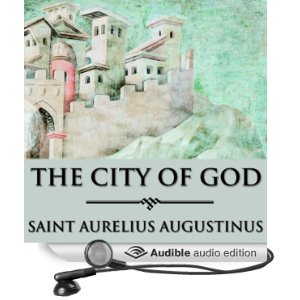
Also on my commutes, especially in the evenings, I’m listening to an audiobook version of The City of God by St. Augustine. It’s a wonderful recording, not least of all because the reader is an older British man with a wise, witty, and kindly voice, who occasionally runs out of wind on Augustine’s longer rants, adding a touch of saintly exasperation to the reading.

The language and writing style are poetic and complex, but the book, thus far, is full of insight and contemporary relevance. For instance, after describing the folly and decline of Rome from many different angles, citing as evidence the descent of morality and the rise of materialism, celebrity, and indecent entertainment, St. Augustine ties the fall of the empire specifically to the fall of liberty and the rise of domination as the fundamental value of Rome.

This makes sense to me, then and now. Liberty recognizes the value of the individual; it can be defended, or in peaceful times, it can be content to live and let live. Domination, on the other hand, is aggressive and discontented by nature; it consolidates power and values the state. Augustine asks if a person might be considered more blessed who had modest wealth, sufficient resources for survival, and peace, compared to one who has untold riches and power and constant fear of war, assassination, or overthrow. So, too, a superpower? At what point did we aspire to be the greatest nation on earth, and what has that cost us?

* * * * *

86884-hemingwayIn November of 1935, Ernest Hemingway wrote a commentary for Esquire magazine called “The Malady of Power: A Second Serious Letter.” Hemingway was a great observer of the nature of men, and of war, and he knew another great war was coming to Europe. He closed the piece with the following:
Whoever heads the nation will have a chance to be the greatest man in the world for a short time — and the nation can hold the sack once the excitement is over. For the next ten years we need a man without ambition, a man who hates war and knows that no good ever comes of it, and a man who has proved his beliefs by adhering to them. All candidates will need to be measured against these requirements.

What makes our previous two popes such powerful witnesses? Both were humble servants who led a flock of millions with steadfast conviction and the utmost humility — Blessed John Paul II, in his willingness to be diminished by illness and age on the world stage for the edification of the world, and Benedict XVI, in his willingness to diminish himself and exit that stage for good of the Universal Church. As we wait for white smoke, and the cry Habemus papem in Rome, I am longing for a Servant of the Servants of Liberty here at home.

*According to Wikipedia, our first president was originally addressed as, “His High Mightiness, the President of the United States and Protector of their Liberties,” but critics thought it “smacked of monarchy.”


No Greater Gift

Amen, amen, I say to you, when you were younger, you used to dress yourself and go where you wanted; but when you grow old, you will stretch out your hands, and someone else will dress you and lead you where you do not want to go.John 21:18

Some years ago I brought our son Brendan, then in grade school, to work with me for the day. Among other activities that day, he drew a picture for a dear friend of my own dear friend Patty — a young man who had recently enrolled at United States Military Academy My son had already been thinking for some time about a career in the military, and it excited him to know that there were colleges specifically geared toward such things. He sent the drawing and his best wishes to West Point, and began to shape his own dreams around the U.S. Naval Academy and the Marine Corps.

Over Memorial Day weekend, Patty was herself at West Point for her young friend’s graduation and commissioning. She shared photos with us from throughout the weekend, and the boy who left home four years ago has become very much a fine young man, fit and confident, dashing in his India whites. Brendan was impressed.

I remember once sharing with a different colleague that Brendan hoped to be a Marine one day. His response? “Well, at least you have a few years to talk him out of that…”

As Brendan prepares to enter high school in the fall, I think more frequently about the possibility that he could be called to combat one day, and it frightens me. But someone has to do this job, and if he is called, who am I to refuse to let him answer, when I have benefited so much from the lives of those who have gone before?

* * * * *

Around the same time that Brendan was drawing that picture, Gabe began seriously contemplating the priesthood. Admittedly, at age seven or so, seriously contemplating may be defined rather loosely — but  today he is approaching his twelfth birthday and has not wavered. This spring, recognizing that I hadn’t spent much one-on-one time with Gabe in recent months, I offered a day in which we could do whatever he wanted. As a result, we found ourselves at Sunday morning Mass at St. John Vianney Seminary in St. Paul, at the end of which Fr. Michael, the rector and our former pastor, introduced him as “a future priest, Father Gabriel.” We were greeted by a dozen or so seminarians afterward, including a couple from our neck of the woods, then we went to brunch with Father.

During brunch Father and I both made an effort to include Gabe in the conversation, but several times the discussion turned to more “grown-up” topics: men’s evangelization, stewardship, work and home life. I apologized to Gabe on the way home for not doing a better job of steering the conversation to include him.

“It’s not a problem,” he said. “I learn a lot listening to you guys talk.”

I see him, hear him, in these situations, and think he’s serious about this vocation. Father thinks he is, too. I’ve written about this before … and a friend characterized the religious life, in her view, as a sort of “performance art,” which I took to mean richly symbolic and interesting, but ultimately strange, impractical, and somewhat meaningless. Needless to say, I disagree.

* * * * *

A year or more ago, an an older man I know learned that these two sons of mine aspired to the military and the priesthood. “How old are they?” he asked, and when I answered, said, “That says something, that they are thinking seriously about service at such an early age. You must be proud.”

I am. And frightened. For both of them.

Then yesterday a mutual friend of Patty’s and mine stopped me in a stairwell at the university to ask how the long weekend was. “And what’d you think of Patty’s photos?” she asked.

I told her they hit me hard, in a way I hadn’t expected. Those photos, coupled with Memorial Day and the knowledge that two priest-friends of mine are being reassigned to new parishes (our associate pastor is one; Prairie Father is the other), made me think not only about service and sacrifice, which are hard but noble things, but also about obedience, which for Americans, it seems, and men in particular, can be tougher to stomach.

Both of my older sons currently feel called to a life I don’t believe I could lead — a life of obedience in which the very clothing they wear will publicly signify that they are subject to a higher authority and held to a higher standard. Should they continue on their respective paths, they will be scrutinized and criticized; assigned relentless, sometimes monotonous, work; bear impossible burdens; and pour out their life-blood, figuratively and possibly literally, for people who may or may not appreciate or acknowledge their sacrifice.

This alone would be too much to wrap my air-conditioned, pillow-padded mind around…and then I think of the confidence our leaders inspire in me. Am I confident that my oldest son won’t be sent marching into Hell for political gain? I am not. Am I confident my middle son will be able to shepherd his flock without getting crosswise of a government and a society who has little use for Truth and even less for faith? Not at all.

And they will be expected to serve, to sacrifice, to obey, regardless. I don’t know if I would be strong enough to do that. I pray to God that my sons are better men than their father.

* * * * *

In addition to observing Memorial Day, we’ve also celebrated the Feasts of the Ascension and Pentecost — Christ’s Great Commission before returning to His heavenly Father and the descent of the Holy Spirit so the disciples could carry out that commission. On Ascension Sunday, our deacon spoke in terms of graduation to describe the bittersweetness of Jesus’s departure, and it makes sense: Christ Himself was “graduating” from his earthly ministry to assume his true heavenly kingship, but so, too, were the Apostles about to leave behind what they knew (or thought they knew) before to answer a deeper call and become something greater still — a new Body of Christ on Earth.

Then on Pentecost, our associate pastor related the story of his ordination as a transitional deacon (on the way to priestly ordination) — how, in our archdiocese, those seminarians being ordained begin in the pews seated next to their families, then at a certain point, are called forward before the altar and “never return again.” They are no longer the men they once were, but are public persons and servants of Christ.

Reflecting on his words brought to mind a Scripture passage that has often troubled me:

And another said, “I will follow you, Lord, but first let me say farewell to my family at home.” [To him] Jesus said, “No one who sets a hand to the plow and looks to what was left behind is fit for the kingdom of God.” Luke 9:61-62

In the past this passage has felt almost heartless, but in the context of Father’s story, it began to make sense to me.

Once we are called to something — a vocation, an act of love, and opportunity in life to do real good and to do it well, we should act immediately and rejoice in doing so. As believers, in particular, we should have confidence that God is working for the good of all, and that not one of His sheep will be lost or wasted. In this light, my sons should rush headlong into the unknown, provided they are heeding the Master’s call.

The road that stretches before the feet of a man is a challenge to his heart long before it tests the strength of his legs. Our destiny is to run to the edge of the world and beyond, off into the darkness: sure for all our blindness, secure for all our helplessness, strong for all our weakness, gaily in love for all the pressure on our hearts. — My Way of Life: The Summa Simplified

Go get ’em, boys.

Last Roll Call

sarge calls the roll until —
once, twice, three times:
rank and last name
rank, first and last
rank, first, middle and last
louder each time.
the name echoes in the silence.
to a man, the same thought:
answer, dammit.
it’s the sun that makes
these young men squint;
the dust they blink away.
it’s sweat trailing down
their windburned cheeks
as the bugle cries.

War Torn

I love good silver-screen battle scene. Especially battles that precede the 20th century, when most warriors still had to get up close and personal with their adversaries – and get blood on their hands.

The appeal of such scenes to me isn’t the action and gore, but the courage of conviction in the face of horrific violence they represent. When you are forced to look your enemy in the eye and assess their humanity firsthand before killing him, you best believe in the cause, right?

What our men and women in Iraq are doing requires that same sense of purpose. Think about it: they’re fighting in close urban quarters against an enemy that can only be distinguished from the civilian population with difficulty. According to the few accounts I’ve heard, our soldiers are often making split-second decisions at point-blank range – who to kill, who to let live.

I was talking to this guy on the bus the other day, saying that it seems to me we shouldn’t be surprised that soldiers are returning with mental health issues, given this up-close-and-personal style of combat and the widespread misgivings about the war (if not among the soldiers, at least on the home front).

“It’s tough,” I said. “I mean, regardless of how you feel about the current administration or its policies, the troops have to know that we support them.”

A woman seated in front of me turned around and said she’d done a tour a in Iraq. “It’s extremely important,” she said. “It means a lot to know they have support back home.”

The question then becomes how do you criticize an administration, a policy, or a war while still expressing support for the men and women fighting?

Steve Earle has one answer. On his 2004 release, The Revolution Starts Now, Earle included a spoken-word-over-guitars piece called “The Warrior.” The song, if you can call it that, pays homage to warriors past and present, while holding modern warfare and policy-makers in contempt – and ultimately, holding all of us responsible.

It’s magical, poetic – a tribute to the warrior spirit and a passionate plea for peace. At least that’s how I take it.

What about you? From a practical standpoint, is it possible to openly criticize the policy and still give the troops the moral support they need to face death on daily basis?

The lyrics to “The Warrior” can be found here.

Incidentally, if you ever really get fed up with our current administration, take Pearl Jam’s self-titled release, Green Day’s American Idiot, and selections from Steve Earle’s The Revolution Starts Now (“The Warrior,” “The Gringo’s Tale,” “Home to Houston,” “Rich Man’s War,” and “I Thought You Should Know”) and Jerusalem (“Ashes to Ashes,” “Amerika v.6.0,” “Conspiracy Theory,” “John Walker’s Blues,” “The Truth” and “Jerusalem”), put them on your iPod, and shuffle freely at high volume.