I received a somewhat uneven education at Yale University, primarily because I was a 17-year-old kid when I arrived, and given a smorgasbord of courses and little guidance. Yale’s approach was to require a certain number of courses from each of four groupings, plus the prerequisites for your degree. With that as my framework and anthropology as my major, I had plenty of room in my schedule to take whatever caught my eye, from Herpetology to Polish to The History of Jazz.
The history course catalog, in particular, lured me down a rabbit hole: I took two History of the American West courses back to back, essentially two semesters following the colonial frontier westward over the history of Europeans on this continent, then a course called North American Environmental History, which traced our peculiarly American views and impacts on land, nature, and the environment over that same period.
That’s a long preamble to a book review.
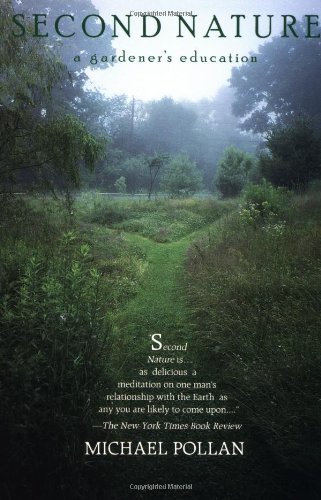
The reading lists for these courses were eclectic, but a few books became staples on my shelves, including Second Nature: A Gardener’s Education by Michael Pollan.
Perhaps you’ve heard of Pollan, who has become well known for his books and films on the food we eat and where it comes from (In Defense of Food, The Omnivore’s Dilemma, Food Inc.). Second Nature was his first book, published in 1991: a memoir of his adventures establishing a garden on his overgrown New England farmstead, interspersed with reflections on gardens from his past and an exploration of America’s complex view of nature.
Pollan is a good writer, a natural storyteller who weaves humor and beauty into a book rich with historical, literary, and philosophical references. It’s a smart read, but easy and enjoyable.
His overarching theme appeals to me because it makes sense. Americans tend to have an all-or-nothing approach to land and the environment: leave it pristine and untouched, or “you might as well put up condos.” Pollan makes a strong case that viewing nature as virginal and sacred is both impractical and untrue, since man is a part of nature and as far back as we can know, has modified the environment with fire and tools to make it more hospitable, more productive, more appealing and supportive of human life.
At the same time, we can learn a great deal from nature about how best to interact with it. The natural world is naturally productive, naturally adaptive, naturally sustainable over the long term. The more we work with nature on its own terms, the better the results over the long haul.
Pollan argues for a happy medium between the unbroken band of TruGreen ChemLawns linking our surburban homes and the untouched (and untended) wilderness area waiting for a spark to regenerate itself in wildfire. Essentially it’s an argument for stewardship and conservation. Ice ages and global warming may come and go, but not wasting (or laying waste to) our natural resources and environment is just common sense.
Interestingly, Pollan neglects his Jewish roots by never referencing Genesis. His view of the garden would be deepened from a Judeo-Christian standpoint by the fact that the Creation story places Adam and Eve in a garden and assigns them a role as stewards:
God blessed them and God said to them: Be fertile and multiply; fill the earth and subdue it. Have dominion over the fish of the sea, the birds of the air, and all the living things that crawl on the earth.
Genesis 1:28
Lest we translate this as, “Might as well put up condos,” Genesis 2 provides Adam with a more specific mission:
The Lord God took the man and put him in the garden of Eden to till it and keep it.
Genesis 2:15
We are of the earth (made from the dust), enlivened by God, and invited to tend and even participate in His creation. Unlike the animals and the angels, each moment we are free to choose how we participate—how we tend what He has given us.
It is a distant dream of mine to have a small farmstead of my own and write a response to Second Nature. Perhaps Human Nature would be a good title, since in truth, we are made for the Garden.
In the meantime, Pollan’s book stands, and I recommend it!
 Archangel Stomp