Who Reigns In Your Heart?

Put no trust in princes, in children of Adam powerless to save. 
Who breathing his last, returns to the earth; that day all his planning comes to nothing. – Psalms 146:3-4

This Sunday is the Feast of Christ the King, celebrating the authority and lordship of Jesus over all of creation and marking the end of the liturgical year. Falling just before the all-consuming holiday season and the secular New Year, this feast provides us with an opportunity to reflect on what holds mastery over our hearts before the avalanche of turkey and tinsel. And since it specifically celebrates Chris’s kingship, it takes on special relevance in the aftermath of a contentious election.

Who is this Jesus who rules over all? We are blessed to have an immense icon of Christ the King in the dome of our church. This image, called Pantocrator or “ruler of all,” depicts our glorified Lord looking down from heaven, holding the Book of Life by which we are judged (God’s justice) but with His right hand raised in blessing (God’s mercy). The three-rayed halo behind His head and Greek letters in the image identify Him simultaneously as Jesus Christ (IC XC) and as “I Am Who Am” (WON), or God Himself.

This God-man is the same Jesus who was born in a stable; who grew up a carpenter’s son; who ate with sinners and challenged authorities; who said to His followers, “This is my Body; take and eat;” who suffered humiliation and torture to die on a cross; who rose from the dead and ascended to heaven; and who sent the Holy Spirit to guide the Church in these latter years. This is the same Jesus about whom Nathanael asked, “Can anything good come from Nazareth?” (John 1:46) and Thomas said, “My Lord and My God!” (John 20:28).

We have a second icon of Christ behind the altar and tabernacle, depicted in the womb of the Blessed Virgin. Though within His mother, He does not appear as an infant or as any child we have likely ever seen. His high forehead and discerning eyes convey wisdom and judgment beyond His years. This is the same Jesus that St. Augustine calls, “ever ancient, ever new” and that dwells in the tabernacle, in the Eucharist. He is the very Word of God referenced in John’s Gospel:

In the beginning was the Word, and the Word was with God, and the Word was God. He was in the beginning with God. All things came to be through him, and without him nothing came to be. What came to be through him was life, and this life was the light of the human race; the light shines in the darkness, and the darkness has not overcome it. – John 1:1-5
What joy, what hope, what light we have when He who is the very source of all blessing sits upon the throne of our hearts—and what sorrow, what despair, what darkness we experience when we yield His seat to idols: to fallen persons or passing things that will not—cannot—sustain us.

Advent begins next weekend: four weeks of penance and preparation Christmas. As the Church year ends and we prepare to welcome the newborn King of Kings, let us ask ourselves in whom we have placed our hope and trust. What or whom have we set upon the throne of our hearts? The time is now to elevate Christ to His proper place, that all else may fall into place and peace may prevail.

Reflection on Freedom

From my Facebook page on Nov. 3:

Reflecting on, of all things, a line from the old song Remember the Alamo: “Young Davey Crockett was singing and laughing/With gallantry fierce in his eyes/For God and for freedom, a man more than willing to die.” 

Freedom like that — courage and even joy in the face of persecution, destruction, and death — does not come from politicians, legislation, constitutions, or economies. It comes directly from God. It is not freedom from, but freedom for, and it can only be taken away by the Devil. Only he can bind us, and only if we let him. 

Make no mistake, we are free men and women. This next week, and next four years, can only change that if we allow it. 

Thank you, Lord, for this beautiful morning.

It’s another beautiful day today. We are blessed by God with life and liberty — may we be as free as that song lyric: free to laugh in the face of power, danger, and death, knowing these things cannot touch our inner mystery: that we are made in His image, out of love and for love.

I’m not suggesting armed conflict is coming, but reminding us that we are always — always! — free to do what we think is best. We may suffer for it, but suffering in this life is expected and temporary. And as the Catholic evangelist Mark Hart says, even when our legs shake, the rock upon which we stand will not be shaken.

Take courage, whatever happens. You are free, unless you yield it up yourself.

Your Eternity Begins Now


For the past few years, our family has joined numerous others from our parish and surrounding churches for Life Chain, an hour of silent public prayer for an end to the evil of abortion in our country. We spread out along Highway 19 between the parish school and Middle School West and stand facing the road, holding signs and praying.

On the back of the signs are suggested hymns, prayers, and petitions to guide our personal reflection during that hour. Every year, I am taken aback by the petition that asks me to pray for God’s mercy for all I have failed to do to protect life and work for an end to abortion—because every year, I am convinced I could have done more.

Now we are two weeks out from electing a new president. Most of us have likely made up our minds how we will vote—guided, I hope, by reason and a well-formed conscience.  God willing, no Catholic will cast a vote in support of abortion or its proponents. Beyond that, faithful Catholics can and do disagree on how best to combat the evils in our society by our actions at the ballot box. With that in mind, I would like to share three thoughts about the aftermath of Election Day.

First, remember the words of St. Therese of Lisieux: “The world is thy ship and not thy home.” We are a pilgrim people, and although our country is great and worth fighting for, the kingdom to which we truly belong is not here. We are called to evangelize and make disciples; to deny ourselves, take up our cross, and follow Jesus. The outcome of this election will not change our mission.

Second, we are all called by God—and not one of us is worth less in His eyes because of the votes we’ve cast, the mistakes we’ve made, or the sins we’ve committed. Whatever happens on November 8th, we will continue to suffer for our faith, as Christ foretold, and our nation and world will continue to need our light, our service, our faithful example. Cast your vote on Tuesday and move on, because we must pull together as one body, one spirit, in Christ.

Finally, we have no time to waste. Too often our efforts on behalf of the unborn, marriage, freedom of conscience, or religious liberty hinge on the headlines and reach a fever pitch every four years with the election of a new president. We support particular candidates or policies; we act as though everything is riding on the results of the next election, then shake our heads when nothing changes and go back to minding our own business.

What about the roughly 1,460 days between presidential elections?

As Catholics, our opposition to abortion and the other great evils of our time is not primarily about saving lives, but about saving souls—including our own. Obedience to Christ and His Church is a daily choice. Disobedience is also a choice. So is complacency and non-action.

Every moment, God calls; every moment we respond. Our eternity begins now.
Lord, have mercy on me for all have failed to do here in my own community to draw people to you and build your kingdom. Amen.

And the Heavens Respond

We have no love at all except that which comes from God. All love in this world is, as Dante writes, “the Love that moves the sun and other stars.” For as St. John the Evangelist tells us, God is love; and as Moses learned, God Is Who Is—He is Being itself, in whom we live and move and have our (own) being.  From this perspective, Love is the substance of being, its essence, its purpose, its end.

What does this Love look like? It looks like us, roughly—we are made in His image. But we are, most of us, broken and sinful, so the image is distorted. Let us look to Mary, then, as the created image, and to Jesus Christ as the begotten one. Let us look at these two and ask again: What does this Love look like?

It is pure, intense, obedient. It is courageous, honest, and merciful. It is boundless, bloody, and self-sacrificing. It accomplishes the Father’s will at whatever cost to itself. It never fails.

This is the universe in which we live. This is what we are made of, and what we are made for. The very dust of this world cries out in love, for love. And the heavens respond.

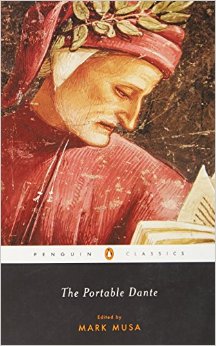
Dante, or Three Things to Love About the Divine Comedy

Blogger’s Note: Several years ago, I agreed to my friend Jacqui’s challenge to read 15 Classics in 15 Weeks. I continue to press forward, this being number 13 of 15, and at this point 15 Classics in 15 Years seems quite doable…

Late last week I finished reading Dante Alighieri’s Divine Comedy in its entirety for the first time. I had read excerpts for different classes over the years, and have read a little about the great work. The book itself was something of a pilgrimage through hell, purgatory, and heaven. This is my least favorite of the thirteen classics I’ve read so far as part of this challenge, and was tough sledding at times. Nevertheless, I do agree that this is a great literary work and worth the effort to complete at least once.

Without further ado, Three Things to Love about Dante’s Divine Comedy:

  • The Ambition. Dante the poet takes us on a journey through the Inferno (Hell), Purgatorio (Purgatory), and Paradisio (Heaven) with Dante the Pilgrim in order that the fictional Dante may change his ways and be saved. Each of these three journeys are told in verse, thirty-three cantos each, with each canto approximately 140 to 150 lines long. Along the way he meets ancient and more recent historical figures, who comment and prophesy on the political and religious turmoil of Dante’s time and place, along with sharing their own experience in the world and in the afterlife. The running commentary on the political machinations and rivalries in Dante’s home was the least interesting aspect of the book for me, but it is nonetheless impressive how much he weaves into this ambitious work.
  • The Creativity. The denizens of Hell and Purgatory, in particular, suffer in hundreds of ways peculiar to their specific sins and attachments. Dante’s Hell is hellish, disgusting and terrifying at times, culminating in an immense figure of Satan, not surrounded by flame, but eternally frozen in ice, suffering for his own sins. The journey through Purgatory is hopeful, but not easy, as imperfect souls labor to let go of those earthly things that weigh them down. Heaven, to me, was actually the least interesting of the three, in part due to the poet’s continued insistence that the beauty of the place was beyond his words and ability — but persevering to the end, to full union with God in the beatific vision, has its rewards. The last few cantos are lovely.
  • The Deep Belief. This, to me, is the greatest aspect of Dante’s masterpiece: the depth of theology, of faith, of true belief. Dante believes in the reality of Hell, and he puts people he loved in this world in that place of torment because of their sins. He peoples his poems with friends, contemporaries, nobles, and popes, explaining how and why each fell or rose, and when Dante the Pilgrim is asked to testify to his own faith, the lines resonate as the poet’s own sincere profession. Who knows how accurate a portrayal of the afterlife these poems are, but Dante gives us much to contemplate as we navigate this world.

I have begun number fourteen of fifteen classics, Tolstoy’s Anna Karenina, with that great opening line: “All happy families are alike; each unhappy family is unhappy in its own way.” It is a long book, but engaging— I hope to be done within the month!