Preparing for Baby Boggles the Mind

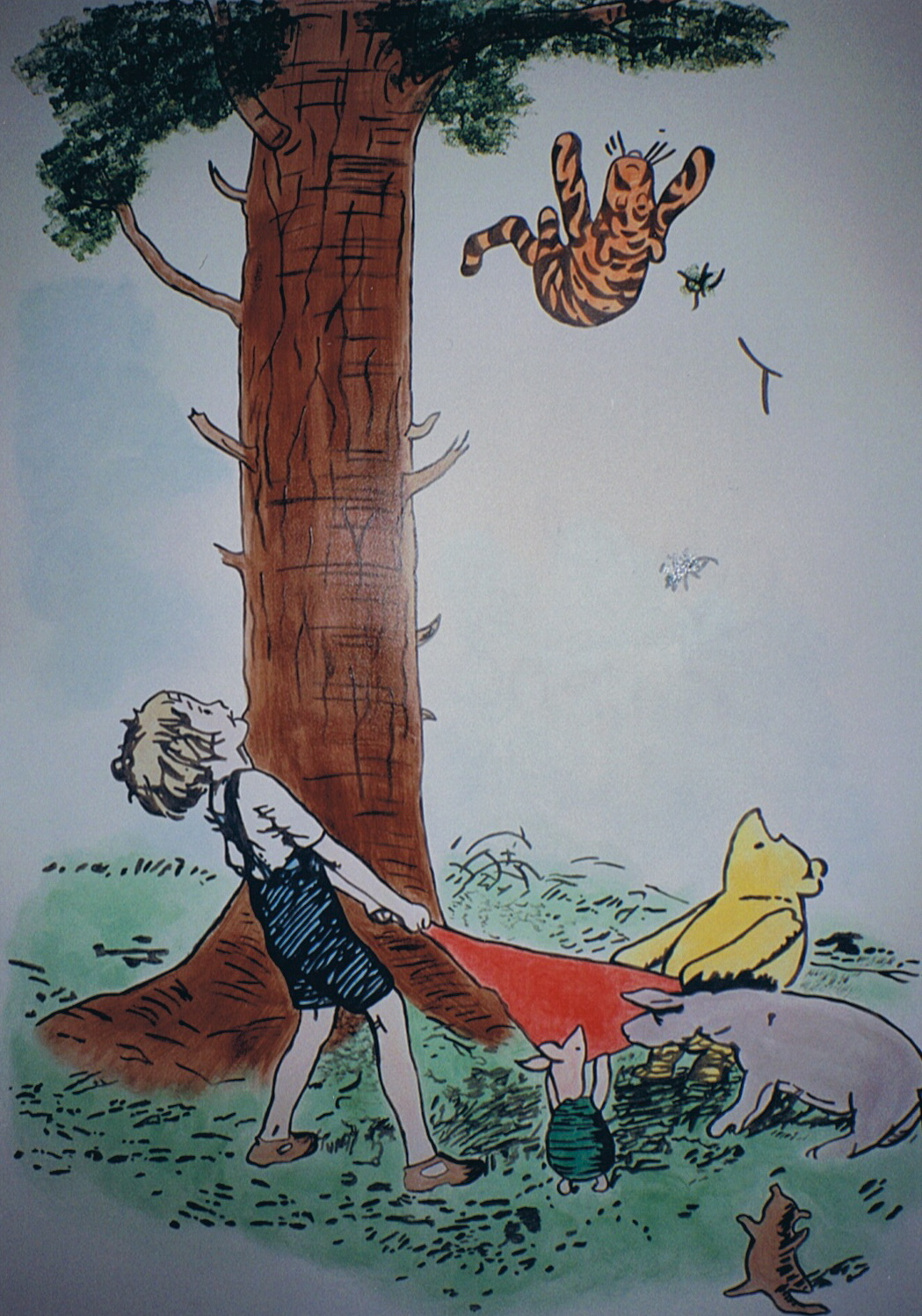
[Blogger’s Note: This is a classic Pooh mural my sister painted in the baby’s room in Michigan when Brendan was a toddler, just before Gabe came along. There was a plaque alongside with the following inscription: “Getting Tigger down,” said Eeyore, “and Not hurting anybody. Keep those two ideas in your head, Piglet, and you’ll be alright.” The rest of this post originally appeared in the Friday, Oct. 14, 1997, edition of The Pioneer daily newspaper, Big Rapids, Mich. The first third is a bit much, but I was excited at the time that people would pay to read this sort of thing. It is the column referenced in yesterday’s Almost There post.]

It’s Friday, and this is a Friday kind of column.

For those who looked in Tuesday’s paper to find my column, thank you. I appreciate those people in the community who have said that they enjoy my columns. (I would say “my work,” but do you realize what O’m paid to do? I get to write.) I appreciate those who enjoy them and do not say so. I appreciate those people who read my columns and don’t like them — tell me what you don’t like, and we’ll discuss it.

It might make fodder for another column.

It’s Friday. Not my usual day for a column — I would say that too much work kept me from writing Tuesday’s column, except that my column is part of that “too much work,” and so is no real excuse. I got my other work done…

I could tell you that other people’s columns took precedence, except that a day or two ago I was accused of writing with honesty, and to be honest, everyone including me expected I’d have a column in for Tuesday. I can’t even blame a lack of ideas — I’ve got no less than a dozen columns started right now. No ends in sight, though.

I have slowly discovered that I have a readership. (A readership!) It’s a good feeling, and a source of pressure. I like to write columns, and now I feel I have a responsibility to turn out quality material every Tuesday so as not to disappoint my readership. Several weeks back I ran a piece out of my college journal — I drove from Big Rapids to Remus and back in the middle of the night to deliver that piece to the paper because I hadn’t written my column and didn’t want to let the Taylors down.

Crazy, yes, but dedicated.

But, as our night editor used to say (at least once), “{People don’t want to see how the sausage is made.”

They want the product.

What follows is this week’s morsel.

October 8, Jodi and I signed our names and purchased a home — three bedrooms, a bath and a half, brick halfway up and a two-car garage. It’s on Maple Street. (Sounds homey, doesn’t in? A friend of mine, Ed Quon, lives on Micheltorena Street — which of us is married and expecting?)

We haven’t actually taken possession yet, and out baby is due Nov. 19, which means any day now. [Blogger’s Note: Too funny. Brendan was born what, 40 or so days later?] At this point, the baby has more stuff than his or her parents, and we’re anxious to get in, repaint the baby’s room, and decorate. We have to repaint the room — its current color just isn’t Classic Pooh.

Classic Pooh is that subtle, old-fashioned Pooh based on E.H. Shepard’s illustrations — very nice; cute and pricey. Will the baby like Classic Pooh? I don’t know.

All decorating and kidding aside, we need to make sure we’re ready for this child. Crib? Check. Carseat? Check. Stroller? Check — but not the one we registered for. Don’t get me wrong; it’s a very nice stroller, but the one we registered for had a reversible handle so the baby could ride facing toward you or away from you.

“Babies like to see their parents,” I’ve been told, by parents who wish they would have gotten the reversible handle.

I suspect parents like to see their babies. Even so, will the baby like the stroller we have?

Snugglie? [Blogger’s Note: Sic. Snugli, not Snuggie…] Not yet. Wedge-shaped pillow to keep baby sleeping on his or her side or back? Nope. Outlet covers? In a couple months, probably — we don’t know yet how many outlets we’ll need covered/

How about corner and door pads — have you seen these? The package proclaims, “Give your child the safety of a padded room,” or something like that.

My kids ought to be in a padded room — is that what they’re telling me?

With millions of products on the market that new parents “need,” how does any baby survive to age one in a family with average income?

Baby wipe warmers?

The retailers and manufacturers have expectant and anxious parents right where they want us. At the beginning of life, just as at the end, people are made to feel guilty unless they spare no expense.

How did babies survive before crib monitors and motion-sensitive night light/musical crib mobiles? How did parents survive before Diaper Genie? [Blogger’s Note: This is the one product about which we were both excited and sorely disappointed. Yes, it makes disposal of diapers relatively odor-free; the magically disappear and are locked away, sealed in scentless plastic…where they ferment for days until you are forced, gagging, to empty the “Genie.” Apparently the pail/bag in combination is somehow scentless, but a bag full of rotting waste on its own reeks regardless…]

What about names? We have two in mind for a boy — Brendan James (middle-named after me) or Zachary Venjohn (middle-named after Jodi, whose maiden name is Venjohn). We like Brendan James, because our oldest boy will be named after his dad. On the other hand, we like Zachary Venjohn because it’s unique, it would mean a lot to Jodi and her family, and he’ll still be named Thorp after his father and his father’s fathers.

For baby girls, it’s either Emily Rose or Rachel Elizabeth. Probably Emily, but will she like it? Is it too old-fashioned? Too cute? Will it serve her well in her profession?

Can you yell it out the back door?

We need to save enough money to cover Jodi’s time away from work and our bills. We need to find day care for when she goes back to work. I need to get a cell phone or a pager [Blogger’s Note: Remember pagers? I wound up with a “bag-phone,” which I lugged everywhere and dubbed Baby-Com.] — what if I miss the birth? Will Jodi remember to breathe? Will I?

With all these questions flitting around my head, how do you expect me to concentrate on a column?

Almost There

Back in my newspaper days, “Almost There” was the name of my weekly column. To me, the title called to mind the joys and challenges of both parenthood and life: the constant wondering and plaintive vocalization (not only from children) of every journey’s most persistent question — are we there yet? — and the fluttergut, giddy anticipation of being always on the verge of something new, terrifying, wonderful…

Tonight we are less than a week from full-term, anxiously awaiting the arrival of our fifth child, and the anticipation is agonizing. Jodi’s discomfort, and her growing anxiety about the discomforts to come, is a burden I would carry for her if it were permitted. I, on the other hand, find myself choking back tears at odd moments, caught up in memories of my love’s labors past, her courage now, and her life-giving beauty.

We’re quite a pair, we two.

Our home is a pre-Christmas jumble. Our kids are wound to their full holiday potential, and occasionally fly off into the wall or ceiling in a buzz of released tension. The baby magnifies all, and the air in the house is thick with suppressed emotion. When this child comes, you’ll know.

On Monday, Jodi said she felt as though something had dropped. We went to the clinic on Tuesday and were told that was not the case; our little one was still high above the birth canal and content to stay there. On Wednesday, returning from Christmas shopping alone, my bride had her first real contraction. “It hurt so bad I thought I was going to die,” she told me when she got home. “I thought, ‘I should pull over,” then thought, ‘I’d rather die at home.'”

We laughed. We’ve done a lot of that. Just one contraction. A doozy, but none since. We wait.

The week before, our doctor, an older man with a wizard’s eyebrows and the experience to wear them without pretense, felt Jodi’s belly — “Feet, rump, head,” he declared as his hands moved and pressed lightly — and told us he felt a great deal of fluid and a not-unusually-large infant. He is not concerned at this point, given our history of large babies and no troubles.

His proclamation, coupled with Jodi’s finicky stomach and appetite and other tiny cues, have led to my official prediction for our baby: we are having our tomboy, an active girl of about 10 pounds (plus or minus two ounces; 9-15 like her daddy would be just fine), 21 inches long or so. She’s gonna sleep alright, but when she starts moving about, she’ll be our first climber. We shall have our hands full. She will have a Thorp head, of course, and Jodi’s hazel eyes that look green in the right light.

You heard it here first…but who knows, really?

If we welcome a boy, our intention is to call him Samuel Firmin Thorp — Sam — middle-named for Jodi’s maternal grandfather (it means “strong”), unless God calls him something else when we see him. If she is a girl, as I predict, she will likely be Lily — Lillian Clara Thorp, middle-named for Jodi’s paternal grandmother.

And so you know: we intend to bring our four older children to the hospital to see the baby and guess the gender before the big “reveal,” so to speak. This means we will tell you much, but not all, when it happens. I will let you know that we’re in labor, and let you know when we have a child, the health and well-being of all involved — but you’ll have to be patient on the specifics. Modern technology is poor at keeping secrets, even from middle- and grade-school kids.

A few weeks back, just before friends held a baby shower for Jodi, someone asked Jodi what we needed for the new arrival.

“I don’t know,” she shrugged. “Nothing really.”

Another friend asked one of the shower organizers the same question.

“Everything, I think!”

Our family, friends, and parish have provided abundantly for us at little cost. I was flipping through old columns and ran across one from 1997, before Brendan arrived, with the headline, “Preparing for baby boggles the mind.” What we worried about then is funny now. So much we didn’t know, and yet we have four children about whom we could not be prouder.

Are we pushing our luck?

No matter. We have what we need, and what we lack will be provided, come what may. We are ready. Little one, are we there yet?

Rosebud on Food

Our daughter is a picky eater. She likes what she likes (toast, buttered noodles, brownies, meat) and little else (most plants). She also has a sense of humor about food and eating.

A few days ago, the boys were talking about our recent train ride to Mall of America and brought up Rainforest Cafe, which no Thorp but Emma has ever entered (for a friend’s birthday party). The boys were speculating about the entrees, and Brendan — recalling Indiana Jones and the Temple of Doom, no doubt — asked if they serve monkey brains.

“I’m not sure,” said Emma, deadpan,  “but not on the kids menu!”

Then this morning, she and I were eating English muffins together. “Emma,” I said sternly, “you’ve got butter on your little finger. You know what you have to do now.” Then I mimed licking my finger and savoring the white fatty goodness.

She smiled. “I’ll do that when I’m finished,” she said. “I’m gonna make sure there’s lots of butter on it!”

Book Break: How We Decide

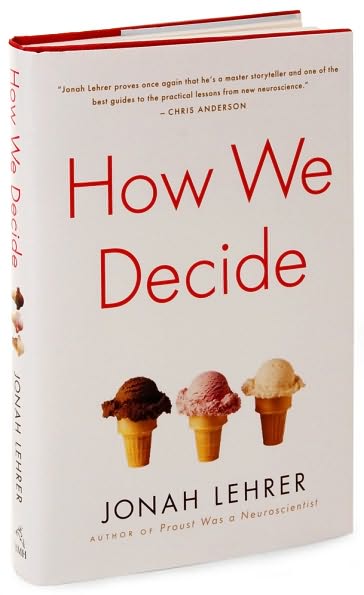
My latest work reading, completed just this week, was Jonah Lehrer’s How We Decide, an engaging and easy-to-read account of the brain science (as we currently understand it) behind our decisions. Drawing on ancient philosophy, modern psychology and neuroscience, and examples as diverse as military conflict, professional sports, gambling, and shopping, Lehrer exposes the strengths and weaknesses of our emotional and rational thought processes — and shows each to be inadequate without the other.


The book was a relatively quick read, understandable and action-packed, which is not always easy to achieve when writing about science. The stories used to illustrate key strengths or weaknesses of the ways in which we think are sometimes suspenseful, sometimes tragic, and always fascinating, and several times I saw myself in the concepts illustrated by the book: recognizing what I would do in a situation before I know why; looking for patterns where there are none; over-thinking in some cases, and making snap decisions in others that prove to be simply (and obviously) wrong. 


One of the more fascinating discussions, given the endless run-up to the 2012 elections, is the problem of confirmation bias, which stems from our own certainty and our resulting tendency to discount opposing evidence and emphasize that which supports our biases. Even among “non-biased,” so-called experts — for example, seasoned political journalists and commentators — the problem of overconfidence in one’s expertise causes their predictions about political results and world events to be worse than random chance. (The Wall Street Journal ran an article by the author explaining this in more detail.) Another had to do with a phenomenon called the anchoring effect, in which the brain stores potentially meaningful information that can unconsciously influence unrelated decisions. This was illustrated by an experiment in which participants were asked to recall the last two digits of their Social Security number, then were asked to write down the maximum amount they would pay for a variety of diverse items up for “auction” — and subjects with numbers on the higher end of the spectrum (00 to 99) recorded bids that were on average 300 times higher than those on the lower end. (This is the effect exploited by car dealers who post an inflated asking price on a car, which will invariably be reduced, but also subconsciously raises the amount you’re willing to pay.)


If you read Malcolm Gladwell’s The Tipping Point or Blink, you know the type of book this is. I found The Tipping Point interesting, and Blink a bit more personally revealing and useful — this book snatches the ball from Blink and runs with it. I recommend it highly, with only one caveat: the chapter on moral decisions, I think, makes a mistake in straying from psychology and brain science to comment on religion, but only shallowly. Lehrer points out instances in which the rational parts of our brain, left to their own devices, fail in making or explaining moral judgements. Often we just “know” right from wrong. He makes no real attempt to explain this “knowing” in a scientific way, aside from a vague reference to “basic primate morality” that evolved as primates became more social creatures and became aware that causing pain in another of their species was somehow bad for both the victim and the social group in general. He then dismisses religious morality as mis-ordered: 


“Religious believers assume that God invented the moral code. It was given to Moses on Mount Sinai … But this cultural narrative gets the causality wrong. Moral emotions existed long before Moses. They are writ into the primate brain. Religion simply allows us to codify these intuitions, to translate the ethics of evolutions into a straightforward legal system.”


In addition to the laughability of a “straightforward legal system” based on Judeo-Christian religious values in this day and age, there is a bigger problem here. Lehrer is mistaken to think that the faithful believe morality was invented by God at the time of Moses — as though He were just some wise and benevolent being who showed up on the scene and tried to help Moses and the Jews out. Lehrer misses the transcendence of God, in which creation, order, love, and justice are all of a piece, and he misses the chance to discuss the concept of Natural Law, another (and perhaps better) explanation for what he calls “moral emotions…writ into the primate brain.”


Even so, this chapter and the entire book are compelling, thought-provoking, and even entertaining at times — read it if you have a minute.

Pass the Beer Nuts


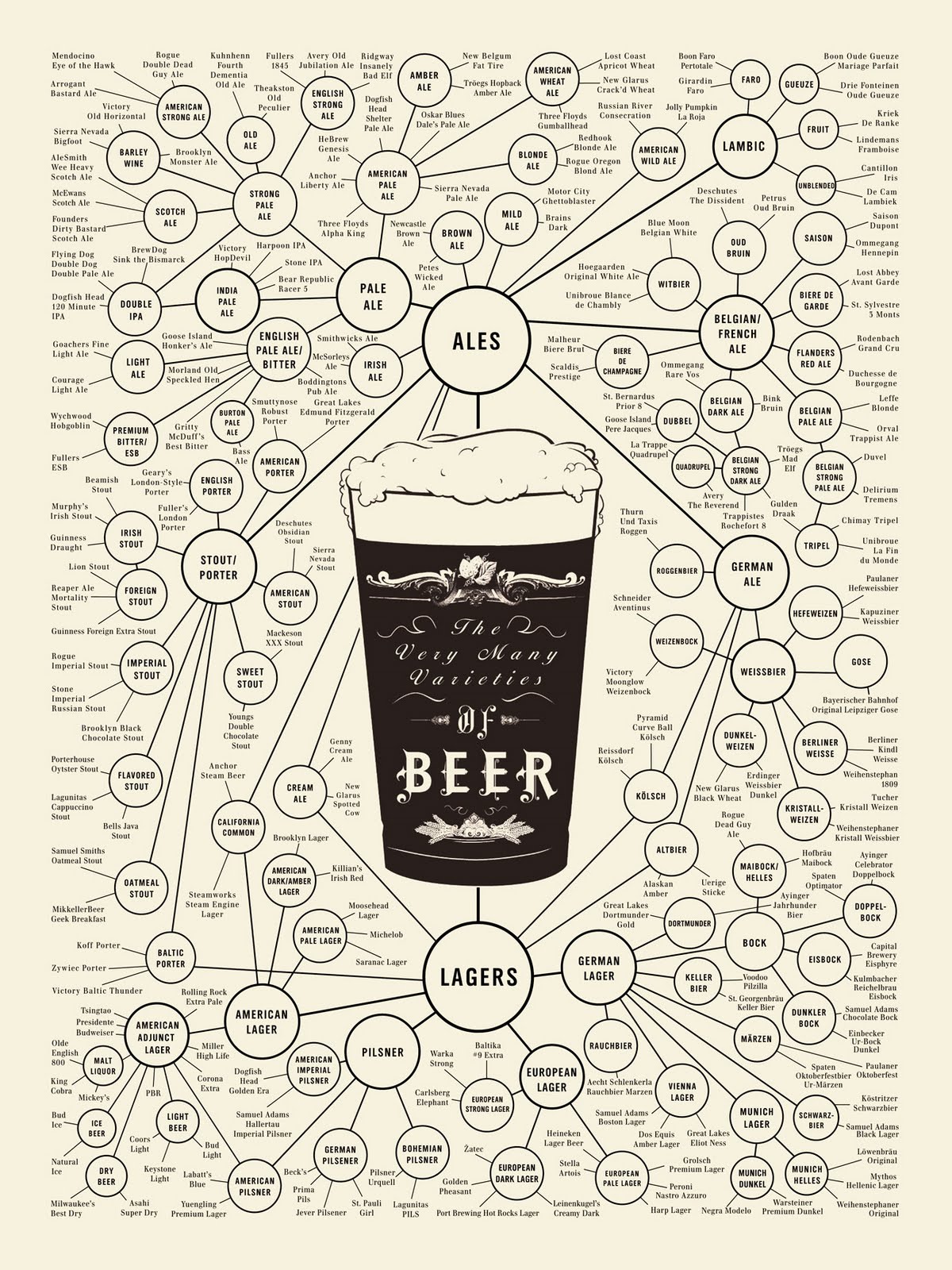
Blogger’s Note: I had another beer-related post in mind for tonight, but ran out of creative juices. This piece originally appear under the headline above as a column in the February 24, 1998, edition of The Pioneer daily newspaper in Big Rapids, Michigan. It explains the origins and peculiarities of my love of beer. So gosh-darn cute and innocent, too. Oh, yes … and this awesome poster image above? Not mine, but it can be purchased from the creative minds at Pop Chart Labs. Check it out!

“Bread is the staff of life,
but beer is life itself.”
— old English proverb

The world is home to beer drinkers and beer lovers, and most often the two are not the same.

The majority of beer drinkers care little about the alchemy at work in converting bread and water into those heady concoctions known collectively as beer. Most beer drinkers buy their beverages in packs of twelve or more and are content believing that born-on dates and pure mountain water are the two most important elements in  choosing a beer.

Ever wonder why the less expensive domestic beers tend to tout their water? As beer judge and connoisseur Bob Klein said about one American brew, “…take away that crisp, clean, fresh liquid, and it’d hard to tell what you have left.” Commercial breweries — those with “vats the size of Rhode Island” — speak highly of their water to avoid the Crispix debate: Which tastes better, the corn or the rice?

Barley, my friends — barley, hops yeast and water [Blogger’s Addendum: And occasionally a little wheat…] give us ales and lagers; porters, stouts, lambics, pilsners, bocks and barley-wines.

The world is home to a great many beers, and I am a beer lover.

I began drinking regularly at the “proper” time in my life — my twenty-first birthday — which has given me interesting perspectives on beer and drinking. (At least I think they’re interesting — they seem more so over a room-temperature Guinness.) I drank my first beer when I was three, sitting on my daddy’s knee one summer day at a family barbecue. I was holding his beer for him, and asked if I could have a sip. Dad said sure, assuming, I’m certain, that I wouldn’t like it.

I took a sip, and sat quietly for awhile, the took another.

A short while later, Dad took the can from me and was surprised to find it all but empty.

Did I like it? Did I get sick? I don’t remember. [Blogger’s Note: I do, however, remember the brand. Because I loved the jingle.]

I did not taste beer again until my twenty-first birthday — seriously. I did it then for two reasons: first, because I was of age — a sort of rite of passage — and second, because my future in-laws were drinkers of beer, and although they never pressured me to do so, I felt I’d like to be able to share the experience with them, and more importantly, be able to offer Jodi’s father and brothers a beer when they came to visit us.

A couple of college buddies took me out to dinner that day and ordered me a respectable brew: Sam Adams Boston Lager. It was bitter, nasty, and I drank only half of it. My friends — good friends that they are — said the beer was on them, and to enjoy it or not at my discretion.

Still, I was determined to find a beer that liked. The following week, another friend, Steve, introduced me to a raspberry wheat beer (“If you can drink any beer, it’s this one — it doesn’t even taste like beer!” he said) and Woodchuck hard cider (not beer at all). Both were easy to drink, fruity and flavorful. Neither could be offered to Jodi’s brothers with any sort of self-respect.

Steve took it upon himself to introduce me to a couple of new beers every week — the following week it was the English classic, Bass Pale Ale, and I was hooked. It was over that first Bass that I first gasped the mystical nature of beer. It occurred to me that, on first swallow, I thought Bass tasted pretty good; the second sip was better, and the more I drank, the more my taste buds relaxed, no longer bracing themselves against the bitterness of the hops or the sting of carbonation. I began to note intricacies of flavor I’d never noticed before, and I felt a certain oneness with the beer, until I was no longer certain who loved whom. I smiled at the revelation that I was no longer sure whether Bass tasted good or felt good, and smiled again at the notion that both were likely true, and it was impossible to extricate one from other.

As the weeks went on, Steve introduced me to a world of other beers — some black, some red, some brown, some yellow, and most very friendly. I discovered that when I discussed these beers with others, not everyone felt the same as I. Some beer drinkers liked only light beers, for example, and some beer drinkers, irrational as it seems, didn’t like beer at all.

Which is why I say I began consuming beer, and it me, at the proper time. I drink beer because I enjoy the taste (some of which, I’ll admit, is acquired — I do like Boston Lager now, especially on a hot day). I also began drinking beers A) not readily available in groups bigger than six, and B) too expensive to drink in mass quantities.

I remember a German exchange student in high school who could not understand her American friends’ fascination with sneaking off with a case of beer to get drunk. In Germany, she drank beer with meals as just another beverage, and she didn’t look at beer (especially American brews) as any sort of thrill or high.

I understand that now, but not everyone does.

Jodi and I had gone to a bar one evening with some friends of hers from work. I ordered a tall black and tan (a truly beautiful drink — the magic of physics causes Guinness Extra Stout to float atop Bass Pale Ale, and the layers remain separate: Irish and English, dark and light, yin and yang…). A short while later, I tried a Polish brew, in honor of my mother’s heritage.

When my glass was again dry, I ordered a Samuel Adams Honey Porter. I do not drink to excess — after two beers, I was very relaxed and drank the third with scarcely a second’s thought.

As I drained the glass, I realized that I had no idea what Sam Adams Honey Porter tasted like. When I voiced my disappointment, everyone except Jodi looked as me as though I were nuts: “You don’t have an impression of your last beer? That’s a new one.” “Yeah — who’d want to remember?”

Call me a beer nut — I would.