The Art of Understatement

This cold winter night,
that old wooden-head buddha
would make a nice fire
– haiku by Buson

It’s cold this morning – the kind of cold that, after just a few minutes, makes you imagine what you’d do to stay warm if you didn’t have a warm house close by …

The haiku by Buson illustrates this feeling nicely, I think, with subtle humor. It is detailed and concise – saying just enough to capture your attention and spark your imagination. You can read it and “get it” immediately – or you can think on it and uncover some deeper truth about the world. It conveys the poet’s mindset and message, not by taking the reader by the hand, but by setting the reader’s mind on the path and trusting they will arrive in due time. In my ongoing discussions with Cowboy Bob regarding what makes a poem a poem (especially poems that don’t have clear rhythm or rhyme) this is perhaps the best explanation I’ve found.

People wonder sometimes why I’m fascinated with Asian poetry and film. It is in part because, in many cases, the Asian masters seem to have perfected something many Americans (especially film-makers) seem to have lost – the Art of Understatement. (There are notable exceptions, of course, including classic kung-fu and samurai flicks, which appeal to me for entirely other reasons. More on that another time.)

*****
Wrapping dumplings in
bamboo leaves, with one finger
she tidies her hair
– haiku by Basho

Film critic Roger Ebert says, “If you have to ask what something symbolizes, it doesn’t.” He makes a good point – symbols cannot be so obscure that no one grasps them. But scenes, references and language that make you think – or better still, feel – without telling you how or why offer opportunities for discovery.
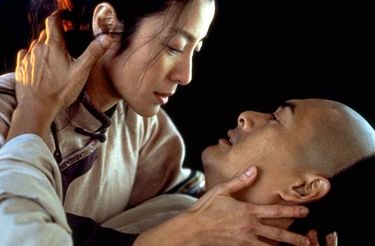

Consider two of my favorite “love scenes” on film, one from an Asian filmmaker (who has made “American” films) and the other from an American filmmaker, but in a film set in imperial Japan. In Ang Lee’s Crouching Tiger Hidden Dragon is a scene in which Chow Yun Fat and Michelle Yeoh – two star-crossed warriors who’ve loved each other for years but have been unable to act upon that love – enjoy a quiet moment and a cup of tea. He takes her hand and brings it to his cheek, and you can feel their ache for each other. They exchange a few simple lines, as I recall, but that’s it. Their faces and hands tell the story. (If anyone knows where to find this clip online, let me know. You can see a portion of the scene as part of this montage from the film, near the 2:15 mark – thanks, Tyler!)

There is another love scene in the movie that is more aggressive (and more biomechanically accurate), but even this scene is short and and involves no nudity – and yet you have no doubt what has happened, both physically and emotionally.

And in Edward Zwick’s The Last Samurai, Tom Cruise’s character, who has been cared for by the widow of a samurai he killed (she does so on orders from her brother, the leader of the clan) is dressed for battle by her in her late husband’s armor. The woman has come to love him, and although they do kiss (once, and lightly), they wouldn’t have to for the scene to be effective. No nudity. No slo-mo. No sweat.

Now, I know that Asian films and filmmakers aren’t always this subtle – Ang Lee, in particular, has pushed the envelope with his portrayals of sexuality, both in the States and abroad. But what catches my attention is 1) how relatively rare it seems that an American film takes the more subtle route, especially in terms of love or sexuality (and I don’t think it’s a coincidence that Zwick’s scene is in a movie set in the Far East), and 2) how this subtle approach parallels, in my mind, haiku and other Asian poetry.

Maybe it’s what I’ve come to expect, or the movies I choose to see – or maybe Asian film-makers are exporting what they think Western audiences want from them. Whatever the case, it’s clear to me that these movies approach their subject matter from a different mindset, and that mindset intrigues me.

*****

Both of these movies, and other similar films, also end on a note of uncertainty. The American film tries to tidy up a bit at the end – gives you one possible outcome – but neither is altogether happy or altogether neat. My wife hates that …

One last haiku – perhaps the best I’ve found at taking the reader to the verge and then letting go:

This world of dew
is only a world of dew –
and yet
– haiku by Issa

Blogger’s Note: Top two photos of Chow Yun-Fat and Michelle Yeoh in Crouching Tiger, Hidden Dragon. (© 2000 Sony Pictures Classics. All rights reserved.) Bottom photo of Tom Cruise and Koyuki in The Last Samurai. (© 2003 Warner Bros. All rights reserved.)

Tales of the Inexplicably Frightening III

Heard on the way to work this morning: Numerous pundits and primary voters claiming that, in the past few days, Hillary Clinton has finally shown her humanity and proven she has a soul.

Initial reaction: Shouldn’t one’s humanity and possession of a soul be some sort of baseline requirement for public office, rather than the thing that pushes you over the top?

Current thinking: So along with calculating and ambitious, we get get emotional and fallible — bonus!

Bottom line: Maybe a cold, calculating leader with a commanding presence wouldn’t be so bad — vote Zod in 2008!

In a Family Way

Blogger’s Note: I’ve been a little swamped, but here’s a musing on fatherhood from a few years back. (You’ll note we have four children now, and none on the way , knock wood.) Got me a little choked up to read it again — they grow up so fast!

Brendan was about six months old when I took him to his first auction. It wasn’t just some farm sale with buckets of odds and ends and a hot-dog stand by the tool shed — I wouldn’t have dragged him out in the rain for that. Twice a year the area’s Amish folk held a huge consignment sale and flea market on the Yoder place: farm equipment, tools, automobiles, horses, mules, buggies, handmade quilts, goats, furniture, bicycles, scrap lumber, you name it. Plus the best Amish home-cooking money can buy.

The weather was miserable. I strapped Bren to my chest and put a plastic poncho over us so just his head stuck out. We got there late, so finding my own father was no small feat. We finally spotted him at a long table under a makeshift pavilion made of two-by-fours and blue plastic tarps, drinking coffee with three young Amish men who eyed Brendan and me curiously.

I said my hellos, and Ben Miller, the farrier, gave their curiosity a voice: “Just you and the boy today?”

“Yeah, just us,” I said.

Ben glanced at the others, who looked incredulous. “Not scared to change diapers or anything?”

Before I could answer, Dad spoke up: “I don’t think Jim’s afraid of much of anything anymore.”

Amish men don’t do much in the way of caring for babies. Admittedly, they’ve got a bit more on their plates than me — the whole sun-up-to-sun-down schedule, and no time-saving crutches like e-mail or mass transit. It’s too bad, though — they’re missing out.

I’ve been fortunate enough to hold Jodi’s hand through three births, to choke up at the sight of three misshapen purple heads, cut three cords, and hold Jode’s hand again, three times, as her body shook from the residual adrenaline. I’ve made three long drives to the hospital, camped on three hospital cots, and twice introduced older brothers to their new siblings. I’ve played good-pop-bad-pop while interrogating mischief-makers, enforced time-outs with infinite patience, and thrown up my hands in frustration and defeat. I’ve been clueless. I’ve been helpless. I’ve been idolized. I’ve been blessed.

I don’t know how dads ever sat in the waiting room. Number four is on his or her way, and I can’t imagine not being there. Don’t get me wrong — it ain’t pretty. On miracle scale, it’s much more a plague of frogs than water to wine. (Well, maybe water to whine…) But what guy wouldn’t stick around to see a plague of frogs? Thousands of frogs hopping all over the place, and all the girls freaking out? It’d be like junior-high biology class, which was pretty sweet, I thought …

Sweeter still are the miracles that follow childbirth. The big ones — like the first laugh, the first steps, the first words, and the first morning you wake to the realization that the baby hasn’t yet. And the small ones, like Brendan connecting with the first pitch and lining it toward third, Emma singing the Barney theme song, only with a frown in her deepest, growliest monster voice, and Gabe discovering that you can point with your “picking finger,” too.

My father was wrong on one count — I am still afraid. Afraid I’ll mess this up somehow. I went with Brendan to school the other day, and as he navigated his classroom, it became apparent that I was now in his world, a little place I rarely see and have virtually no control over.

I keep telling myself that Jodi and I are giving our three (soon to be four) children what they need. The truth is, we’re doing our best, and praying it’s enough.

So far, so good.

New Directions

Well, looky here: I’m changing blog addresses and titles. As interesting as Viable Thirds may have been in my head, what I’m doing here really has little to do with public policy or opinion, and much more to do with writing and music, etc.

So over the next few days, Viable Thirds will be gradually phased out in favor of Werd-Fu. What better venue for sparring over the written word?

Learning to Live With Yourself

The drive home tonight was made infinitely more enjoyable by an NPR interview with a legend I only barely recall from my younger days: Merle Haggard. At age 70, he’s got a new disk, a bluegrass sound this time around, and the sand and wisdom of years in his voice.

The interview was a breath of fresh air in the midst of campaign coverage, and I encourage you to check it out here. If you’ve got the connection for it, click Listen Now. It’s so much better, funnier, and more musical (not to mention quite a bit longer) live.

It got me thinking: first, about my last post, and his favorite song of the new batch, “Learning to Live With Myself.” Sounds like it’s a lifelong journey.

And second, about the notion of “growing old gracefully.” Too often our culture seems ashamed of our aging population; consequently, sometime older folks are embarrassed or ashamed to slow down or show infirmity.

But I remember Dad’s old friend Louie Randall, who spoke in a wheezing whisper through a hole in his windpipe and swung a three-pound sledge like it was a meat tenderizer well into his 70s. And I recall the the first time I saw Johnny Cash’s hauntingly beautiful video rendition of Nine Inch Nail’s “Hurt”—gazing into the camera, frail and unapologetic. And I remember Pope John Paul II, hunched and trembling, waving off his aides (dare I say irritably?) to give hope to hundreds of thousands of young people from around the world. They didn’t turn away, but loved him for it.

And I hope that I one day I’ll be every bit as weathered and white and tough as these old men. In this life of ease and plenty, however, it seems unlikely.