LIFT Links: On Christmas, Mentoring, and Chastity

Blogger’s Note: In an effort to help friends find great Catholic content that supports them in the practice of their faith, periodically I’ll be sharing articles, websites, books, and other resources that may be of interest.

  • This Christmas, Strive to Look Good on Wood. It’s a bit poetic, but this reflection on the scandal of God coming down to be born in a feed trough and die on a cross is worth a slow read in a comfortable chair. Oh, how He loves us!
  • Sticks and Stones? Those Catholic Men reflect on how important it is for mentors (from fathers to teachers, coaches to catechists) to be thoughtful in their words. I know I’ve been one to snarl, “Man up!” from time to time myself…but how beautiful the words of God: This is my beloved son, in whom I am well pleased!
  • Chastity Is For Lovers. A columnist for the National Catholic Register reviews a book with an important message, not just for young adults, but for old married couples as well. I can speak to this from my own conversion after 11 years of marriage (most of them as a practicing Catholic): marriage does not do away with the need for chastity. Indeed it is essential to happiness in married life!

    The Feast Before the Feast

    Alarm at 6. Hands inside a semi-frozen turkey at 6:05, breaking free the neck and extras. Stuffed and in the oven by 6:20. Sun’s not even up yet. Maybe I should head back to bed — it’s a holiday, after all.

    Nah. Coffee and a quick post about the Feast before the feast.

    Each year, the church offers a special Thanksgiving Mass on Thanksgiving morning — the perfect start to a day dedicated not so much to fats and football, but to that most precious of human expressions: gratitude. We are blessed people. Blessed to be breathing. Blessed to have a God in heaven who cared enough to create us, to give us an ordered world in which to live, and the freedom to strive, fall, and strive again.

    In The Lamb’s Supper: The Mass as Heaven on Earth, Scott Hahn reminds us that the sacrifice of the Mass, the Holy Eucharist, takes its name from the Greek word for thanksgiving: “Man’s primal need to worship God has always expressed itself in sacrifice: worship that is simultaneously an act of praise, self-giving, atonement, and thanksgiving (in Greek, eucharista) (p. 26).”

    In the early Church, the Eucharist would have been the most distinctive and outlandish characteristic of “the Way,” and the Church today reaffirms the sacrament as the source and summit of our faith. Our greatest expression of thanksgiving is a re-presentation of the greatest sacrifice ever known: God’s own humiliation and death on a cross.

    Thank God it didn’t all end there.

    Hahn goes on to write:

    Perhaps the most striking liturgical “ancestor” of the Mass is the todah of ancient Israel. The Hebrew word todah, like the Greek Eucharist, means “thank offering” or “thanksgiving.” The word denotes a sacrificial meal shared with friends in order to celebrate one’s gratitude to God. A todah begins by recalling some mortal threat and then celebrates man’s divine deliverance from that threat. It is a powerful expression of confidence in God’s sovereignty and mercy (p. 32).

    Our own family feasts of gratitude, then, should also involve a sacrifice, signifying that what we have is not ours by right, but a gift from above. We should give something back. And lest we think we’ve faced no mortal threat from which God has delivered us in this past year, we should remember Christ’s victory over death and Hell — the fundamental threat of our mortality, which none can escape except through God’s grace.

    So instead of scarfing the last of the potatoes on our plate to beat our siblings to the last piece of pie, or skipping cleanup to ensure we get the sunniest couch cushion on which to nap, we should give and serve. We should make a point of saying Grace and sharing our blessings. And we should avail ourselves of the Feast before the feast: the precious Body and Blood of Jesus, at our communal table, the altar.

    Time now for a shower. If I don’t see you this morning, may you have a blessed Thanksgiving!

    Wear Your Faith Lightly

    “Seriousness is not a virtue. …[S]olemnity flows out of men naturally; but laughter is a leap. It is easy to be heavy: hard to be light. Satan fell by the force of gravity. 

    – G.K. Chesterton, Orthodoxy

    About the time I graduated high school, I remember a conversation with my dad about a friend of mine. You know the guy—great fun to be around, but always on the edge of trouble, and one could never be sure he’d stick around if things went south. “But someday,” said Dad, “he’s going to grow up, raise a family, and be an upstanding citizen. And he’s going to look back on his high-school days and think, ‘Man, I had fun.’”

    He looked at me and said, “Sometimes I wonder if you’ll be able to say the same.”

    I have always been a serious soul—earnestly wanting to do the right thing, to avoid the mistakes I could and learn from the ones I couldn’t. I was the kind of kid who felt so badly for things I did wrong that I ratted on myself. Even today, I am an emotional sort who avoids the news to keep from raging or sorrowing over the terrible things that happen to people I don’t know.

    This serious streak has also manifested itself in my faith life. I am so abundantly blessed, both at home and at work, but you wouldn’t always know it. The weight of my faults and earthly concerns drag my gaze downward until all I see is dust and grime. At times I dwell on past sins that have already been forgiven, and against my own advice to others, I worry about things that have not, and may never, come to pass.

    This is not what God desires for us. In the parable of the talents from last weekend’s gospel, the master bids his two worthy servants, “Come, share your master’s joy.” Earlier in Matthew’s gospel, Jesus reassures his disciples, “Come to me, all you who labor and are burdened, and I will give you rest. … For my yoke is easy, and my burden light.” Though Jesus tells us we should expect to suffer for our faith, these are not the words of a Lord who wishes for us to suffer needlessly. God wants us to be happy.

    A friend recently gave me a collection of C.S. Lewis speeches entitled The Weight of Glory. Lewis opens with a reflection on the idea that Unselfishness has replaced Love as the highest virtue in modern society, and insists that this shift is a mistake, because it put the emphasis on denying ourselves and not on helping others. The focus has shifted inward, but in a stoic, joyless sort of way that fails to acknowledge the extravagant promises to us who live a holy life. Lewis writes, “We are half-hearted creatures, fooling about with drink and sex and ambition when infinite joy is offered us.”

    Imagine: infinite joy! Should that not put a spring in our step and a laugh in our throat, and raise our gaze toward heaven? And won’t that light-hearted faith be far more attractive and illuminating to those lost souls circling like moths in the darkness, trying to find their way?

    Blogger’s Note: This article appears in the Sunday, Nov. 23, church bulletin .

    Inspiration and Aspiration: Our Blessed Mother and the Apostles

    inspiration – n. – the action or power of moving the intellect or emotions
    aspiration – n. – a strong desire to achieve something high or great

    Last month, our adult faith formation groups talked about Our Blessed Mother. The discussions were good, and the Q&A with our priests each night centered primarily around the Immaculate Conception and the fact that Mary remained sinless throughout her life.

    I find Mary to be a tremendous inspiration. By saying yes to God plan and saying no to sin, she received her heavenly reward, body and soul, immediately upon leaving this world. And that simple, resolute yes changed the history of the world! Would that all of us could do the same: resolve to do God’s will, whatever the cost, and refuse to yield to temptation, however strong.

    Of course, we are not immaculately conceived and full of grace — so while it can be inspiring to meditate on Mary, the crown of creation, it can be difficult (and perhaps moreso for a man) to imagine putting ourselves in her shoes and following in her footsteps.

    This month, the adult groups will be talking about Saints Peter and Paul. I recently had the chance to show an Orthodox priest and iconographer the great Eastern-style icons in our sanctuary, and I asked why Paul was portrayed in the dome with the other 11 original apostles. He replied that in the Eastern tradition, Peter and Paul always go together: the weak one who denied Christ and became the Rock, and the proud one who persecuted the church and became the great evangelist to the Gentiles. Both men prove that it doesn’t matter who or where we are, what we do, or how much we stray — when at last we are ready to turn to God, He is right there beside us.

    The apostles are great examples of the wondrous creations God can make with broken pieces like you and me. With all their imperfections, St. Peter and St. Paul call us to holiness and to persevere in faith — and because they stumbled along the way, they make the path to heaven seem navigable.

    LIFT Links: Resources for “Practicing” Catholics

    We are all practicing”Catholics – learning how to live our baptism, our vocation, and a sacramental life here on earth. In an effort to help friends find great Catholic content that supports them in their practice, periodically I’ll be sharing articles, websites, books, and other resources that may be of interest.

    As the first installment of this series of posts, I want to share two resources – one for Catholic parents, and two specifically for Catholic men, who are arguably the linchpin in sustaining strong Catholic families. (Moms do so much, but it’s hard to do it alone!)

    For Catholic parents:

    • Quick Read: Five Ways Parents Can Engage Children in the Faith. A parishioner and friend shared this great, brief article from Fr. Ed Broom on CatholicExchange.com, highlighting several easy things we can do as parents to lead our children to heaven. The tips on how to acknowledge the Real Presence of Christ in the Mass and the Eucharist are particularly important: remember, our kids can tell if we’re just going through the motions.

    For Catholic men:

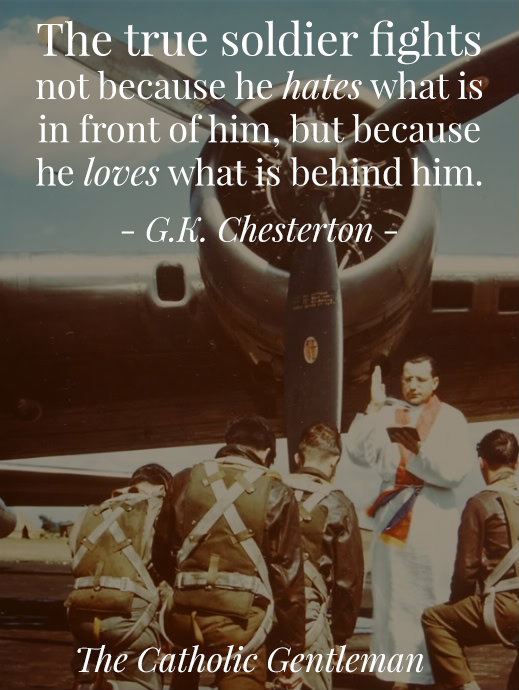
    • Manly Inspiration: The Catholic Gentleman. With solid articles, great photos, and timely topics like “The Thrill of the Chase: Prayers and a Patron for a Virtuous Hunt,” the website The Catholic Gentleman is a great place to go for a regular dose of manly inspiration for teens on up. If you are on Facebook, “like” The Catholic Gentleman for daily encouragement like the image at the right.
    • Strength In Numbers: Catholic Man Night. Catholic Man Night got its start right here in our neck of the woods in 2010, providing men with opportunities to come together to pray, eat, and get to know Jesus Christ. The website alone is full of great information, links, and resources, but the real opportunity for growth here is to attend an upcoming Catholic Man Night in person. We regularly host these events at St. Michael, so keep your eyes peeled for the next one and join us!