(Pro) Life, Without Religion, Part 2: A Little … Something

Inspired by recent ultrasounds of our tiny child resting peacefully in utero, last month I shared my response to a common abortion-rights argument: “It’s my body; it’s my choice.” In that post, I argued that, in no way could an embryo or fetus be considered the mother’s body, or even part of the mother’s body.

The question remains, then: what is it? A few possibilities come to mind: it may be a bit of foreign debris or tissue; it may be a tumor (benign or malignant); it may be nonhuman organism (like a parasite or symbiotic microorganism); or, it may be Homo sapiens – a human organism. I’ll address these possibilities one at a time:

  • Foreign debris or foreign tissue. If an embryo were nothing more than a bit of foreign matter that had somehow found its within the woman, it makes sense that her body would respond accordingly, targeting the embryo in the same way it might a sliver or a piece of shrapnel, either to eliminate it from the body or encapsulate and neutralize it. Of course, an embryo consists of living cells, so the body does not react to it as thought it were a simply a foreign object. If an embryo were living, foreign tissue, it makes sense that the woman’s immune system might react negatively to it, in the same way that it might reject a donor organ. In fact, in the vast majority of cases, the woman’s body does the opposite, suppressing it’s own immune system and laboring to provide a protective, nurturing environment and nutrients to encourage growth and development of the embryo. It is true that in certain cases (e.g., an Rh-negative mother carrying an Rh-positive fetus), the woman’s immune system may react to presence of Rh-factor in the fetus’s blood, sometimes leading to death of the fetus – however, most of the population (approximately 85 percent, I believe) is Rh-positive, so such a reaction is certainly not the norm. Nor does it change the fact that the woman’s body continues to try to accomodate the fetus even as antibodies in her blood attack the fetus’s red blood cells.
  • Benign or malignant tumor. I’ve heard it more than once “It’s just a ball of cells.” Actually, I did a little reading for this post to help ensure I’m using the right terminology, and learned that tumors are more commonly defined as a neoplasm that has formed a “lump” – and a neoplasm is a new and abnormal growth or proliferation of cells not coordinated with the body’s healthy tissue. Is an embryo a neoplasm? It is certainly a new proliferation of cells, but typically (left to its own devices), its growth is in clockwork coordination with the healthy tissue around it; in fact, the surrounding, healthy tissues of the woman’s body (left to their own devices) change to become more accommodating to the new growth – again, encouraging growth and development. To quote Arnold Schwarzenegger in Kindergarten Cop: “It’s not a tumah!
  • Parasite or other nonhuman organism. An embryo or fetus certainly derives nutrients and protection, and at some cost the woman in whose body it resides – but is it a parasite (like a tapeworm) or some other symbiotic nonhuman organism (like our gut flora and other bacteria that exist on or in our body and are beneficial or neutral to our health and well-being)? First, consider that non-human organisms (parasitic or otherwise) are not native to us nor do they spontaneously generate within us. Instead, they are acquired. Even our gut flora are acquired at birth and rapidly afterward, from our mothers and the environment. An embryo, on the other hand, is not something caught from another person or acquired from the environment which then colonizes the uterus. And while it takes the introduction of a male gamete to fertilize an egg and ultimately form an embryo, even sperm cells cannot be considered parasites or symbiotic organisms – they have a short-life span and cannot reproduce themselves or “colonize” the woman on their own; those that do not fertilize an egg ultimately die off and are eliminated.
  • Human organism. To review, start where you like: a zygote, an embryo, or a fetus. Clearly these are not non-living things; they are living cells that use nutrients and multiply. If it were merely foreign tissue or an infection, the woman’s body would work to destroy it – no abortion necessary. If it were a parasite or symbiotic organism, it would be acquired externally, not formed internally from two cells whose sole function is reproduction. Now, consider that when a sperm and egg unite and form a zygote, the result is genetically identifiable as human – 23 pairs of chromosomes is the norm, but even some variation in this number (as in the case of Down Syndrome), when permitted to develop, can result in a viable independent organism that we would recognize as human. Some will argue that a skin cell, or an eyelash, or a cancer cell might be alive and genetically human, but we kill those all the time; certainly that isn’t murder, is it?  Of course not. But as we’ve already established, an embryo clearly is not any part of the woman’s body (it’s not even a genetic match) nor is it a tumor (it is developing in coordination with the woman’s body and the result will be a viable, independent human organism). Without a doubt, an embryo is a living, human organism.
Even some abortion supporters make it this far. At this point, the arguments become much more philosophical: abortion supporters claim is that this human organism is not a human being – it is a genetically human living thing, but only a potential human being. This raises a fundamental question: What makes a human organism a human being? I’ll share how my pre-religious mind tackled that question in my next post on this topic.
(Pro) Life, Without Religion, Part 1: It’s My Body!

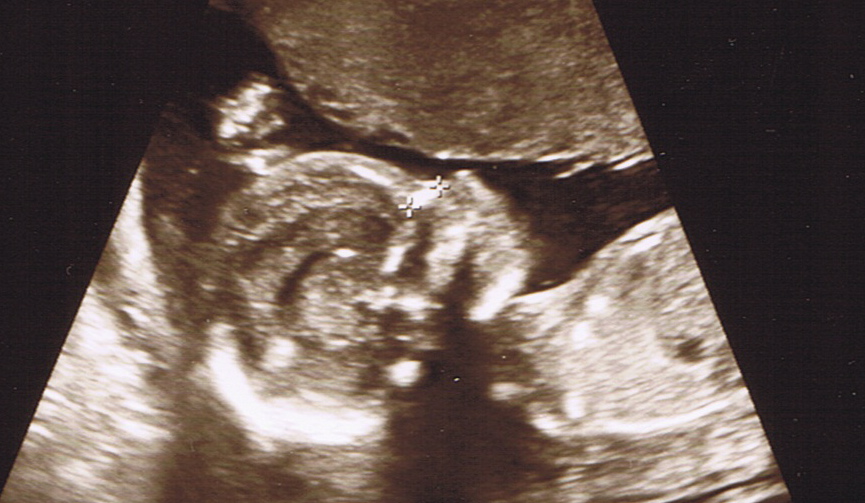
This morning Jodi and I saw the face of an angel — our angel, a tiny new Thorplet, just 11 ounces now at 18 weeks of development. Our baby pulled away from the attempts to examine his or her feet, just like all of our children, but otherwise kept uncooperatively still, making it difficult to get a good look at the tiny, chugging heart. When the sonographer was finally finished her thorough examination, she took the photo above: a tired wee child, hand above head, resting peacefully.

I’ve always loved ultrasounds. In part, it’s the geeky wannabe scientist in me, but mostly, it’s the wonder and sweet jealousy of seeing our tiny baby alive and safe inside the love of my life, and knowing that yeah, I can pee standing up, but I’ll never feel life moving within me. This was a level-2 ultrasound: given my bride’s so-called “advanced maternal age” (I wouldn’t begrudge her a right cross next time someone says that…not this time, but next time…) they offer it as a way of taking a closer look at how both the baby and the mother are progressing. We turned down all the other tests and genetic screening, but taking a closer look at our little one and Jodi, especially given the size of our babies, seemed like a good idea.

The photo above was the highlight of the hour or more we spent in a dimly lit room with the sonographer. It was worth the wait, but to be honest, I was more excited about these two images:

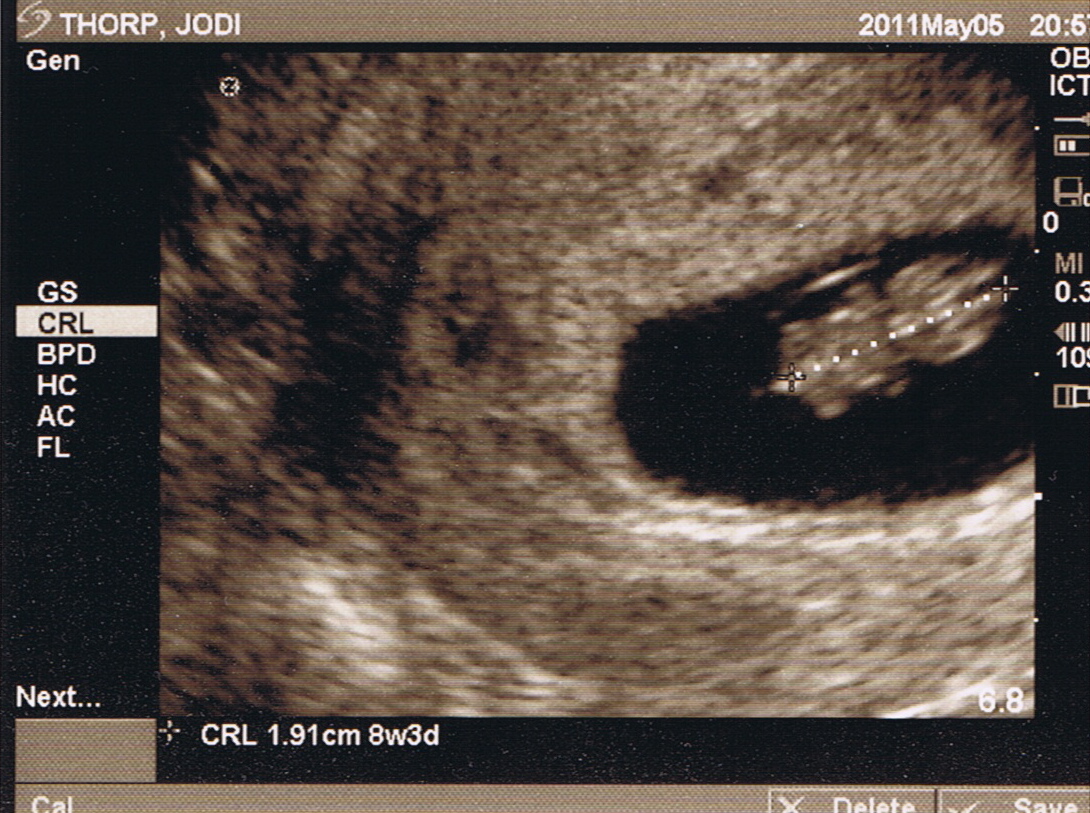
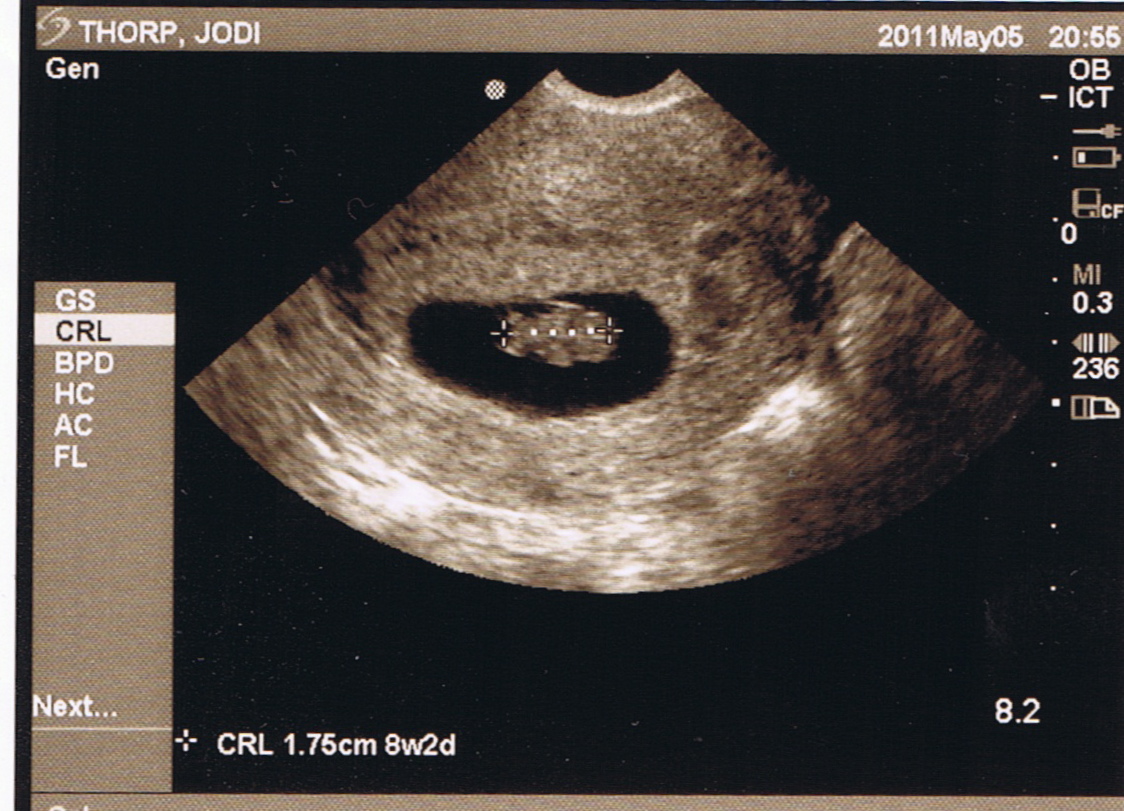
These show our baby at just eight weeks of development. We’re looking down on him or her from above, with an absolutely Thorpian head to the right, and a torso with four tiny limbs extending to the left and down in the lower image. This was a thrill, not only because we lost a little one last fall and were hoping for an “all systems go!” from our doctor, but because there on the screen was a tiny person, less than two centimeters long, with a beating heart and legs and arms that moved independently of any thought or command from Jodi or me. A child the size of my fingertip who, just before Christmas, we will be blessed to welcome and trusted to raise.

Some people say miracles are impossible; others believe they happen, but only rarely. I believe miracles happen daily, all across the world. I’ve got photographic proof.

As we drove home from the earlier ultrasound, I was reminded of an extended argument I had once, on a political blog in South Dakota, with a staunch and pseudonymed liberal who dismissed me and two of my friends as Bible-thumpers for being against abortion. I explained to him that, on the contrary, I studied physical anthropology and human evolution in college and was anti-abortion well before I became a practicing Catholic. I articulated to him a set of arguments against abortion, completely independent of religious belief or church doctrine, and asked, then begged, then dared and taunted, him to engage me on them. He would not.

What came back to me as we drove home was the first argument I offered to him. As I recall, he insisted, on behalf of women everywhere, that “It’s their body; it should be their choice.”

“Which part of their body is it?” I asked.

An abortion removes something from a woman’s body, without a doubt. If what is removed is her, or some part of her, then it should share both her gender and her genes, and she should be somehow physically diminished, something less than the whole and functional woman she was before the procedure. If she had her gallbladder removed, for instance, or a toe, a mortician or coroner might note such a thing upon her death.

A woman who has a “successful” abortion, however, emerges physically intact, but no longer pregnant. What is removed, though taken from within her, and attached to and dependent on her, is not her — not genetically, and not logically. (In my online arguments, I moved from what a fetus isn’t, step by step, to what it is, over several exchanges. In time, I think I’ll do the same here.)

This was made clear again to me when I saw our tiny infant, wriggling in amniotic bliss, at eight weeks of development. Jodi had no say in the flailing of those tiny arms and legs, and that tiny heart beat in part because of, but not for, her. No choice on her part, short of violence, could have stopped it.

And of course, it was made clear yet again today when we saw that beautiful profile at the top of this post. There’s a reason that the Knights of Columbus and other Catholic and pro-life organizations are investing in ultrasound machines for clinics and teaming with expecting mothers to show live ultrasounds of their babies to middle- and high-school students. There’s no better way to recognize the humanity of others than to see them face to face.

Gabe’s Humor

It’s Gabe’s birthday, and he was feeling his oats, as they say — a little rambunctious; a little silly (as were the other kids, me included). So just before we begin, I look around and find Trevor, lying on his belly with his butt in the air and “aimed” directly at me, as it were.

“What is that!?” I roar, pointing at the pajama-clad rump.

Without missing a beat, Gabe says, “It’s a horrible crime against nature!”

The Second Third, Week 35: Best-Laid Plans

Sometimes it appears that I am unable to go with the flow. This is not true. (No, it isn’t!) I can absolutely go with the flow. But once I have a plan, I have a hard time adjusting it or letting go.

I have a good reason for this — one that cropped up again today. As a writer, I have to push myself to get work done in a reasonable timeframe, and now that I’m able to work from home (surrounded by potential distractions) I have to be even more structured with my time. So I’ve got my work week carved into blocks of time for specific projects, for writing, for catching up on reading and administrative tasks, etc. It is my intention to cultivate discipline in myself…unfortunately, this morning I woke up feeling quite ill and started the day slow. Then I started to spread myself out in my home office space and realized I didn’t have enough open work surface for the project, so I had to do some rearranging. By the time I got situated, I was supposed to be moving on to the next project. I didn’t achieve much that I set out to. Tomorrow must be a better day than today, or I’ll be seriously behind my self-imposed deadlines. And even though they are self-imposed, if I don’t take them seriously, I’ll never accomplish anything.

Similarly, today is my bride’s birthday, and I wanted it to be special. I’ve spent the past several days thinking about how to achieve this and formulating plans in my head: how can I give Jodi exactly what she wants, and surprise her?

What does she want? The bathroom repainted, relit, recaulked, etc.; a new curtain or blind for the kitchen window; and (eventually) new bedding. And to go out for supper. And a pineapple upside-down cake. I knew, based on what we have scheduled this week and weekend, that the bathroom was not going to get done until next weekend at the soonest…and since we’re still trying to narrow down what she wants for the kitchen window, I urged her to consider moving the bedding up on her list of priorities, because we had done a little looking already and that was something I could do tonight. After all, I wanted her to have something to open.

I also planned to have lunch with her today, and supper out, and then cake. It was going to be great!

I was going to pull lunch together with the kids, but people kept calling Jodi, so I was working while she talked…and next thing I knew, she was cooking something for lunch. Strike one.

“Why are you cooking?” I said. “We have plenty to eat, and the kids can do this!”

She shrugged. “It’s fine,” she said. “It’s lunch time and I felt like it.”

We talked a bit about her “home improvement” gifts, and I thought I’d slip quietly out to get what I needed for the cake and come back with the bedding we had looked at…except then she said we should shop some more — at least at JC Penney and Bed, Bath, and Beyond — before we purchased anything. Strike two. At least I could still make a cake.

Jodi and I discussed supper plans. There was a fair chance that wherever she decided to go, we would get dessert. Tomorrow is Gabe’s birthday — we will celebrate it as a family, but he’s having a party (and his cake) on Friday.

“Maybe we should get dessert at the restaurant tonight, and hold of on your cake until tomorrow,” I sighed. “Then there will still be a cake on Gabe’s birthday, and one for his party.”

“That sounds good,” said Jodi.

Strike three.

I spent the afternoon stewing. Jodi made lunch. Jodi had no presents or cake. All she had to mark the day was a card, or best birthday wishes, and dinner out. That had better be good!

We went to Texas Roadhouse. Having no experience with the place or the portions, we thought we would order a couple appetizers as a treat. (We almost never order appetizers.) The boys wanted chili cheese fries. Jodi wanted potato skins. The two younger kids wanted macaroni and cheese and fries for their meals, but we reminded them we were getting fries as an appetizer. We were also snacking on delicious warm bread and cinnamon butter as we discussed it…so by the time we had settled on what we would order, Jodi and I looked at each other and said, “Probably just one appetizer.”

Except that now all four kids were expecting fries. Jodi ordered chili cheese fries instead of potato skins. Then, just before we ordered our entrees, she announced she was ordering a sandwich — one of the cheapest things on the menu.

“Are you sure?” I asked, incredulous. “Don’t worry about the cost because…”

“It’s fine,” she said. “It’s what I want.”

“It comes with more fries,” I said. “Why don’t you get the potato skins instead?”

“It’s fine!”

Jodi was getting exasperated. It occurred to me then that I wanted the day to be special, but only in part for her…that I was also trying to be a Good Husband. I didn’t want her to tell anyone that she cooked, and didn’t have a gift or a cake, and had a pulled pork sandwich and fries for supper, because people would think I was a jerk. (And if she insisted it was a good supper or a good day, people would nod knowingly, because that’s the kind of woman she is: Of course she wouldn’t badmouth Jim, the big jerk!)

She ate her sandwich, her fries, and a small dish of complimentary ice cream and chocolate sauce. We stopped at JC Penney on the way home and looked but did not buy. And I couldn’t help myself: on the way home, and at least once after we got back, I apologized for not making the day more special.

“It was fine, honey,” she said. “I got a lot of reading time, dinner was fun…and the sandwich and fries were perfect for me!”

She may have had a point there: Brendan and I were both miserable from eating too much, and Gabe brought most of his home.

I had plans and couldn’t let them go. I wanted things to be perfect, and wound up driving my bride slightly batty today. In my Second Third, I need to learn when to stick to my plans, when to be flexible, and when to let go.

Strength In Weakness

A few years ago, I briefly joined the kids in studying Chen-style taijiquan — the original “tai chi,” an ancient Chinese grappling art rarely taught in the West. During a “push hands” class, I was partnered with a diminutive older woman. We stood toe-to-toe, our right hands extended and connected, back-of-wrist to back-of-wrist; I would shift my weight forward (toward her) and rotate my hand to push her hand toward her; when she could shift no further backward, she would redirect my push in a circular fashion, rotate her own wrist, and push back into me in the same fashion. We did this continuously, until our quads were burning and droplets of sweat ran down our forearms, and the longer we went on, the faster her redirect, until it felt (to me) barely controlled. I shrugged inwardly — she was a more experienced student than I — and tried to maintain a slow and steady pace.

Our instructor, Jose, approached and watched us a moment, then gently reminded her to move in a more deliberate and controlled manner. “I’m trying,” she replied, “but he’s pushing like hell!”

Jose shifted his knowing gaze to me and smiled. “I paired you with someone of a different size on purpose,” he explained. “One of the most difficult parts of taiji for men — especially large men — is learning to sense the other person and knowing their own strength, learning to be gentle. Anyone can be hard, but it’s often difficult for men to be soft.”

Jodi had told me for years that that I didn’t know my own strength and that I should be more careful when “handling” her or the kids — but this lesson drove it home. We resumed the exercise, and I tried to empty myself. I could barely feel that we were connected, which made it difficult to respond to my parter’s movements. I found I needed to be infinitely more attentive to my partner. Jose was right: It was hard to be soft.

A week or so later, I was partnered with a man closer to my own size and build, in a similar exercise, except this time the circular hand motions were more vertical in orientation, and the one whose hands were beneath the other’s was supposed to bear the weight of the other’s arms. This requires the other person to empty himself and let his weight (or at least, the weight of his arms) be carried — another act that does not come naturally to men. Both of us tested the other by periodically stopped our circles and watching the “empty” person continue to circle on their own, a sure sign that he was not truly “empty.” This time we were forced to be more attentive to ourselves.

It is easy to find the power in our strengths — to rely on our size or our natural aptitudes and bulldoze our way through the problems that confront us. This past Sunday, Fr. Mark of Our Lady of the Black Hills Catholic Church preached on the topic of meekness, in part using the definition “strength under control,” and indeed, the New Testament of the Bible is rife with the apparent paradox that we are strong in our weakness.

I’ve struggled with this concept myself and, in the past, have made my peace with it in the sense of Clint Eastwood’s line (above): “A man’s got to know his limiations.” But a few weeks back, our associate pastor at St. Michael Catholic Church, Fr. Meyers, helped my understanding in a profound new way. In a three-minute homily at a Saturday morning Mass, he said that each of us has a tendency toward one of the seven deadly sins — I believe he referred to this as our primary fault — which can also be the means of our salvation. (I’m certain I’m oversimplifying and not doing this topic justice.)

This resonated with me. I know that I struggled, early in my marriage, with lustfulness and learning to better love my bride, and I know that coming to terms with the Church’s teachings on married sexuality has transformed my marriage, my faith and family, my entire life. Despite a number of strengths as a husband, father, and man, I had a basic weakness and misunderstanding that kept me from being all I could be in all three of these areas. Not only did I come to understand my limitations, but my weakness was turned to strength.

St. Paul, in his second letter to the Corinthians (Chapter 12, verses 7-12), says:

Therefore, that I might not become too elated, 3 a thorn in the flesh was given to me, an angel of Satan, to beat me, to keep me from being too elated. Three times I begged the Lord about this, that it might leave me, but he said to me, 6 “My grace is sufficient for you, for power is made perfect in weakness.” I will rather boast most gladly of my weaknesses, in order that the power of Christ may dwell with me. Therefore, I am content with weaknesses, insults, hardships, persecutions, and constraints, for the sake of Christ; for when I am weak, then I am strong.

May we all be blessed with such a thorn, and find the strength in our weaknesses.