The Flitter-Flutter of Tiny Wings

“Geronimo!”

For the past several days, we’ve had just two kids at home, Trevor and Lily. The elder three were at Extreme Faith Camp, Brendan as a leader, Gabe as a member of the prayer team, and Rose as a camper. Their return, I think, was bittersweet for the younger ones — although bored and (allegedly) overworked at points, they enjoyed having Mom’s and Dad’s full attention. Lily got in trouble for interrupting far less, because there was far less to interrupt. And Trev got to go to Culver’s and Jurassic World with just Jodi and me.

We parents, on the other hand, missed our teens. It took only a day or so for me to stop and calculate that we are just six years from potentially being a permanent four-person household, and eight years from Lily being alone with us, At some point unmarked in the past, the pitter-patter of tiny feet was drowned out by the flitter-flutter of tiny wings as the fledglings prepare to leave the nest.

This, I’m discovering, is going to be harder for me than the fact that I, too, am aging and yet still feel like I have much to learn — in fact, my own feelings of inexperience in this world only magnify my anxiety for my offspring. Have a taught them what they need to know to survive? Will they thrive? Will they avoid the pitfalls and snares in which Jodi and I have become entangled over the years? Have the courage to be faithful in public? To remain Catholic, with all that entails?

We see encouraging signs from each of them. Bren, now 17 and approaching his senior year, has changed his views on a military career, primarily due to moral concerns. He takes his faith very seriously: donates to Catholic causes, joins his friends for weekday Mass on Wednesdays, joins his girlfriend Olivia in the Adoration Chapel in our church. Gabe, nearly 15 and a coming sophomore, still has his eyes on the priesthood, joins his brother and friends at Wednesday Mass, and just last night asked where he could find the Divine Office that priests commit to praying daily — hinting that he’d like to take it up, but that he’d rather not do it alone. Thirteen-year-old Emma came home from having been deeply impacted by Eucharistic Adoration at camp, trembling with emotion before the Blessed Sacrament and alternating between sorrow and joy (ending on joy) as she prayed.

Yesterday I came home from the church for lunch, and popped in a DVD that would not play in my work computer. The video came up immediately, and featured Fr. Robert Barron tackling common Catholic apologetics questions in short video clips. I began cherry-picking a few that might be interesting, and Trev, who will be 11 in few days, sat down to watch. For more than an hour, we watched and discussed the rational foundations for our Catholic faith. It’s amazing to see what he absorbs in such a short time, and I pray the same has been true for the others.

Lily, of course, is only three. She knows Jesus by sight, likes to pray (the Angelus and petitions, in particular, and especially for her friends and for babies) most evenings, and is at home in our church, if not fully engaged by the Mass yet. As I continue in my job as faith formation director, planning the coming year’s program, I realize how much more we could be doing with our parish youth, and by extension, how much more I could have done with my own children. Lily will benefit from that realization — and yet when I look at her four older siblings, I wonder how much I should do differently. But how can I give anything less than my all for my family when the stakes are so high and the implications, eternal?
The Sacraments Keep Us Catholic

“At last the most wonderful day of my life arrived, and I can remember every tiny detail of those heavenly hours … How lovely it was, that first kiss of Jesus in my heart—it was truly a kiss of love.” – St. Therese of Lisieux, describing her first Holy Communion

Last month I was blessed to witness nearly 140 young people from our parish and school receiving their first Holy Communion. They were, by and large, reverent and excited—and those I spoke with personally understood at least in concept that they were receiving Jesus’s Body and Blood under the appearance of bread and wine. I hope at least a few of them remember the day with the same deep joy and devotion as St. Therese expresses above.  I’m almost certain, unfortunately, that a few have not been back.

Our approach to preparing children for First Confession and First Communion in recent years has increasingly fallen on their parents. In one sense, this is as it should be: the Catechism of the Catholic Church affirms that, through marriage, “parents receive the responsibility and privilege of evangelizing their children” and “should initiate their children at an early age into the mysteries of the faith.”

On the other hand, many parents do not feel equipped to share those mysteries, being uncertain themselves about the Church’s teachings on Reconciliation and the Eucharist. And while we provide families with workbooks to help them teach their children, these are poor substitutes for the level of love and support young Therese had in the months leading up to the sacraments. Her desire to make a good confession and to receive the gift of the Eucharist consumed her completely, and everyone in her family and community fueled her understanding and love for the Lord in whatever way they could.

As a parish, we can certainly do more. Beginning this fall, First Reconciliation and First Communion students will have an extra class or activity (in addition to LIFT) each month dedicated to sacramental preparation and a deeper understanding of the great gifts of Christ’s love and mercy we find on the altar and in the confessional. But this is no substitute for the evangelizing witness of parents leading a sacramental life in which their Catholic faith is a top family priority.

This is true for two reasons. The first is this: because children naturally observe and imitate their parents’ actions and interests, parents don’t have to have all the right answers, but it helps if you do the right things. Secondly, the sacraments are defined as outward signs instituted by Christ to give us grace—in particular, sacramental grace, which strengthens us to live according to our faith and state in life. The sacrament of Matrimony, for example, confers upon the spouses the graces needed to live in union as husband and wife, come what may.

The same applies to the sacraments of Confession and Communion. They strengthen us to resist temptation and seek communion with God, to forgive and seek forgiveness, to love sacrificially—in short, to be holy men and women of God. Each time we receive them, we are changed for the better. And when our children imitate us, so are they. What better way to ensure our kids remain Catholic?

Blogger’s Note: This article appears in the Sunday, May 24, church bulletin.

Book Break: Saint John Paul the Great: His Five Loves

This past Christmas, our church gave to all parish and visiting families a copy of Jason Evert’s book Saint John Paul the Great: His Five Loves. I finished it this past week while recuperating, and it seems only right that on this tenth anniversary of the great man’s passing, I offer a brief review and encourage family and friends to read it.

First, let me encourage you to read the Foreword and Introduction, as both share personal anecdotes that share what sort of man Pope John Paul II was, The first half of the book, then, is a condensed and easy-to-follow biography of Karol Wojytla from his boyhood in Poland to his death at the Vatican at age 85. Some years ago, on a long solo road trip, I had the pleasure of listening to an audiobook version of George Weigel’s JPII biography, Witness to Hope — Evert’s book uses Weigel as one of several sources, and provides a great overview of the events and circumstances that shaped young Karol into Father Wotyla, then bishop, archbishop, pope, and saint. When I hear these stories, I can’t help but be proud to be (half) Polish and Catholic.

The second half of the the book uses additional sources and anecdotes to outlines the “five loves” that inspired and sustained Pope John Paul II in his priestly ministry and personal holiness:

  • Young People: From his earliest priesthood, he was drawn to youth and young adults, recognizing early on that they were the church’s best hope for the future, and that a watered-down morality would not satisfy their idealism and thirst for the challenge of living full and Godly lives.
  • Human Love: He saw, in human love and sexuality, and image of the Holy Trinity’s loving and life-giving communion, and went to extraordinary lengths to explain the unity of love, sex, marriage,and procreation and to elevate these topics to the realm of the sacred.
  • The Blessed Sacrament: His love for the Holy Eucharist and experience of the Real Presence of Jesus was so deep and strong that he spent hours in adoration and conversation with God, and more than once, located the Blessed Sacrament in hidden chapels and unknown places by his love for and sense of the Divine alone. 
  • The Virgin Mary: After the loss of his mother, and ultimately his brother and father as well, he embraced Mary, the Mother of God, as his own and never ceased his devotion to her guidance and intercession — he knew that she always leads us to Christ.
  • The Cross: He saw the dignity in the elderly, the disabled, the sick, and the suffering, and showed it to them, first by articulating the ways in which human suffering can be used to benefit others, and finally, by living his own painful and debilitating struggles in the public eye, serving the Church until his death.
Last I looked, we still had a few copies of this book in the Gathering Space. If you didn’t get one, let me know. It’s a quick and enlightening read that is almost sure to inspire!

What’s Keeping You?

It’s been nearly eight months since I left the University of Minnesota to work full-time for our parish. At some point in each of my previous jobs, I looked around and asked myself, “Jim, what are you doing here?” Thankfully that has yet to happen since I joined the church staff, but I don’t doubt that it could—work is work, after all.

Faith is work, too. It’s hard sometimes to believe in a good God with so much wickedness in the world, including within the Church. It’s hard to do the right thing when so few people agree on what the right thing is, even within the Church. It’s hard to pray or read or learn more about Jesus, to drag ourselves to Confession, or to haul the family to Mass each Sunday when so many Catholics just…don’t.

I’ll bet at least once you’ve sat in church, looked at Father and the people gathered around you, and asked, “What am I doing here?” It’s a worthwhile question to consider. According to data collected by the Pew Research Center, not only do most U.S. Catholics say they attend Mass once a month or less, but many disagree with the Church’s fundamental teachings regarding marriage, contraception, and the sanctity of life. Yet they persist in calling themselves Catholic. What’s keeping them in the Church?

Well, what’s keeping you? Is it habit or family tradition that brings us here week after week? That makes us seek the sacraments for our children? Is it a hope we hold out for the next generation, even though we may have lost it for our own? Is it a hollow ache in our chest that insists there must be something more to this life? Or is it the peace that radiates from altar, the tabernacle, the Eucharist—peace the world cannot provide?

This month the adults in our LIFT classes focused on the Mass and Holy Communion. We heard the deeply personal testimony of one of our youth ministry volunteers on her own struggles with her Catholic faith—and ultimately, on how she could never turn her back on the Real Presence of Christ in the Eucharist. Jesus said, “This is my body…This is the cup of my blood”—and so it is. Jesus is God, and God’s words are the very words of Creation. They bring about exactly what they say.

I’ve said more than once that if we as Catholics truly understood who was present in the tabernacle, nothing could keep us from Him. We would fill the pews to overflowing, bring family and friends to a personal encounter with Jesus. We would gladly sacrifice to spend time at His feet, listening to Him, learning from Him, serving Him.

And yet I don’t do these things. We don’t do these things.

The red lamp above the tabernacle signifies that He’s always there. What’s keeping you?

Blogger’s Note: This article appears in the Sunday, Jan. 25, church bulletin .

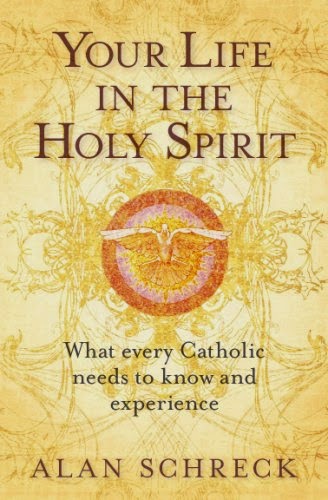
Book Break: Your Life In the Holy Spirit

Blogger’s Note: I reserve the right to re-read this book and revise this review as what I’ve read continues to sink in. I wanted to write about it soon, but honestly, my head is spinning!

If you’re like most Catholics, the concept of the Holy Trinity — three persons; one God — is one of the mysteries of our faith that is most difficult to grasp. The best explanation I’ve heard uses marriage to teach us about the Trinity, and vice versa:

  • God is a loving communion of persons.
  • Just as God the Father loves God the Son, and God the Son reflects that love back to God the Father, so to with husbands and wives: the two are united in love so completely they are inseparable and become one person.
  • Just as that shared love between husband and wife can become so powerful, life-giving, and tangible that it results in a new person and is given a name, the shared love between God the Father and God the Son is so abundant and powerfully life-giving that it takes on a life of its own and becomes a third person, God the Holy Spirit — who, in the Nicene Creed each Sunday, we call “the Lord, the Giver of Life.”

This explanation helps me to conceive of the Three-In-One, but the ability to relate to the Holy Spirit as a person remains elusive to me. I recently found up a copy of Alan Schreck’s Your Life in the Holy Spirit and decided to read it, in hopes that it would relieve this difficulty and help my devotion to the Holy Spirit as a person, rather than some mysterious force that helps me understand the Father and the Son. Schreck is a theology professor at Franciscan University of Steubenville and a contributor to Catholic Answers — so he seems like a good source on the topic.

Continue reading