Blogger’s Note: This is the latest in a collection of daily posts outlining my journey to the Sacred Heart over the past year or more. See an overview and links to past posts here.
Yesterday was Father’s Day. Providentially my re-consecration readings in 33 Days to Morning Glory were focused on Mary’s gradual discovery of her vocation not just to be the mother of Jesus, but the mother of the whole Church and all Christians. The book drew my attention to one scripture passage in particular, Matthew 12:46-50.
While he was still speaking to the crowds, his mother and his brothers appeared outside, wishing to speak with him. Someone told him, “Your mother and your brothers are standing outside, asking to speak with you.” But he said in reply to the one who told him, “Who is my mother? Who are my brothers?” And stretching out his hand toward his disciples, he said, “Here are my mother and my brothers. For whoever does the will of my heavenly Father is my brother, and sister, and mother.”
Fr. Gaitley explains that, among other things, this passage indicates the primacy of spiritual realities over physical realities, and in particular, spiritual parenthood over natural parenthood. Although the focus of his writing was Mary, on Father’s Day I couldn’t help but think in terms of St. Joseph and spiritual fatherhood. Continue reading
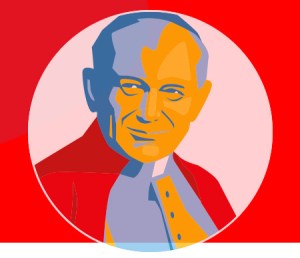 Born Karol Wojtyła in Wadowice, Poland, in 1920. Suffered the loss of his family, freedom, and country by the time he was 21 years old; risked his life under the Nazi regime to promote Polish cultural resistance and study for the priesthood. Recognized as a gifted theologian, pastor, and bishop; elected pope in 1978 and brought the Good News to 129 countries. Instrumental in the fall of dictatorships and Communism; wounded critically in an assassination attempt in 1981; credited Our Lady for preserving his life and met with and forgave the assassin. Served as pope until his death in 2005, despite declining health due to Parkinson’s and old age. One of the most recognized figures of the 20th century.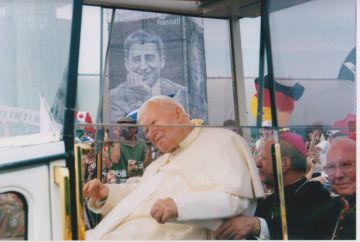
 Born Helena Kowalska in Głogowiec, Poland, in 1905, to a poor, religious peasant family. Felt called to religious life at an early age, but went to work as a housekeeper to help support herself and her family. Accepted to the Sisters of Our Lady of Mercy (OLM) in Warsaw in 1924, and in 1926, received her habit and the name Sister Maria Faustina of the Blessed Sacrament. Began having visions of Jesus as “the King of Divine Mercy” in February 1931, instructing her in His love and mercy, asking her to to paint His likeness with the inscription “Jesus, I Trust in You,” and to establish a feast of mercy in the Church.
  Archangel Stomp