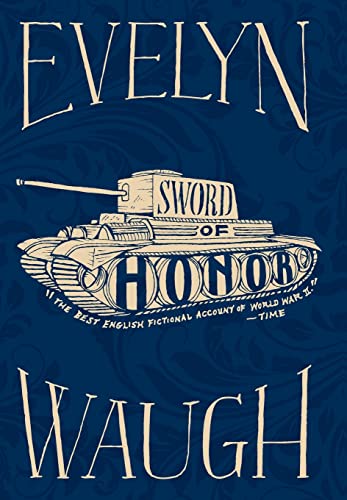
Last month, I drove to Michigan and back on consecutive weekends. Roadtripping comes easily for me, especially with a good audiobook. During the winter, I saw an article on the Imaginative Conservative website about Evelyn Waugh’s Sword of Honor trilogy, and since I haven’t read anything by Waugh since Brideshead Revisited in 2011, it seemed like a solid choice.
In case you don’t know (I didn’t): Arthur Evelyn St. John Waugh is a British man; an author, journalist, and book reviewer; a World War II veteran; and a twice-married convert to Catholicism. Sword of Honor comprises three separate novels published in chronological order: Men at Arms (1952), Officers and Gentlemen (1955), and Unconditional Surrender (1961).
The books trace the wartime story of Guy Crouchback, the only surviving son of a once well-to-do Catholic family in England, who is floundering after his beautiful but promiscuous wife leaves him for another man (and another, and another) in the early days of World War II. Despite being older than most recruits, he joins the Army to escape his loneliness and reassert himself as a man—God willing, to do something meaningful with his life.
Much of the book is devoted to Guy’s military service, seeking glory where there is little to be found. He learns to love the history and traditions of his regiment, the fictitious Royal Halberdiers, but also learns the frustrations of military life: boredom, confusion, inefficiency, idiocy. The military makes officers out of fools and sidelines actual fighting men. The government and the press make heroes out of cowards and scam-artists, while ordinary men of (relative) honor and virtue are held in suspicion or disdain.
At times Guy crosses paths with his wife (though civilly divorced by his wife, as a Catholic he regards them both as still married); at times he serves alongside the man she left him for. The novels follow her life during the same period, including her relationship with yet another acquaintance of Guy’s, her fall from grace and prosperity, and Guy’s reaction and treatment of her when she turns to him in need.
A favorite, heartbreakingly awkward scene: Guy is lonely for female companionship and physical intimacy, and his beautiful former bride is in town and has made it no secret that she would love to see him (along with any other old flames who may be around). He avoids the temptation, until an acquaintance tells him a story of Catholic gentleman who, though separated from his wife, sought her out in order to sire an heir. The friend insists it was not sin for the man, because they were still married in the eyes of the church. Guy then seeks out his “ex” for a romantic tryst. She is more than willing until she realizes he is with her, not because he wants her despite his religion, but because he deems her still his wife and the one woman he can sleep with. She mocks and humiliates him, never wanting to believe that he actually does desire and perhaps even love her. Ever the gentleman, he does not push or force her, but leaves, dejected.
As a satirical look at life during wartime in an age of propaganda, it was an enjoyable read, if a little overlong. But where the trilogy really shines is in its exploration of masculinity and faith. Like many men, Guy wants to be a part of something great and glorious, bigger than himself. Like many men, he seeks it in the wrong places—the wrong woman, the war—and fails to look to God. He questions his manhood, his courage, his purpose, his faith. He begins to wonder if trying to do the right thing is worthwhile at all.
But he knows he is meant for more. What that more is entirely surprises him, as much as his response surprises everyone else around him. I recommend these books.
 Archangel Stomp