The Second Third, Week 37: Can-Do Attitude

“I am always doing that which I can not do, in order that I may learn how to do it.”
– Pablo Picasso

Jodi has commented more than once that she wishes she were more like my sister when it comes to trying new things. “Jill can do anything,” my bride tells a friend. “She painted that mural in Emma’s room, and bought a hanging lamp, cut the cord off it, and turned it into a ceiling light. She’s like, ‘I’ve never done that before; of course I can do it!'”

Jill gets that from my dad, a mostly self-taught machinist, mechanic, and builder of … well, pretty much anything, and my mom, who has been known to take a raised eyebrow or a snicker of unbelief as reason enough to turn a cartwheel in the living room, just to show she still can. (That was years ago, but please, don’t tempt her.)

I got just enough of the can-do attitude to believe, just after we were married, I could change the water pump in my car with a socket set, a couple screw drivers and wrenches, and a Xeroxed copy of the Chilton’s instructions in the open parking lot of our first apartment in Sioux Falls. When the landlord came out halfway through the procedure to point out that Jodi’s lease forbade auto repairs on the premises, I apologized, but suggested it might be best to let me finish and clean up the mess than to snarl things any further. I’ve retrofitted a flush-mount ceiling fan to hang on the level from a sloped cathedral ceiling. I drew the picture my sister projected and painted on Emma’s wall. I did these things because somebody had to do them, and I was available. But I don’t necessarily go out of my way to look for new challenges of this sort.

So this past week, Jodi and I looked at the calendar and realized that Gabe was registered for a mid-day soccer camp, and both of us had to work. We suggested he ride his bike a mile or so up the road to the middle school on quiet residential streets and paved bike paths, for the most part. We also suggested that Brendan accompany him on his bike, with his cell phone – at least on the first trip – to be sure Gabe didn’t have any problems.

I was informed that Bren hasn’t really been riding his new bike much since last summer, mostly because he didn’t “get” the gears: he couldn’t find one he liked, and whenever he shifted to another, the chain made annoying noises. Gabe’s problem was more practical: he wasn’t sure how he could ride a bike and carry his soccer ball at the same time.

I was exasperated. When I was their age (and younger!), I stripped all the “extras” off my BMX – chain guard, reflectors, handbrake, etc. – because I wanted the lightest functional bike possible, and I rode my bike to the lake near our house with a lifejacket, tackle box, fishing pole, and bucket for the catch, without issue or explanation. I explained to Brendan that he should take a minute to look at his sprockets as he shifted gears, and when his chain was making noise, so he could see what was going on – that most of the time, you just need to back the shifting mechanism off slightly once you changed gears to make the noise stop. I suggested to Gabe that there was a hands-free way to carry stuff to school that would work just as well on a bike as it does on foot: his backpack. I assured them (somewhat sharply) that they could handle this little adventure – and might even enjoy it.

Only later did it occur to me why I was that way as a kid (and as a newlywed). My dad did all his repairs – auto repairs, home repairs, you name it – himself, and required me to be with him, come sunshine, rain, or snow. I didn’t have “the knack,” but I learned to look more closely at how things worked, and learned which tools did what, and where to find them. After hours in the shop, working on my bike was a piece of cake.

And Mom and Dad set clear boundaries and rules, then gave me the freedom to roam the neighborhood, the woods, and even the docks and beaches, playing, exploring, fishing, and even hunting. If I wanted to take advantage of this freedom (and make the most of my time) I had to figure what I needed and how to transport it. We built forts in the woods, repaired bikes on the road, camped on islands in the middle of the lake, without anyone carting me around.

We do live in a different place and time, but I have consistently opted to keep the kids close to home rather than send them out on their own, and I avoid DIY projects in order to protect “family time.” As a result, my kids are well-mannered, bright, obedient … and perhaps overly dependent. In my Second Third, I need to recognize that working together with my kids, or even letting the kids do thing together on their own, is family time, too. I need to do what my folks did: create opportunities for my kids to do, to learn, and even to make mistakes – so when they are my age, whatever challenge they face, they’ll echo their Aunt Jill: “Huh. I’ve never done that. Of course I can!”
(Pro) Life, Without Religion, Part 1: It’s My Body!

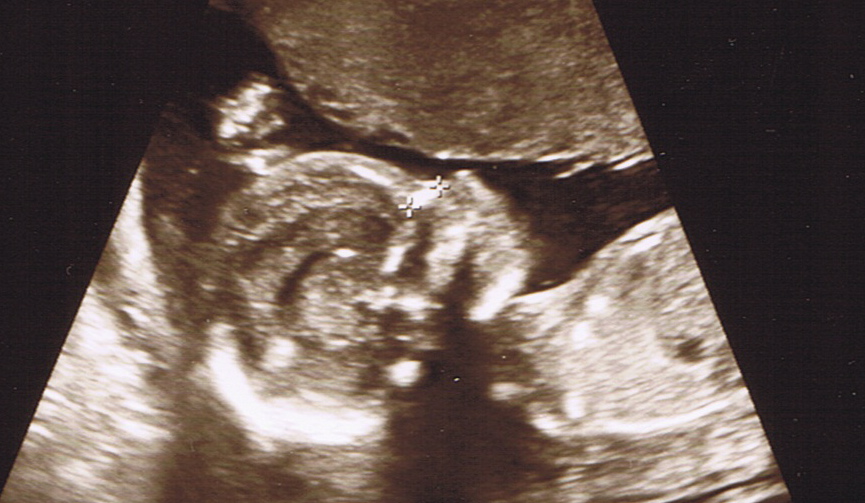
This morning Jodi and I saw the face of an angel — our angel, a tiny new Thorplet, just 11 ounces now at 18 weeks of development. Our baby pulled away from the attempts to examine his or her feet, just like all of our children, but otherwise kept uncooperatively still, making it difficult to get a good look at the tiny, chugging heart. When the sonographer was finally finished her thorough examination, she took the photo above: a tired wee child, hand above head, resting peacefully.

I’ve always loved ultrasounds. In part, it’s the geeky wannabe scientist in me, but mostly, it’s the wonder and sweet jealousy of seeing our tiny baby alive and safe inside the love of my life, and knowing that yeah, I can pee standing up, but I’ll never feel life moving within me. This was a level-2 ultrasound: given my bride’s so-called “advanced maternal age” (I wouldn’t begrudge her a right cross next time someone says that…not this time, but next time…) they offer it as a way of taking a closer look at how both the baby and the mother are progressing. We turned down all the other tests and genetic screening, but taking a closer look at our little one and Jodi, especially given the size of our babies, seemed like a good idea.

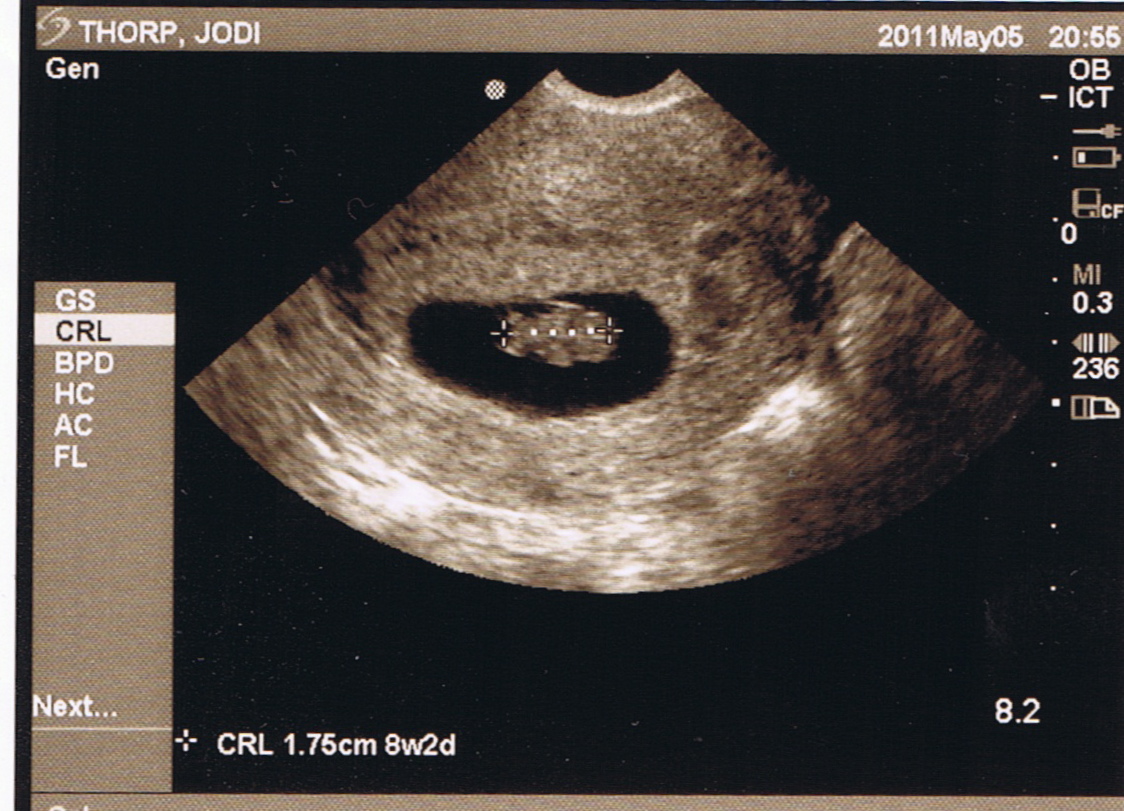
The photo above was the highlight of the hour or more we spent in a dimly lit room with the sonographer. It was worth the wait, but to be honest, I was more excited about these two images:

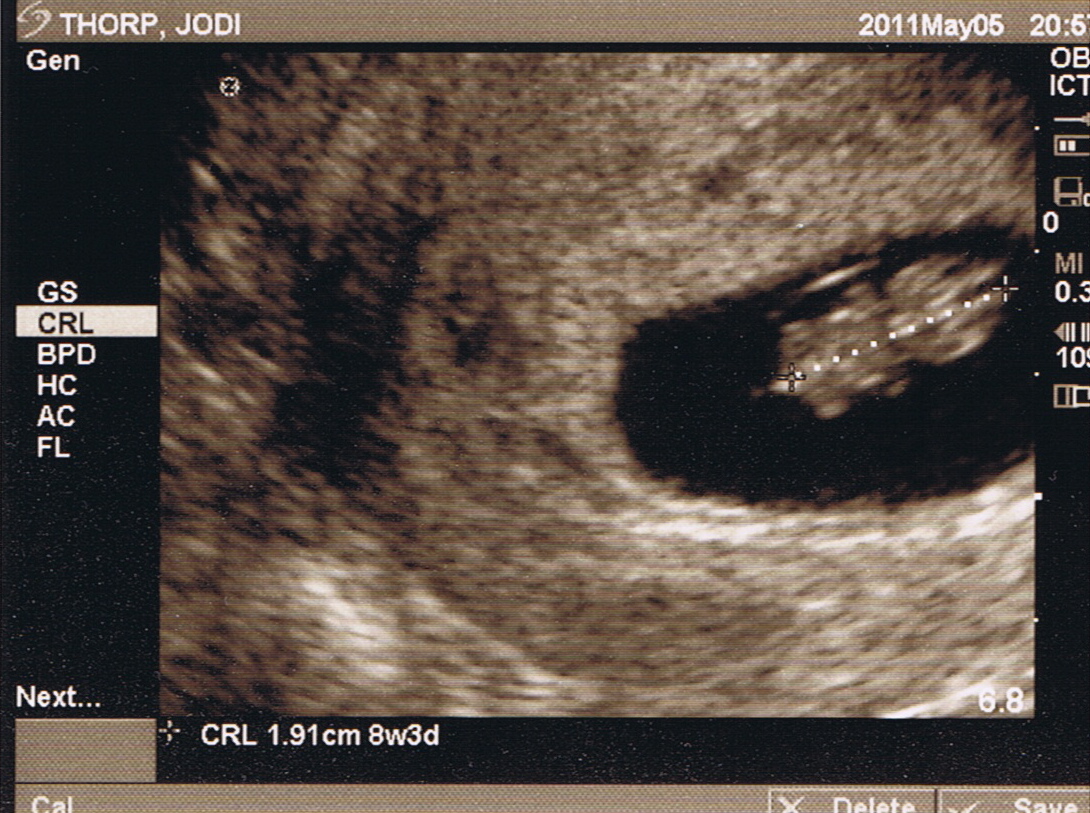
These show our baby at just eight weeks of development. We’re looking down on him or her from above, with an absolutely Thorpian head to the right, and a torso with four tiny limbs extending to the left and down in the lower image. This was a thrill, not only because we lost a little one last fall and were hoping for an “all systems go!” from our doctor, but because there on the screen was a tiny person, less than two centimeters long, with a beating heart and legs and arms that moved independently of any thought or command from Jodi or me. A child the size of my fingertip who, just before Christmas, we will be blessed to welcome and trusted to raise.

Some people say miracles are impossible; others believe they happen, but only rarely. I believe miracles happen daily, all across the world. I’ve got photographic proof.

As we drove home from the earlier ultrasound, I was reminded of an extended argument I had once, on a political blog in South Dakota, with a staunch and pseudonymed liberal who dismissed me and two of my friends as Bible-thumpers for being against abortion. I explained to him that, on the contrary, I studied physical anthropology and human evolution in college and was anti-abortion well before I became a practicing Catholic. I articulated to him a set of arguments against abortion, completely independent of religious belief or church doctrine, and asked, then begged, then dared and taunted, him to engage me on them. He would not.

What came back to me as we drove home was the first argument I offered to him. As I recall, he insisted, on behalf of women everywhere, that “It’s their body; it should be their choice.”

“Which part of their body is it?” I asked.

An abortion removes something from a woman’s body, without a doubt. If what is removed is her, or some part of her, then it should share both her gender and her genes, and she should be somehow physically diminished, something less than the whole and functional woman she was before the procedure. If she had her gallbladder removed, for instance, or a toe, a mortician or coroner might note such a thing upon her death.

A woman who has a “successful” abortion, however, emerges physically intact, but no longer pregnant. What is removed, though taken from within her, and attached to and dependent on her, is not her — not genetically, and not logically. (In my online arguments, I moved from what a fetus isn’t, step by step, to what it is, over several exchanges. In time, I think I’ll do the same here.)

This was made clear again to me when I saw our tiny infant, wriggling in amniotic bliss, at eight weeks of development. Jodi had no say in the flailing of those tiny arms and legs, and that tiny heart beat in part because of, but not for, her. No choice on her part, short of violence, could have stopped it.

And of course, it was made clear yet again today when we saw that beautiful profile at the top of this post. There’s a reason that the Knights of Columbus and other Catholic and pro-life organizations are investing in ultrasound machines for clinics and teaming with expecting mothers to show live ultrasounds of their babies to middle- and high-school students. There’s no better way to recognize the humanity of others than to see them face to face.

Gabe’s Humor

It’s Gabe’s birthday, and he was feeling his oats, as they say — a little rambunctious; a little silly (as were the other kids, me included). So just before we begin, I look around and find Trevor, lying on his belly with his butt in the air and “aimed” directly at me, as it were.

“What is that!?” I roar, pointing at the pajama-clad rump.

Without missing a beat, Gabe says, “It’s a horrible crime against nature!”

Strength In Weakness

A few years ago, I briefly joined the kids in studying Chen-style taijiquan — the original “tai chi,” an ancient Chinese grappling art rarely taught in the West. During a “push hands” class, I was partnered with a diminutive older woman. We stood toe-to-toe, our right hands extended and connected, back-of-wrist to back-of-wrist; I would shift my weight forward (toward her) and rotate my hand to push her hand toward her; when she could shift no further backward, she would redirect my push in a circular fashion, rotate her own wrist, and push back into me in the same fashion. We did this continuously, until our quads were burning and droplets of sweat ran down our forearms, and the longer we went on, the faster her redirect, until it felt (to me) barely controlled. I shrugged inwardly — she was a more experienced student than I — and tried to maintain a slow and steady pace.

Our instructor, Jose, approached and watched us a moment, then gently reminded her to move in a more deliberate and controlled manner. “I’m trying,” she replied, “but he’s pushing like hell!”

Jose shifted his knowing gaze to me and smiled. “I paired you with someone of a different size on purpose,” he explained. “One of the most difficult parts of taiji for men — especially large men — is learning to sense the other person and knowing their own strength, learning to be gentle. Anyone can be hard, but it’s often difficult for men to be soft.”

Jodi had told me for years that that I didn’t know my own strength and that I should be more careful when “handling” her or the kids — but this lesson drove it home. We resumed the exercise, and I tried to empty myself. I could barely feel that we were connected, which made it difficult to respond to my parter’s movements. I found I needed to be infinitely more attentive to my partner. Jose was right: It was hard to be soft.

A week or so later, I was partnered with a man closer to my own size and build, in a similar exercise, except this time the circular hand motions were more vertical in orientation, and the one whose hands were beneath the other’s was supposed to bear the weight of the other’s arms. This requires the other person to empty himself and let his weight (or at least, the weight of his arms) be carried — another act that does not come naturally to men. Both of us tested the other by periodically stopped our circles and watching the “empty” person continue to circle on their own, a sure sign that he was not truly “empty.” This time we were forced to be more attentive to ourselves.

It is easy to find the power in our strengths — to rely on our size or our natural aptitudes and bulldoze our way through the problems that confront us. This past Sunday, Fr. Mark of Our Lady of the Black Hills Catholic Church preached on the topic of meekness, in part using the definition “strength under control,” and indeed, the New Testament of the Bible is rife with the apparent paradox that we are strong in our weakness.

I’ve struggled with this concept myself and, in the past, have made my peace with it in the sense of Clint Eastwood’s line (above): “A man’s got to know his limiations.” But a few weeks back, our associate pastor at St. Michael Catholic Church, Fr. Meyers, helped my understanding in a profound new way. In a three-minute homily at a Saturday morning Mass, he said that each of us has a tendency toward one of the seven deadly sins — I believe he referred to this as our primary fault — which can also be the means of our salvation. (I’m certain I’m oversimplifying and not doing this topic justice.)

This resonated with me. I know that I struggled, early in my marriage, with lustfulness and learning to better love my bride, and I know that coming to terms with the Church’s teachings on married sexuality has transformed my marriage, my faith and family, my entire life. Despite a number of strengths as a husband, father, and man, I had a basic weakness and misunderstanding that kept me from being all I could be in all three of these areas. Not only did I come to understand my limitations, but my weakness was turned to strength.

St. Paul, in his second letter to the Corinthians (Chapter 12, verses 7-12), says:

Therefore, that I might not become too elated, 3 a thorn in the flesh was given to me, an angel of Satan, to beat me, to keep me from being too elated. Three times I begged the Lord about this, that it might leave me, but he said to me, 6 “My grace is sufficient for you, for power is made perfect in weakness.” I will rather boast most gladly of my weaknesses, in order that the power of Christ may dwell with me. Therefore, I am content with weaknesses, insults, hardships, persecutions, and constraints, for the sake of Christ; for when I am weak, then I am strong.

May we all be blessed with such a thorn, and find the strength in our weaknesses.

The Second Third, Week 33: Taking It All In

Blogger’s Note: Sorry so late. On the road in South Dakota.

In many ways, , our fifth child is a second chance of sorts for me. It’s been seven years since Jodi’s been pregnant. I was involved in the past: I attended doctor’s appointments when I could, encouraged my bride and cut the cord, helped with the older kids and the baby when practical, and generally tried to be a good dad. But even with Trevor — even though we thought we might be done having children — I never thought of it as over or that I’d miss anything.

But I did miss it. My wife is beautiful always, but uniquely so when pregnant, and the miracle of new life has not lost its wonder. So in my Second Third — since this may or may not ever happen again — I’m taking it all in: every appointment and ultrasound, the anticipation, the excitement of our children…and in December, God willing, every moment and change in our new growing baby. I cannot wait. Best. Christmas. Ever.